
With the appointment of Adolf Hitler (NSDAP, 1889–1945) as Reich Chancellor ("Reichskanzler") on 30 January 1933, the National Socialist dictatorship was still far from fully established. A decisive next step was to extend control to the individual German states. Prussia, the largest of them, had already been brought under Reich authority in mid-1932, but the most crucial case now was Bavaria, which appeared to offer the strongest resistance to the new regime. Nevertheless, on 9 March 1933, the Nazi seizure of power took place here as well.
Concept and meaning
Although “Machtergreifung” (seizure of power) was not originally a specifically National Socialist term – the Nazis themselves generally spoke of a “Machtübernahme” (assumption of power), a “national uprising,” or a “national revolution” – the later term “Machtergreifung” has gained currency. It is particularly apt, as it expresses the firm conviction of Adolf Hitlers (1889–1945) and his supporters that once they had attained the comprehensive power they sought, they would never again relinquish it. Although the National Socialists, by using the term “Machtübernahme”, sought to emphasise the constitutional legitimacy of the change of government, the process was in fact illegal under the constitution of the Republic: it meant the absolute obliteration of democracy in Germany. Hitler’s assumption of power in the Reich, although formally legal, was therefore not merely another of the frequent changes of government that had occurred in the past (a view that was indeed widespread: many of his opponents assumed that Hitler would soon fail and have to make way for a new administration). In reality, it was a far-reaching process that, through the reshaping of the state, penetrated deeply into all aspects of social life.
The ”Machtergreifung” and the German states

Although the assumption of power in the Reich (Hitler’s appointment as Chancellor of a presidential government on 30 January 1933) was decisive, a true dictatorship could not be established without control of the individual states. Despite the relatively centralising Weimar Constitution, the states remained separate entities, and most of the administration – above all the police (there was no Reich police force) – was under their authority.
While election results for the state parliaments were important for gaining power in the individual states, they were not decisive. States that had early and strong NSDAP representation – for example Oldenburg, which gained an absolute NSDAP majority in May 1932 – ultimately played only a minor role in the final establishment of National Socialist rule.

In contrast, the situation of the governments in the states, especially in the two largest, Prussia and Bavaria, was of great significance. It should be noted that here too, as in most German states, only administrative governments without a parliamentary majority were in office: in Bavaria from 1 August 1930 the Held III and IV cabinets (Heinrich Held, 1868–1938, BVB, Minister-President since 1924), and in Prussia from 24 April 1932 (Otto Braun, 1872–1955, SPD, Minister-President since 1920). This resulted in a marked weakening of political leadership. The decisive step was the dismissal of the Prussian government on 20 July 1932 (the “Preußenschlag”, the Prussian coup d'état) by Reich Chancellor Franz von Papen (1879–1969, Reich Chancellor in 1932), who then governed Prussia as Reich Commissioner. Since Papen remained Reich Commissioner for Prussia under Hitler, and Hermann Göring (NSDAP, 1893–1946) became Minister of the Interior under him, a separate seizure of power in Germany’s largest state was no longer necessary in 1933: Prussia fell into Hitler’s hands together with the Reich.
While some northern German states had already established National Socialist–led governments before 1932 (for example, Oldenburg and Mecklenburg-Schwerin), the southern German states remained resistant to National Socialism, even though most of them were governed by minority governments. Bavaria appeared to pose the greatest challenge for Hitler, as he expected particularly strong resistance there from Catholic and monarchist forces.
Bavaria before 1933
In Bavaria, even after the state election of 24 April 1932, the government of Heinrich Held – brought down in 1930 – remained in office. Under the constitution, it could be replaced only if a majority could be found for a new administration. Although the BVP held 45 seats and the NSDAP 43 (with the SPD holding 20, the Bavarian Farmers’ League 9, and the KPD 8), the BVP and SPD could not reach an agreement, and no party was willing to work with the National Socialists. The administrative government therefore remained in place. Like the rest of Germany, Bavaria suffered from the global economic crisis; this further unsettled a society that had already been in turmoil since 1918 (revolution, the Treaty of Versailles, the Hitler Putsch, nationalism). Previously stabilising forces – such as the strong Bavarian People’s Party (Minister-President Held; Fritz Schäffer, 1888–1967, party chairman since 1929), the churches (especially Cardinal Michael Faulhaber, 1869–1952, Archbishop of Munich and Freising since 1917), the older senior civil service (for example Karl Stützel, 1872–1944, Minister of the Interior since 1924), and the long-established traditions, particularly those of the Wittelsbach monarchy (Crown Prince Rupprecht, 1869–1955) – were visibly losing their strength.
Although the in Munich established NSDAP had enjoyed considerable influence in Bavaria around 1923, it had been pushed back sharply by the state government after the Hitler Putsch, so that after 1930 Bavaria was among the states in which Hitler achieved the lowest electoral success. Nevertheless, the national leadership of the party remained based in Munich. Of the NSDAP leaders in Bavaria (six Gauleiter since 1928), only a few carried real weight in Hitler’s eyes (above all Adolf Wagner, 1890–1944, Gauleiter of Munich–Upper Bavaria since 1930), as well as Julius Streicher from Franconia. However, the presence of the powerful SA leader Ernst Röhm (1887–1934) and Hitler’s personal attachment to Munich also had to be taken into account. The party had won support above all among the middle classes, among workers, and in rural areas, wherever there were no close-knit socialist or Catholic social milieus. By contrast, in Bavaria too, Protestantism – which had traditionally been aligned with the national parties – had, to a considerable extent, shifted its support to the NSDAP.
For the Bavarian government, the central issue in 1932/33 was not the question of a Hitler government, but its relationship with the Reich. The “Preußenschlag” had shown that the independence of a state could be abolished at any moment by appointing a Reich Commissioner; Bavaria therefore protested sharply and opposed von Papen’s policy. At the national level, Bavaria worked for the restoration of orderly government, but this would only have been possible through a coalition between the Centre Party / BVP and the NSDAP. Such a coalition was also considered in Bavaria after the 1932 state elections, especially by the party chairman, Schäffer. However, the BVP was not willing to grant the NSDAP any unlawful influence (it continued to uphold the state bans on uniforms and took firm action against National Socialist methods of intimidation); moreover, Minister-President Held personally rejected any cooperation with Hitler’s party. A coalition between the BVP and the SPD – which, in retrospect, one might wish had formed a bulwark of democracy – was not seriously contemplated by either side, given the hostility between the two parties.
After 30 January 1933

After 30 January 1933, Hitler’s assumption of power in the Reich had no immediate formal consequences for the states (apart from Prussia), but it was of great practical significance. The jubilant reaction of National Socialist supporters, who believed their time had now come, aroused fears that the new government in Berlin would soon intervene in some form, and made it clear that the mood of National Socialist voters would also have to be taken into account in Bavaria. The Hitler government then finally removed the Prussian government, which had already been pushed aside in 1932, and sought to paralyse the Reichsrat (House of Councillors). Where the Reich was able to intervene on the basis of the emergency decrees, for example through newspaper bans, it did so with full severity. The decisive step was the emergency decree of 28 February 1933, the Reichstag Fire Decree, which in effect established the dictatorship. The NSDAP’s campaign for the Reichstag elections of 5 March 1933 then surpassed all previous public demonstrations and acts of intimidation.

The Bavarian government and the BVP attempted to resist this trend, maintaining contact with Paul von Hindenburg (1847–1934, Reich President since 1925), who assured them that no Reich Commissioner was planned for Bavaria, reactivating the “Bayernwacht” self-defence organisation founded in 1930, and taking firm action against communist activities in order to deny Hitler any pretext for intervention. Close confidants of Minister-President Held included, in Munich, the BVP parliamentary leader Georg Wohlmuth (1865–1952), and in Berlin, the head of the Bavarian legation, Franz Sperr (1878–1945), who made repeated attempts at mediation, especially during March 1933. He later played an important role in the Bavarian resistance.
The most notable initiative came in February 1933, when monarchist groups and conservative circles within the BVP (including Fritz Schäffer and Alois Hundhammer, 1900–1974, a leading figure in the Christian Farmers’ Association) attempted to draw on the still very popular attachment to the monarchy in order to safeguard Bavaria against a National Socialist takeover. If the traditional royal house were once again placed at the head of Bavaria, so the reasoning went, the November Revolution would, in effect, be brought to an end in Bavaria; and a king could scarcely be pushed aside. According to the Reich constitution this was perhaps not entirely impossible, but in Bavaria it would have required either a constitutional amendment, which was not attainable, or the appointment of Crown Prince Rupprecht as General State Commissioner by the Minister-President. The latter option was not very attractive to the monarchists, who wanted a king, and Held set conditions for it that were so high as to amount to a refusal. Overall, the initiative was poorly prepared, and the monarchist groups themselves were divided. In Berlin, only the restoration of the Hohenzollerns would have interested the Reich President, and during a meeting on 1 March Hitler warned Held that a restoration would lead to a very serious catastrophe. There was therefore no realistic possibility of preventing the emerging dictatorship by restoring the monarchy, despite later claims to the contrary after 1945.
After the Reichstag election of 5 March 1933

At the national level, Hitler achieved an absolute majority for his governing coalition on 5 March (NSDAP 43.9%, Kampffront Schwarz-Weiß-Rot 8.0%); this made it possible for the first time since 1930 to form a regular parliamentary government in Berlin. The Bavarian results were less favourable for Hitler, but even so, alongside the 43.1% won by the NSDAP, the BVP, with only 27.2% (a loss of 4.2%), fell clearly back into second place (SPD 15.5%; KPD 6.3%). The fact that the NSDAP, as the Chancellor’s party, was successful for the first time even in Catholic areas indicated a change in previously milieu-based voting behaviour. Although the Reichstag election, in itself, had no direct constitutional implications for Bavaria, the pressure of the “national awakening” was so strong that the Bavarian government now also had to be reshaped. If an outright illegal overthrow was excluded, the possible options were new elections, a majority government of the NSDAP and the BVP in the existing Landtag, or the appointment of a Reich Commissioner. While new elections were discussed only in the press, the other two options were seriously considered in political terms and were at least tentatively set in motion. The Ministerrat (Council of Ministers) gave the go-ahead for a coalition between the BVP and the NSDAP, which Hitler also supported (the prospective head of government was the Nazi parliamentary leader in the Landtag, Dr Rudolf Buttmann, 1885–1947). At the same time, the appointment of a Reich Commissioner was still being contemplated. But the element of violence was also present, both in assaults carried out by the SA, which was particularly strong in Bavaria, and in local moves towards an unregulated assertion of power, for example through marches and the hoisting of swastika flags (e.g. 7 March in Neustadt/Pfalz, 8 March in Nuremberg). Meanwhile, Hitler, together with Röhm and Wagner, was in Berlin planning the next steps to be taken in Bavaria.

The day of the “Machtergreifung”: 9 March 1933
In retrospect, the day appears as a coordinated interplay between an SA mass demonstration in Munich, initiatives by leading National Socialist figures in Bavaria, and targeted support from the Reich authorities in Berlin – although the precise details still await thorough investigation. At midday on 9 March, Röhm, Wagner and Heinrich Himmler (1900–1945, Reichsführer-SS since 1929) appeared before Minister-President Held at the government offices in the Montgelas Palace on Promenadeplatz. They demanded the Reichstag member Franz Xaver Ritter von Epp (1868–1947, formerly a member of the BVP in 1927, since 1928 a member of the NSDAP) be appointed as General State Commissioner, in order to deal with what they claimed was an unsettled situation. Held and the cabinet, which was convened immediately, were not prepared to agree to this, but offered instead to form a BVP–NSDAP government. Repeated attempts to obtain support in Berlin, or to persuade the Reichswehr in Munich to intervene, failed. When the National Socialist delegation, now accompanied by Epp, returned in the afternoon, they were informed of the refusal, which brought the negotiations to an end. Meanwhile, and even before this notification, the new Reich Minister of the Interior, Wilhelm Frick, had ordered from Berlin (supposedly without the knowledge of the Reich Chancellor and the Reich President) that Epp be appointed Reich Commissioner on the basis of the emergency decree of 28 February. Although the news was already known in the Brown House (the NSDAP headquarters in Munich) in the afternoon, the official notification to the government was not sent by telegraph until 8.45 pm. Held protested against this, but the Bavarian National Socialists celebrated Epp’s appointment that same evening as a decisive victory. In Berlin, too, it was interpreted as an event of nationwide significance. At a ministerial meeting on 15 March, Hitler declared that the idea of the Reich had proved surprisingly strong throughout southern Germany: “The overturning in Bavaria was perhaps the most thorough” (Minuth, Akten der Reichskanzlei, I).
-
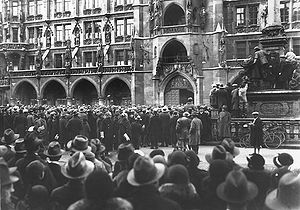 A crowd gathers on Munich’s Marienplatz on 9 March 1933 to witness the raising of the swastika flag at the town hall. (Stadtarchiv München – Munich City Archives, DE-1992-FS-NS-00031)
 -
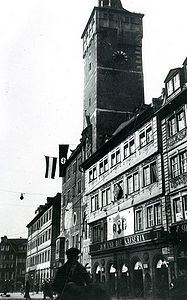 On 9 March 1933, the swastika flag was hoisted alongside the black-white-red flag of the German Empire at Würzburg City Hall. (Stadtarchiv Würzburg – Würzburg City Archives, Photo Collection "Nationalsozialismus")
 -
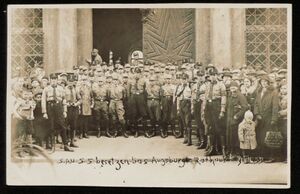 SA and SS occupy Augsburg Town Hall 9 March 1933 (City Archives Augsburg, FS FA A 10695)


The new National Socialist government in Bavaria

The powers of the Reich Commissioner were, on paper, very limited (restricted to the preservation of public order) and did not in themselves remove the government from office. For this reason, negotiations on forming a new government continued for some time, with Hitler also taking part. In practice, however, the Reich Commissioner was understood as the guarantor of National Socialist power in Bavaria; he immediately appointed commissioners to the various ministries and thus exercised the full functions of government. The Held cabinet attempted to remain in office, but was systematically pushed aside. When Held travelled to Switzerland on 15 March for health reasons, he sent letters that were not entirely clear but indicated that he was temporarily laying down his duties. On 16 March, Epp then took over the government as acting Minister-President, without regard for formal legal procedure. He appointed acting ministers: for the Interior, Gauleiter Adolf Wagner; for Finance, Ludwig Siebert (1874–1942), Lord Mayor of Lindau; for Justice, the lawyer Hans Frank (1900–1946); and for Education, Hans Schemm (1891–1935), Gauleiter of the “Bayerische Ostmark”. At the same time, SA special commissioners were appointed for all government and district authorities, and in some cases also at the municipal level, under Commissioner Röhm. Himmler was appointed head of the Bavarian Political Police, the forerunner of the Gestapo. When Epp was appointed Reich Governor in Bavaria on 12 April 1933, with retroactive effect from 10 April, on the basis of the First Reich Governor Act, Siebert was appointed Minister-President, in addition to holding the finance portfolio, and the previous commissioners were confirmed as ministers. The fact that Ludwig Siebert, long-time mayor of Rothenburg ob der Tauber and of Lindau, was chosen as Minister-President and thus as the second representative of the state may at first seem surprising. He was little known and not a committed party man. In reality, however, this corresponded to Hitler’s wish for a more conservative figure in the conduct of state administration, and it also had the advantage of excluding other contenders for the office, above all Buttmann, who was not popular within the party (Rittenauer, Amt).
"Gleichschaltung”: bringing state and society into line

In the months and years that followed, the aim of the NSDAP was “Gleichschaltung”: first to bring the state into line with the Reich, and then to bring society into line with the regime. At the beginning of April 1933, the Landtag, as well as the municipal, district and county councils, were reconstituted on the basis of the Reichstag election results; the NSDAP now held 56 seats together with the German National People’s Party (DNVP) (the BVP held 30, the SPD 17). On 28/29 April, in a ceremonious session, an Enabling Act (a law to “remedy the distress of the Bavarian people and state”) was passed with the support of the bourgeois parties (against the votes of the SPD). It was the Landtag’s final session, and after the banning of all parties except the NSDAP in July 1933, independent political life came to an end.

One year after Hitler took office, on 30 January 1934, the German states were stripped of their sovereignty; the state parliaments, and shortly afterwards the Reichsrat (House of Councillors), were abolished. Bavaria, like all the other states, continued to exist, but only as a subordinate administrative unit. Increasingly, the institutions of the party took precedence over those of the state – both the Gauleiter with their Gau offices, and the organisations of the party (e.g. SA, SS, HJ), together with the affiliated associations (e.g. NSLB, NSV). The trade unions were dissolved on 2 May 1933 and replaced by the German Labour Front (DAF). Associations such as sports clubs and teachers’ unions, and later also business and agricultural associations, were subjected to the “Führerprinzip” (the leadership principle, meaning strict top-down authority) and infiltrated with National Socialist personnel. The press was quickly brought under censorship, and theatres and other cultural institutions fell into line. The strongest resistance came from the churches, above all the Catholic Church, which was to some extent pacified by the Reich Concordat of 1933, but could not be fully absorbed into the regime’s structure. Many of these developments were welcomed by parts of the population, because they appeared to serve a long-desired unity of society (the “Volksgemeinschaft”). Moreover, in the early years they were accompanied by a marked economic upswing and an impressive sense of collective renewal (e.g. harvest festivals, honours for mothers, sports festivals, and the 1936 Olympic Games in Berlin and Garmisch-Partenkirchen).
The victims of the “Machtergreifung”
Although March 1933 did not mark the end of Bavarian history, Bavaria’s independent state organisation, which had existed since the late Middle Ages, was abolished by force and against the will of a still considerable majority of its inhabitants. The people were deprived of their democratic rights, which had been significantly strengthened since 1918. The inhumane ideology of National Socialism spread steadily with the support of state power and came to influence even those who had previously felt distant from it.
-
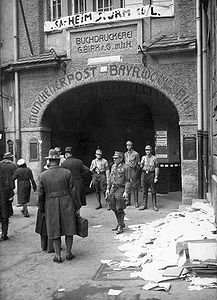 On 9 March 1933, the publishing house of the social democratic Münchener Post was occupied and vandalised by the SA. Stadtarchiv München DE-1992-FS-NS-00069)
 -
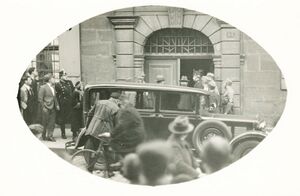 Delivery of prisoners in protective custody to the Erlangen District Court prison on 9 March 1933. (Stadtarchiv Erlangen - City Archives Erlangen, VI.F.b.266)
 -
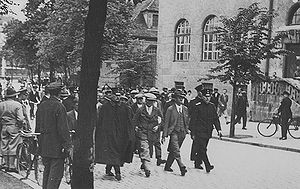 Eighteen Social Democrats were arrested in Straubing on 30 June 1933. The photograph shows sixteen of the detainees being led past the main post office towards the railway station to be taken to the Dachau concentration camp. (Stadtarchiv Straubing – Straubing City Archives, Helene Joringer Photo Collection, photograph by Karl Götz)


Anyone whose views or actions deviated from those demanded by the regime was removed or punished. The violence on 9 March – directed at former ministers, the SPD and the trade unions, and Jewish citizens – did not remain an isolated episode. Later that month, Himmler established the Dachau concentration camp, marking the beginning of systematically organised state terror. Persecution fell most harshly on communists and socialists from the outset, but many others – particularly those with close ties to the churches – soon suffered as well. Bavaria also saw an exodus of artists and scholars. The steadily intensifying exclusion of Jews likewise began in 1933.
-
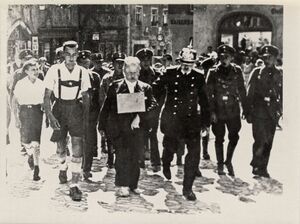 In August 1933, Jewish merchant Leopold Westheimer (1869–1942) is driven through Rothenburg by police and Nazi supporters for alleged “racial defilement”. (Stadtarchiv Rothenburg - City Archives Rothenburg)
 -
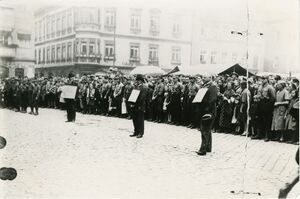 Public humiliation of political opponents of the NSDAP on Coburg's market square on 30 September 1933. (StACo, Bildersammlung 4366)


Further questions
The seizure of power in the German states has not yet been examined in a fundamental way; in this respect, a comparison of the differing developments could offer deeper insight into the varied methods by which power was asserted. In the case of Bavaria, discussion has focused almost exclusively on whether the Free State collapsed through internal weakness and a tendency towards fascism, or whether it was overwhelmed by external pressure from Berlin; the question remains disputed (Wiesemann – Schwend). However, several other questions still remain to be explored. For example, the events in Munich on 9 March require closer investigation: why was the appointment of a General State Commissioner initially sought when plans were already underway in Berlin to appoint a Reich Commissioner – were different concepts at work? Further questions also arise regarding the behaviour of the provinces during these events: were they in the vanguard (the Swabian Gauleiter Karl Wahl, 1892–1981, always claimed this to be the case in Augsburg), or did they simply follow what was happening in Munich? How, in concrete terms, did the seizure of power and the process of “Gleichschaltung” unfold in individual cities and regions? What compromises had to be made with local elites, and what were the consequences? There are a number of studies on this (e.g. Gehringer; Hoser; Hoth; Kuropka), but comparative work would still be necessary here. Then the relationship of the new National Socialist government to Bavarian traditions also needs to be examined. It was probably no coincidence that Hitler appointed Franz von Epp – formerly commander of the royal Leibregiment, later a Freikorps leader, and a Catholic who had allegedly “liberated” Munich from the councils’ rule in 1919 – as Reich Governor in Bavaria (elsewhere this office was generally given only to the Gauleiter). To what extent did the party and government maintain the traditional folk culture of the various regions? Finally, the question of how easily Bavaria was taken over, and of the ultimate absence of resistance, remains pressing. Held did not give way (unlike the Prussian government in 1932), but neither did he permit the police to fire on the SA demonstrators, as had happened during the Hitler Putsch of 1923.
References
- Otto Altendorfer, Fritz Schäffer als Politiker der bayerischen Volkspartei 1888-1945, 2 Teile (Untersuchungen und Quellen zur Zeitgeschichte 3), München 1993.
- Karl Otmar von Aretin, Die bayerische Regierung und die Politik der bayerischen Monarchisten in der Krise der Weimarer Republik 1930-1933 (1971), in: Ders. (Hg.), Nation, Staat und Demokratie in Deutschland, Mainz 1993, 65-93.
- Richard Bauer u. a. (Hg.), München - Hauptstadt der Bewegung. Bayerns Metropole und der Nationalsozialismus, Neuauflage Wolfratshausen 2002.
- Winfried Becker, Heinrich Held (1868-1938). Aufstieg und Sturz des bayerischen Parlamentariers und Ministerpräsidenten, in: Zeitschrift für bayerische Landesgeschichte 72 (2009), 807-891.
- Winfried Becker, The Nazi Seizure of Power in Bavaria and the Demise of the Bavarian People's Party, in: Hermann Beck/Larry Eugene Jones (Hg.), From Weimar to Hitler. Studies in the dissolution of the Weimar Republic and the establishment of the Third Reich, 1932-1934, New York 2019, 111-140 [Erweiterte Fassung abgedruckt in: Zeitschrift für bayerische Landesgeschichte 81 (2018), 657-744].
- Michael Cramer-Fürtig/Bernhard Gotto (Hg.), "Machtergreifung" in Augsburg. Anfänge der NS-Diktatur 1933-1937. Ausstellung (Beiträge zur Geschichte der Stadt Augsburg 4), Augsburg 2008.
- Ortwin Domröse, Der NS-Staat in Bayern von der Machtergreifung bis zum Röhm-Putsch, München 1974.
- Wolfgang Dierker, "Ich will keine Nullen, sondern Bullen". Hitlers Koalitionsverhandlungen mit der Bayerischen Volkspartei im März 1933, in: Vierteljahrshefte für Zeitgeschichte 50 (2002), 111-148.
- Martin Faatz, Vom Staatsschutz zum Gestapoterror. Politische Polizei in Bayern in der Endphase der Weimarer Republik und der Anfangsphase der nationalsozialistischen Diktatur, Würzburg 1995.
- Thomas Fürst, Karl Stützel. Ein Lebensweg in Umbrüchen: Vom Königlichen Beamten zum Bayerischen Innenminister der Weimarer Zeit (1924-1933), Frankfurt 2007.
- Horst Gehringer, Die nationalsozialistische Machtübernahme in der Provinz am Beispiel der Ereignisse in und um Bamberg, in: Historischer Verein Bamberg 152 (2016), 297-320.
- Berndt Hamm u.a. (Hg.), Spielräume des Handelns und der Erinnerung. Lutherische Kirche in Bayern und der Nationalsozialismus, Göttingen 2010.
- Paul Hoser, Die Machtergreifung in Freising. – Die „Gleichschaltung“ in Freising seit 1933, in: Amperland 51 (2015), 449-455 bzw. 52 (2016), 28-33.
- Christiane Hoth/Theres Knöferl, Die "Machtergreifung", in: Christiane Hoth/Markus Raasch (Hg.), Eichstätt im Nationalsozialismus, München 2017, 29-56.
- Johann Kirchinger, Die agrarischen Interessenverbände Bayerns und ihre Eliten im Horizont der nationalsozialistischen Machtergreifung im Frühjahr/Sommer 1933, in: Birgit Angerer u. a. (Hg.), Volk, Heimat, Dorf. Ideologie und Wirklichkeit im ländlichen Bayern der 1930er und 1940er Jahre, Petersberg 2016, 191-208.
- Jochen Klenner, Verhältnis von Partei und Staat 1933-1945. Dargestellt am Beispiel Bayerns, München 1974.
- Joachim Kuropka (Hg.), Grenzen des katholischen Milieus. Stabilität und Gefährdung katholischer Milieus in der Endphase der Weimarer Republik und in der NS-Zeit, Münster 2013 [für Bayern:Bayerischer Wald; Oberpfalz; Passau; Pfalz; Bayerisch Schwaben;Unterfranken].
- Manuel Limbach, Bürger gegen Hitler. Vorgeschichte, Aufbau und Wirken des bayerischen "Sperr-Kreises" (Schriftenreihe der Historischen Kommission bei der Bayerischen Akademie der Wissenschaften 102), Göttingen 2019.
- Horst Möller u. a. (Hg.), Nationalsozialismus in der Region, München 1996.
- Daniel Rittenauer, Das Amt des Bayerischen Ministerpräsidenten in der NS-Zeit (Schriftenreihe zur bayerischen Landesgeschichte 169), München 2018.
- Hermann Rumschöttel/Walter Ziegler (Hg.), Staat und Gaue in der NS-Zeit. Bayern 1933-1945 (Beihefte der Zeitschrift für bayerische Landesgeschichte B 21), München 2004.
- Karl Schwend, Bayern zwischen Monarchie und Diktatur. Beiträge zur bayerischen Frage in der Zeit von 1918 bis 1933, München 1954.
- Susanne Wanninger, Nationalsozialistische Pläne zur Regierungsbildung in Bayern. Eine Denkschrift von Rudolf Buttmann vom März 1933, in: Andreas Wirsching (Hg.), Das Jahr 1933. Die nationalsozialistische Machteroberung und die deutsche Gesellschaft, Göttingen 2009, 92-109.
- Peter Weidisch, Die Machtergreifung in Würzburg 1933, Würzburg 1990.
- Falk Wiesemann, Die Vorgeschichte der nationalsozialistischen Machtübernahme in Bayern 1932/1933, Berlin 1975.
Sources
- Winfried Becker, Die nationalsozialistische Machtergreifung in Bayern. Ein Dokumentarbericht Heinrich Helds aus dem Jahr 1933, in: Historisches Jahrbuch 112 (1992), 412-435.
- Wolfgang Benz (Hg.), Politik in Bayern 1919-1933. Berichte des württembergischen Gesandten Carl Moser von Filseck, Stuttgart 1971.
- Max Domarus, Bayern 1805-1933. Stationen der Staatspolitik, Würzburg 1979.
- Hans Ehard/Wilhelm Hoegner, Der 9. März 1933. Erinnerungen und Erkenntnisse, München 1953.
- Erlaß des Reichsstatthalters vom 12. April 1933 über die Ernennung des Ministerpräsidenten und der bayerischen Staatsminister, in: Gesetz- und Verordnungsblatt für den Freistaat Bayern 1933, 113.
- Karl-Heinz Minuth (Bearb.), Akten der Reichskanzlei. Regierung Hitler, Teil I: 1933/34, Boppard 1983.
- Verordnung des Reichskommissars für Bayern, die Übernahme der gesamten Regierungsgeschäfte in Bayern betreffend, 16. März 1933, in: Gesetz- und Verordnungs-Blatt für den Freistaat Bayern 1933, 88.
- Walter Ziegler (Bearb.), Das Kabinett Held IV (1932/33) (Die Protokolle des Bayerischen Ministerrats 1919-1945), München 2010.
External links
- Bundeszentrale für politische Bildung: Übersicht zum Beginn der nationalsozialistischen Herrschaft (Federal Agency for Civic Education: Overview of the beginning of National Socialist rule)
- Deutsches Historisches Museum - Lebendiges Museum Online: 1933-1939 Etablierung der NS-Herrschaft (German Historical Museum – Living Museum Online: 1933–1939, Establishment of National Socialist Rule)
- documentArchiv.de: Zentrale Dokumente zur NS-"Machtergreifung" 1933/34 (documentArchiv.de: Key documents on the National Socialist “seizure of power” in 1933/34)
Related articles
- Kabinett Held IV, 1932-1933
- Landtagswahlen (Weimarer Republik)
- Monarchismus
- Nationalsozialistische Deutsche Arbeiterpartei (NSDAP), 1920-1923/1925-1945
- Rechtsextremismus
- Sturmabteilung (SA), 1921-1923/1925-1945
Staatsangehörigkeit, Indigenat, Staatsbürgerschaft
Cite
Walter Ziegler, The “Machtergreifung” – The Nazi Seizure of Power in Bavaria, 9 March 1933, published 12 March 2007 (updated version 05 February 2019), english version published 16 February 2026; in: Historisches Lexikon Bayerns, URL: <https://www.historisches-lexikon-bayerns.de/Lexikon/EN:The_“Machtergreifung”_–_The_Nazi_Seizure_of_Power_in_Bavaria,_9_March_1933> (4.04.2026)