


In 1835, the first railway line in Germany was built between Nuremberg and Fürth. This marked the beginning of the railway’s triumphant expansion across Bavaria. By 1912, the rail network had reached a total length of more than 8,400 kilometres, opening up large parts of Bavaria to industrialisation and tourism. After important main lines had first been built under state control, and supplemented by private initiatives in the Palatinate and eastern Bavaria, the final decades of the 19th century saw the construction of branch lines to further expand and densify the network. The railway transformed the development of the connected towns and villages, stimulated trade and the economy, and created new jobs and professions. In 1920, the railway network, which had until then been operated by the state of Bavaria, was incorporated into the Deutsche Reichsbahn.
Initial considerations
As early as 1801, Josef von Baader (1763–1835) put forward the first proposals for the construction of horse-drawn iron railways. He had already planned several lines, including one linking the Main and the Danube. King Ludwig I (1786–1868, reigned 1825–1848), however, preferred a canal for this purpose. In 1828/29, the entrepreneur Friedrich List (1789–1846) presented plans for a Bavarian railway network, giving particular emphasis to a connection with the Hanseatic cities.
Development of the main railway network, 1835–1880

The first German railway line between Nuremberg and Fürth was built by a private joint-stock company at the initiative of Nuremberg merchants and opened in 1835. The model was England, where from 1825 passengers were first transported between Stockton and Darlington in carriages pulled by a steam locomotive. It soon became clear that the railway would far surpass traditional means of transport in terms of speed, comfort and, above all, carrying capacity. This development, which had been foreseeable from an early stage, led the Bavarian state to establish the basic legal framework for large-scale railway construction as early as 1836/37. The government secured the right to influence the routing of lines. Certain requirements were laid down for all railway construction projects, including state approval of tariffs and the adoption of a uniform track gauge. The Expropriation Act of 1837 permitted the compulsory acquisition of land for public purposes, which also included the “construction of railways for the transport of domestic and international trade and traffic.”
1843: Transition to the state railway principle

The first major Bavarian railway line, from Munich to Augsburg (1840), was still the result of private enterprise by banks and trading houses. Fundamental political considerations and economic interests led the state government to seek control over the new transport routes and their operation. The Railway Acts of 1843 and 1846 established the state railway principle for Bavaria on the right bank of the Rhine and granted the Assembly of the Estates a role in determining the routes. As early as 1841, Bavaria, Saxony and Saxony-Altenburg concluded an agreement for the construction of a cross-border railway from Nuremberg via Bamberg and Hof a. d. Saale to Leipzig. In the Palatinate, Bavaria’s exclave on the left bank of the Rhine, the private railway principle applied. The construction and operation of the railways remained entirely in the hands of private companies until the Palatinate railways were nationalised in 1909.
First state railway lines

The first state railway lines that were built: 1844 Nuremberg–Erlangen–Forchheim–Bamberg; nationalisation of the Munich–Augsburg line; 1844–1853 Ludwigs-Nord-Süd-Bahn (Ludwig North–South Railway) Hof–Neuenmarkt (with branch line to Bayreuth))–Lichtenfels–Bamberg–Nuremberg–Gunzenhausen–Nördlingen–Donauwörth–Augsburg–Buchloe–Kaufbeuren–Kempten–Immenstadt–Lindau; 1852/54 Ludwigs-West-Bahn (Ludwig West Railway) Bamberg–Schweinfurt–Würzburg–Gemünden-Aschaffenburg-Kahl–Frankfurt; 1853/54 Augsburg–Ulm; 1854 Munich/Pasing–Starnberg and Munich–Großhesselohe; 1857 Großhesselohe–Holzkirchen–Aibling–Rosenheim (Maximilians-Bahn – Maximilian Railway).
This connected the most important northern and southern Bavarian cities to the state railway network and established links to the territory of the German Customs Union, as well as to Leipzig, Berlin, Frankfurt am Main and Stuttgart. Connections to Bohemia and Austria, to Prague and Vienna, were still entirely lacking. King Ludwig I initially gave priority to the construction of the Danube–Main Canal (1835–1846) as a north-west to south-east transport axis. The construction of further railway lines by the state was hindered by financial difficulties. Eastern Bavaria remained a much-lamented “railway desert” until 1859.
The move away from the state railway principle in 1855
While the Bavarian government under Minister Karl von Abel (1788–1859) had completely ruled out transferring railway operations to private hands as late as 1845, a change of attitude became apparent a decade later. The expansion of the rail network and the vital connection to neighbouring countries could only be advanced by abandoning the state railway principle. Time was now pressing, as a state treaty with Austria in 1851 had already provided for the planning of a Nuremberg–Regensburg–Linz line.
Establishment of the Ostbahngesellschaft (Bavarian Eastern Railway Company), 1856
The Ostbahn-Aktiengesellschaft (Bavarian Eastern Railway Company), licensed in 1856 with the participation of banks, investors such as the Princely House of Thurn und Taxis, and the cities of Nuremberg, Fürth, Regensburg and Amberg, succeeded within just a few years in opening up eastern Bavaria with main lines that were of particular importance for the industrial development of the kingdom:
- 1858/59 Nuremberg–Amberg–Regensburg–Geiselhöring–Landshut–Munich;
- 1860 Geiselhöring–Straubing-Passau;
- 1860/62 Schwandorf-Cham-Furth im Wald (with continuation to Pilsen and Prague).
The so-called “Böhmerlinie” (Bohemian Line) was crucial for Bavaria’s coal supply. It was the supply of Bohemian coal that created the conditions for the modern ironworks industry in the Upper Palatinate, with its main centres at Maxhütte near Haidhof, Sulzbach-Rosenberg, Amberg and Bodenwöhr.
The construction of the Bavarian Ostbahn railway lines Schwandorf (Irrenlohe)-Weiden and Weiden–Bayreuth (both opened in 1863), as well as Weiden–Eger (opened in 1864/65), considerably facilitated traffic with Upper Franconia, Saxony and Thuringia and linked another Bohemian coalfield.
Border crossings to Austria
Further crossings into Austria had meanwhile been opened by the state railway. From 1858, it was possible to travel from Rosenheim to Kufstein, and from 1860, also via Endorf, Prien , Traunstein and Freilassing to Salzburg. This created a continuous rail connection from Paris via Munich to Vienna.
Leased railways
In addition to the state railways and the Bavarian Ostbahn, a number of leased lines were built, mostly on the initiative of towns. Private railway companies built the lines and leased them to the state until the construction costs had been recouped. The first of these was the Neuenmarkt/Wirsberg–Bayreuth leased line (opened in 1853, taken over by the state in 1905), financed by the town of Bayreuth. This was followed by the highly successful Ulm–Memmingen–Kempten line (opened in 1862/63, taken over by the state in 1876) at the instigation of the town of Memmingen, and by a rail link to Plattling (1866), made possible through the commitment of the town of Deggendorf. Other leased lines included Munich–Starnberg, Starnberg–Penzberg, Tutzing–Peißenberg, Holzkirchen–Miesbach and others.
Expansion of the rail network and shortcut lines

The main railway network was further expanded in the 1860s and 1870s. Whereas the first railway lines aimed to connect as many larger towns as possible, the focus now was on improving rail transport in both economic and operational terms by creating shortcut routes between the most important towns. Significant new state railways included the shortcut lines Nuremberg/Fürth–Neustadt a. d. Aisch-Kitzingen–Würzburg (1865) and Gunzenhausen–Treuchtlingen-Eichstätt-Ingolstadt (1869/70). The Ostbahn AG also contributed to optimising the network. The direct railway line Regensburg–Neumarkt–Nuremberg, completed in 1873, was particularly advantageous for through traffic from Austria to western Germany. The important Mühldorf–Neumarkt St. Veit–Landau–Plattling line, opened in 1875, was likewise built by the Ostbahn.
Renewed expansion of state railway construction
[[Datei:Isarbruecke Großhesselohe.jpg|thumb|Isar bridge near Großhesselohe, around 1870 (DB Museum Nuremberg, 2019.001931) From the early 1870s, the state once again became more actively involved in railway construction. Important new state railway lines included:
- 1871 Munich–Markt Schwaben-Dorfen-Mühldorf-Neuötting-Simbach;
- 1871 Munich–Grafing–Rosenheim;
- 1872/74 Munich–Geltendorf–Kaufering–Buchloe–Türkheim-Mindelheim–Ungerhausen–Memmingen;
- 1874 Donautalbahn (Danube Valley Railway) Regensburg–Ingolstadt–Donauwörth, with continuation to Dillingen, Gundelfingen and Neuoffingen in 1876/77;
- 1875 Ingolstadt–Augsburg.
Low-mountain regions with structurally challenging terrain were also increasingly opened up by the following routes:
- 1871 Schweinfurt–Bad Kissingen
- 1872 Gemünden–Jossa (Hesse)
- 1874 Ebenhausen-Bad Neustadt a. d. Saale-Mellrichstadt
- 1877 Deggendorf–Zwiesel-Bayerisch Eisenstein, with a connection to Klattau/Bohemia (today Klatovy, Czech Republic)
- 1877/79 Nuremberg–Hersbruck-Ranna-Schnabelwaid (with branch to Bayreuth) – Kirchenlaibach-Neusorg- Marktredwitz-Schirnding, with continuation to Eger in 1883.
By the mid-1870s, Regensburg, Würzburg, Buchloe, Gunzenhausen, Ingolstadt, Holzkirchen, Rosenheim and Schwandorf had developed into railway hubs alongside the early Bavarian railway centres of Munich, Nuremberg and Augsburg. Many of these towns had large railway workshops, sleeper impregnation facilities and administrative offices.
Increasing implementation of the state railway principle (1875/1909)
The denser rail traffic became, the more the coexistence of different transport operators led to competition and conflicts in route planning, construction and operation. As general political and economic considerations also supported this, the Bavarian state government decided in 1875 to nationalise the Ostbahn railways, whose network covered almost 800 km. The immense growth in the importance of transport, especially rail transport, was reflected in the creation of a separate Ministry of Transport in 1904. In 1913, the ministry moved into an impressive new building on Arnulfstrasse, in the immediate vicinity of Munich’s main railway station. In 1909 the Bavarian state railway network again grew considerably with the nationalisation of the Palatinate Railways, adding a further 872 kilometres of track.
Vicinal and local railways
In the 1860s, Bavaria was covered by a wide-ranging network of important main lines. The positive effects of a rail connection on the prosperity of a region were generally recognised. Regions and towns far from the railway network, by contrast, lagged behind in their development. Further densification of the network through cross-connections and branch lines was intended to remedy this (“Vicinal and local railways”).

The first regulations were set out in the Vicinal Railway Act of 1869. However, they did not prove effective owing to the heavy financial burdens placed on the interested parties (funding for land acquisition and earthworks), so that only 15 Vizinalbahnen had been built by 1880. The Local Railways Act of 1882 introduced new rules for the construction of secondary railways and triggered a wave of “local railway fever” across the country, which continued until the First World War. People everywhere now wanted to enjoy the modern achievement of the railway. By 1912 alone, 120 state-owned local railways had been built, with a total length of more than 2,700 km. As the construction and operation of local railways were hindered by legal obstacles and additional financial burdens (the local railway surcharge), the high expectations were not always fulfilled, although the overall positive effects on the general transport situation are undeniable.
Masterpieces of technology
Some remarkable feats of engineering had already been achieved during the construction of the Ludwig-Nord-Süd-Bahn in the 1840s. The 341-metre tunnel through the Burgberg in Erlangen, built in 1841–44, is regarded as the oldest railway tunnel in Bavaria. In the Palatinate, the Schlossberg Tunnel near Frankenstein (Kaiserslautern district), opened in 1849, is particularly noteworthy. Major ridges had to be crossed in the Franconian Forest between Bamberg and Hof. One particular attraction is the Schiefe Ebene between the stations of Neuenmarkt-Wirsberg and Marktschorgast in the district of Kulmbach, one of the steepest railway lines in Germany. A particularly impressive achievement in the construction of the Ludwigs-West-Bahn Bamberg–Schweinfurt–Würzburg–Aschaffenburg (1854) was the Schwarzkopf Tunnel near Heigenbrücken, almost one kilometre in length. As the summit tunnel of the Main–Spessart Railway, it created the breakthrough from the Aubach and Lohr valleys into the Aschaff valley. Crossing rivers posed a particular technical challenge in railway construction and was avoided wherever possible (for example, Plattling station instead of Deggendorf). Larger bridge-building projects were usually long-term and complex undertakings, accompanied by a wide range of technical difficulties.
-
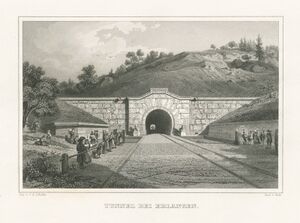 Burgberg Tunnel in Erlangen, steel engraving after Carl August Lebschée (1800–1877) by Joseph Maximilian Kolb (c. 1818–1859), c. 1879 (Bayerische Staatsbibliothek – Bavarian State Library, image archive port-036222)
 -
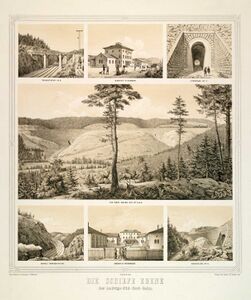 The Schiefe Ebene of the Ludwigs-Nord-Süd-Bahn, around 1851. In the lithograph by Georg Könitzer (1818–1885), the technical masterpiece of the Schiefe Ebene through the Franconian Forest is depicted. (Germanisches Nationalmuseum, Nuremberg)


Locomotives and wagons
Locomotives and carriages for the first Bavarian railway lines were initially imported from Britain, together with engine drivers, stokers and technicians. It was only when the entrepreneur Joseph Anton Maffei (1790–1870), who had acquired an ironworks in Munich in 1838, began producing locomotives with the help of British engineers that engines built in Bavaria came into use, from the mid-1840s onwards. By 1870 Maffei had already supplied more than 400 locomotives to the Bavarian state railways, with a similar number exported abroad. A second locomotive factory in Munich was founded in 1866 by Georg Krauss (1826–1906). Over the decades, many technical innovations were achieved.
-
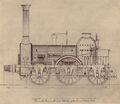 “Der Münchner” was the first locomotive produced by the Maffei works, in 1841. Illustration from: Friedrich Karl Möhl, Hundert Jahre Krauss-Maffei München 1837–1937, Munich 1937, p. 16. (Bayerische Staatsbibliothek – Bavarian State Library, 4 38.186)
 -
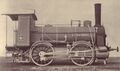 "Landwührden", first locomotive from the Krauss locomotive factory, 1867. Abb. aus: Friedrich Karl Möhl, Hundert Jahre Krauss-Maffei München 1837-1937, München 1937, 31. (Bayerische Staatsbibliothek, 4 38.186)
 -
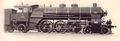 Four-cylinder compound express locomotive for the Bavarian State Railways. Abb. aus: J. A. Maffei, J. A. Maffei München: ... gegründet 1813, München 1922, 3. (Bayerische Staatsbibliothek, 4 Bavar. 3151 d-4)
 -
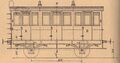 1st and 2nd class passenger carriages, 1857. Abb. aus: Theodor Lechner, Die Privat-Eisenbahnen in Bayern. Eine Betrachtung nach der geschichtlichen, technischen und wirtschaftlichen Seite, München und Berlin 1920, 112. (Bayerische Staatsbibliothek, 4 Bavar. 3139 o
 -
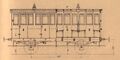 Third-class passenger carriage, 1857. Abb. aus: Theodor Lechner, Die Privat-Eisenbahnen in Bayern. Eine Betrachtung nach der geschichtlichen, technischen und wirtschaftlichen Seite, München und Berlin 1920, 113. (Bayerische Staatsbibliothek, 4 Bavar. 3139 o)
 -
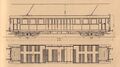 Motor car of the Isartalbahn railway. Abb. aus: Theodor Lechner, Die Privat-Eisenbahnen in Bayern. Eine Betrachtung nach der geschichtlichen, technischen und wirtschaftlichen Seite, München und Berlin 1920, 153. (Bayerische Staatsbibliothek, 4 Bavar. 3139 o)


First electrically powered mountain railway
The first electrically powered mountain railway in Bavaria was the Wendelsteinbahn, opened in 1912. Built by the industrialist Otto von Steinbeis (1839–1920), the ten-kilometre narrow-gauge rack railway, complete with its own power station, overcame an altitude difference of 1,250 metres from Brannenburg, crossing twelve bridges, eight galleries and seven tunnels on its way to the 1,838-metre-high Wendelstein. At what was then the largest construction site in Bavaria, many Italians and Croats were employed in rock excavation work.
-
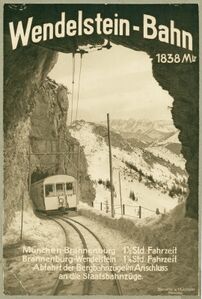 Wendelstein-Bahn AG advertising leaflet, after 1912 (DB Museum Nuremberg, 2022.002178)
 -
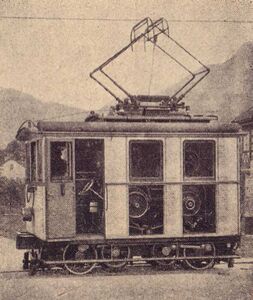 Electric locomotive of the Wendelsteinbahn. Illustration from: Theodor Lechner, Die Privat-Eisenbahnen in Bayern. Eine Betrachtung nach der geschichtlichen, technischen und wirtschaftlichen Seite, Munich and Berlin 1920, p. 209. (Bayerische Staatsbibliothek – Bavarian State Library, 4 Bavar. 3139 o)
 -
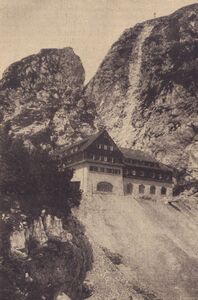 The mountain hotel (terminus) of the Wendelsteinbahn railway. Abb. aus: Theodor Lechner, Die Privat-Eisenbahnen in Bayern. Eine Betrachtung nach der geschichtlichen, technischen und wirtschaftlichen Seite, München und Berlin 1920, 207. (Bayerische Staatsbibliothek, 4 Bavar. 3139 o)
 -
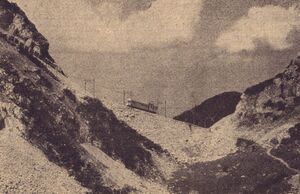 Reindler Scharte on the Wendelsteinbahn railway. Abb. aus: Theodor Lechner, Die Privat-Eisenbahnen in Bayern. Eine Betrachtung nach der geschichtlichen, technischen und wirtschaftlichen Seite, München und Berlin 1920, 206. (Bayerische Staatsbibliothek, 4 Bavar. 3139 o)


Stations, urban and spatial development
The location of a railway station shaped the future spatial development of a settlement. When planning a route, the choice of site was the first issue to be settled. Owing to topographical conditions and the divergent interests of landowners, tradespeople and planners, this was often a protracted process fraught with conflict. Where it was not possible to build a through station because of the existing settlement structure or other obstacles, the decision was made to construct a terminus station, as in Munich or Hof. The first Würzburg station of 1852 (the Ludwigsbahnhof) was likewise a terminus; owing to the rapid growth in traffic, it had to be relocated to its present site after only twelve years.
-
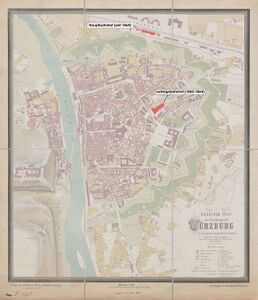 Location of the Ludwigsbahnhof (1852–1864) and the new main station in Würzburg (since 1864). (Bayerische Staatsbibliothek – Bavarian State Library, Mapp. XI,536 c; edited by the editorial team)
 -
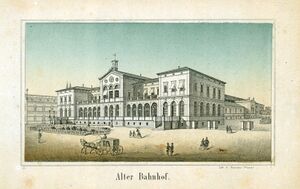 Old station in Würzburg, 1854 (DB Museum Nuremberg, 2022.002183)
 -
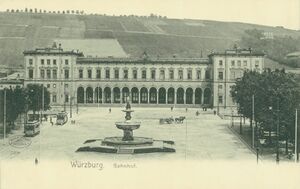 Würzburg main station around 1920, station building and forecourt (DB Museum Nuremberg, 2022.002180)


The first railway stations were often no more than temporary wooden boarding halls, but before long, especially at important transport hubs, representative building complexes were constructed in various historicist styles. Their formal repertoire ranged from antiquity through Gothic and Renaissance to Baroque, with stylistic elements frequently appearing in mixed form. Metropolitan railway stations in particular became highly regarded prestige projects (for example, Würzburg station of 1864 in the Neo-Renaissance style, built by Gottfried von Neureuther (1811–1887)). The station developed into a centre of social and political life. At smaller stations, the station buildings were generally more modest. Along many entire lines, station buildings of varying size but uniform style were erected, depending on the importance of the location and the expected volume of traffic. Around 1860, Eduard Rüber (1804–1874) developed standard plans for station buildings in six categories, which proved exemplary and became widely adopted. Border stations, with their extensive track layouts and customs facilities, had a character all their own. Throughout the country, stations with their forecourts or reception halls became popular postcard motifs.
-
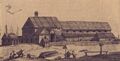 The temporary station building of the Munich–Augsburg Railway was erected in 1839 as a simple wooden structure near today’s Hackerbrücke. After a fire in 1847, the old station was demolished and rebuilt on its present site. Illustration from: Theodor Lechner, Die Privat-Eisenbahnen in Bayern. Eine Betrachtung nach der geschichtlichen, technischen und wirtschaftlichen Seite, Munich and Berlin 1920, p. 50. (Bayerische Staatsbibliothek – Bavarian State Library, 4 Bavar. 3139 o)
 -
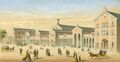 1848 wurde von Friedrich Bürklein (1813-1872) ein neues Bahnhofsgebäude für München errichtet. Kolorierte Lithografie um 1864. (Bayerische Staatsbibliothek, Bildarchiv port-025405)
 -
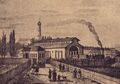 The first Augsburg railway station was built in 1838 as the terminus of the private Augsburg-Munich railway line at the Rotes Tor. It was replaced as early as 1845 by today's main station, which was built as a through station. Abb. aus: Theodor Lechner, Die Privat-Eisenbahnen in Bayern. Eine Betrachtung nach der geschichtlichen, technischen und wirtschaftlichen Seite, München und Berlin 1920, 51. (Bayerische Staatsbibliothek, 4 Bavar. 3139 o)
 -
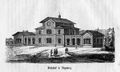 The new main station in Augsburg, lithograph from 1854. The building was constructed by Eduard Rüber between 1843 and 1846. It was extended between 1869 and 1871 by Friedrich Bürklein (1813–1872) and rebuilt in the late classicist style. (Bayerische Staatsbibliothek, Bildarchiv port-010168)
 -
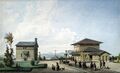 Schwabmünchen railway station around 1848, watercolour by Karl Herrle (1828–1878). The painter created idealised views that document the early construction phase of the Ludwig North-South Railway. (DB Museum Nürnberg, 2019.002475)
 -
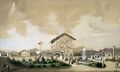 Railway station in Kempten in 1853, watercolour by Karl Herrle (1828–1878). The terminus station near the city was later significantly expanded. Between 1965 and 1969, the station was replaced by a new through station about 1 km south of the old location and demolished. (DB Museum Nürnberg, 2019.002479)
 -
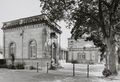 Completed in 1854, the railway station in Veitshöchheim was actually oversized for the village at that time. Its size was justified by its location directly next to Veitshöchheim Palace, which the king still intended to use as his summer residence. In addition to the public reception hall, the station also contained a royal pavilion accessible via a covered walkway. King Ludwig I had prevented the railway line from running directly through the palace gardens. In the second half of the 19th century, the village and its palace gardens became a popular destination for excursions thanks to their Rococo style. (Bayerisches Landesamt für Denkmalpflege, Foto: Eberhard Lantz)
 -
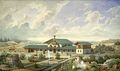 The Günzach railway station was built in Alpine style. Watercolour by Karl Herrle (1828–1878) around 1855. (DB Museum Nürnberg, 2019.002477)


Track watchman’s cottage

Between the stations, the now almost completely vanished track watchmen’s cottages stood in the open countryside at rail and road crossings. Families often lived in these cottages far from the nearest villages, tending a small garden and keeping small livestock for their own needs. By 1861, Ostbahn AG alone had built 303 track watchmen’s cottages, 43 stone guardhouses and 68 temporary wooden huts for supervision along its network of lines, which had by then grown to 450 km.
A new profession: railway workers

By the turn of the century, the railways had become by far the largest employer in the Kingdom of Bavaria. Particularly at railway junctions, with their central operating facilities, workshops and administrative offices, the railways completely reshaped the labour market. Railway service offered a large number of jobs for people with widely varying levels of training, from porters, inspectors, stokers, fitters and engine drivers to civil engineers and lawyers. The new opportunities in railway service required professional flexibility and local mobility. The State Railway Administration alone recorded immense growth, from a few hundred employees in its founding year of 1844 to more than 65,000 by 1914.
Transport revolution in freight and passenger traffic
[[Datei:Ludwig Sued Nord Eisenbahntunnel.jpg|thumb|Ludwig-Süd-Nord railway tunnel. Steel engraving by Alexander Richard Marx (1815–1851). (Bayerische Staatsbibliothek – Bavarian State Library, port-021142)]] The railway far surpassed conventional means of transport in speed and, above all, in carrying capacity, and soon displaced them from the most important transport routes. The entire economy changed and took on new dimensions. Bulk goods such as coal, wood, stone and iron could be moved on a scale never seen before. With the help of the railways, regions poor in raw materials could be supplied with large quantities of coal, the principal source of energy in the industrial age. Local and long-distance trade flourished. Goods that were available in abundance in one place (for example, wood or granite) or could be produced beyond local demand (such as glass and porcelain from eastern Bavaria, beer from Munich or cheese from the Allgäu) became articles of commerce and contributed to economic growth. Previously localised economic areas gained entirely new markets, while at the same time the area traversed by a railway line became a sales market for goods of all kinds from distant regions. The traditional economic structure was severely affected by the increasing spread of factory-made products for everyday needs. Overall, the railway, with its fixed routes, often altered traditional and more flexible transport connections. Branch lines created one-sided links to central places and thus brought about economic and social reorientation. A few examples illustrate this: Ebrach had traditionally maintained close ties with Würzburg, but was linked to Bamberg by rail; Hollfeld, formerly belonging to Bamberg, was connected by rail to Bayreuth. The former imperial towns of Dinkelsbühl and Rothenburg had preserved close contacts with Württemberg through postal routes, but the railway turned them into Bavarian “border towns”.
Effects on spatial planning
The course of the railway lines and the location of a station had a considerable impact on the spatial structure and future development of a settlement. Industrial production sites, factories and wholesale businesses from a wide range of sectors preferred to establish themselves near the station. Owing to the strong expansion of the labour market, population numbers rose rapidly, which in turn led to an increase in residential development and a densification of settlements in the vicinity of stations. While department stores and specialist shops flourished in towns with good transport links, retail turnover in places far from the railway declined in the long term. Authorities and educational institutions of supra-local importance were soon established or expanded in the vicinity of larger railway stations. The expansion of transport, commercial, administrative and residential facilities led to a reduction in the area of land used for agriculture. Railway junctions offered particular locational advantages. The great importance of opening up the country by rail is especially evident at the major railway hubs of Munich, Nuremberg and Augsburg. The state capital, Munich, experienced the strongest growth. Overall, the population shifted increasingly from rural areas to the expanding urban communities.
-
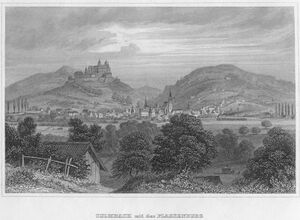 The steel engraving from 1850 shows Kulmbach, still a rather rural town, with the Plassenburg. A train of the Ludwigs-Süd-Nord-Bahn can be seen in the right foreground. (Bayerische Staatsbibliothek – Bavarian State Library, port-001175)
 -
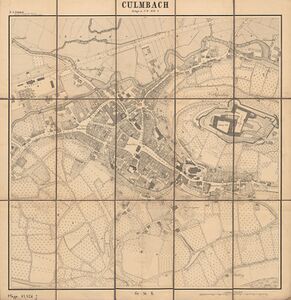 Map of the town of Kulmbach from 1876. The site of the railway station is at the upper left edge, at that time still outside the town. ([Bayerische Staatsbibliothek – Bavarian State Library, Mapp. XI,436 j)
 -
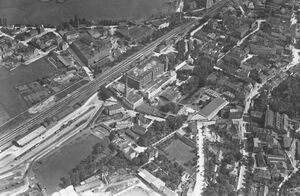 Aerial photograph from 1921. The image shows how industrial facilities gradually developed around the formerly free-standing Kulmbach railway station. (Bayerisches Hauptstaatsarchiv- Bavarian Main State Archives, BS AS II 5, 1504–r)


With the railway into the industrial age

The history of the railway is inextricably linked to industrialisation. Iron was needed for the construction and operation of railways – primarily for rails and locomotives, but also for many other areas of construction and operation. Coal was required for iron production, but it was also indispensable for operating locomotives, for steam engines in a wide range of manufacturing sectors and, not least, as a fuel for heating in the growing cities. It was only with the connection to the railway network that the mining of Upper Bavarian coal in Miesbach and Hausham, in Penzberg and Peißenberg became profitable. The railway gave a decisive boost to the use of steam engines and thus to industrialisation. In order to reduce dependence on imported iron and machinery, the necessary infrastructure was created within just a few decades, thanks to the considerable commitment of leading figures from the fields of technology, industry and politics.
An excellent example of an entrepreneur from the early phase of industrialisation is Josef Anton von Maffei (1790–1870) of Munich, who built up a far-reaching business empire specialising in locomotive and steamship construction and iron bridge building, and who became the principal shareholder of the Maxhütte in 1853.
New chemical and technical advances in brewing and refrigeration from the 1870s onwards formed the basis for increased beer production. With the help of the railway, beer could be exported on a large scale from cities such as Munich, Nuremberg and Kulmbach to northern Germany.
Munich, Nuremberg, Augsburg and Schweinfurt are Bavaria’s well-known industrial centres, but there are also places beyond the major urban areas – such as Maxhütte, Sulzbach-Rosenberg (iron industry), Kolbermoor (cotton spinning mill) and Kirchseeon (sleeper works) – whose development is inextricably linked to their connection to the railway network.
Structural change in agriculture
Until the early twentieth century, arable farming and livestock rearing were the main sources of income in large parts of Bavaria. It was only with the expansion of the railway network that a lasting intensification of agricultural production became possible, a development further strengthened by advances in refrigeration technology. A wide range of agricultural products, including grain, potatoes, milk, butter, cheese, eggs, livestock and poultry, could now be supplied to new markets, particularly the rapidly growing cities. The Allgäu became the most important dairy region in southern Germany. Abattoirs became the new centres of the livestock trade. With advances in refrigeration technology, the shipment of meat took on completely new dimensions. The railway also promoted the long-term use of agricultural machinery (new factories in Augsburg, Sonthofen, Altötting, Lauingen, Günzburg) as well as the use of mineral fertilisers (from 1908 Bayerische Stickstoffwerke AG in Trostberg).
The railway facilitated the cultivation of new crops such as sugar beet. Sugar factories depended on the railway for bringing in beets, coal and other materials, as well as for transporting sugar products and beet waste, the latter being highly valued as animal feed. Between 1898 and 1908 alone, rail transport of sugar beet in Bavaria increased by 300% and that of sugar by 360%.
At the same time, from the 1880s and 1890s onwards, the railway was blamed from many sides for the difficulties faced by agriculture (a shortage of labour due to the railway as an employer, increasing international competition). The developing system of agricultural cooperatives, with warehouses at railway stations, promised an improvement in the economic situation.
Mobility for all sections of the population
The railway also fundamentally transformed passenger transport. Travel became easier, faster, more comfortable and cheaper. In the long term, all sections of the population gained completely new opportunities in shaping their lives, in choosing a career and workplace, in access to education and in private travel. Even longer distances between home and workplace could now be covered daily by rail and the number of commuters rose rapidly. The railway made an important contribution to the democratisation of travel and became a driving force for social and political equality. The origins of mass tourism lie in rail travel.
-
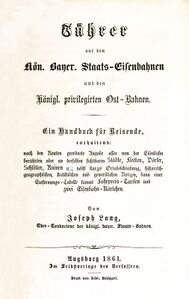 Fig. from: Joseph Lang, Führer auf den Kön. Bayer. Staats-Eisenbahnen und den Königl. privilegirten Ost-Bahnen, Augsburg 1861, title page. (Staatsbibliothek – Bavarian State Library, Bavar. 1595 i)
 -
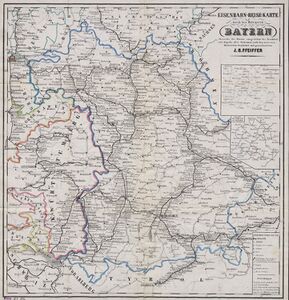 "Neueste Eisenbahn-Reisekarte durch das Königreich Bayern” (Latest Railway Travel Map of the Kingdom of Bavaria), Augsburg ca. 1863 (Bayerische Staatsbibliothek – Bavarian State Library, Mapp. XI,86)
 -
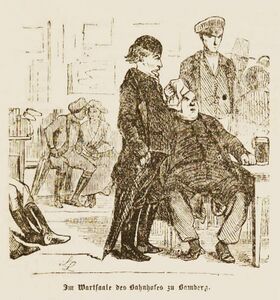 “Im Wartesaal des Bahnhofs zu Bamberg” (In the waiting room of the Bamberg train station). Illustration from: Joseph Lang, Führer auf den kgl. bayer. Staats- und Ostbahnen, Augsburg 1864, 87 (Bayerische Staatsbibliothek – Bavarian State Library, Bavar. 1595 k)


1920 integration of the Bavarian state railways into the German Reich
Bavarian railway history came to an end in 1920. The Weimar Constitution of 1919 stipulated the “transfer of the railways to the central authority of the Reich” in return for financial compensation for the rail network, although this compensation was never paid. The State Treaty on the Railways came into force on 1 April 1920. The Bavarian state railways were incorporated into the Deutsche Reichsbahn. Bavaria thus lost one of the main pillars of its own state economy. As the postal and telegraph administrations were also placed under the authority of the Reich, the Bavarian Ministry of Transport no longer had a field of responsibility and was dissolved in 1920. In 1924, the Reichsbahn established the Bavarian Group Administration, to which the six railway directorates responsible for Bavaria were subordinated.
References
Exhibition catalogues
- Claus Grimm u.a. (Hg.), Aufbruch ins Industriezeitalter, 4 Bde. (Veröffentlichungen zur bayerischen Geschichte und Kultur Nr. 3-6/85), München 1985. (Hier bes.: Bd. 4: Führer durch die Ausstellung zur Wirtschafts- und Sozialgeschichte Bayerns von 1750-1850 in Augsburg.)
- Ursula Bartelsheim (u.a.), Ein Jahrhundert unter Dampf. Die Eisenbahn in Deutschland 1835-1919 (Geschichte der Eisenbahn in Deutschland. Katalog zur Dauerausstellung des DB Museums, Bd. 1), 2. Auflage, Nürnberg 2009.
- Gerhard Bott (Hg.), Leben und Arbeiten im Industriezeitalter. Ausstellung zur Wirtschafts- und Sozialgeschichte Bayerns seit 1850 in Nürnberg, Katalog des Germanischen Nationalmuseums, Stuttgart 1985.
- Gerhard Hetzer/Otto-Karl Tröger (Hg.), Weichenstellungen. Eisenbahnen in Bayern 1835-1920. Eine Ausstellung des Bayerischen Hauptstaatsarchivs, München 2001.
- Eisenbahnjahr-Ausstellungsgesellschaft mbH (Hg.), Zug der Zeit – Zeit der Züge. Deutsche Eisenbahn 1835-1985, 2 Bde., Berlin 1985.
Further references
- Sigrid Amedick, Männer am Schienenstrang. Sozialgeschichte der unteren bayerischen Eisenbahnbeamten 1844-1914 (Industrielle Welt Bd. 57), Stuttgart 1997.
- Max Spindler/Gertrud Diepolder (Hg.), Bayerischer Geschichtsatlas, München 1969. (Hier bes.: Karte 39a und S. 109-111, Bearbeiter G. Wenisch.)
- Max Beckh, Deutschlands erste Eisenbahn Nürnberg-Fürth. Festschrift zur Jahrhundertfeier, Nürnberg 1935.
- Stephan Deutinger, Bayerns Weg zur Eisenbahn. Joseph von Baader und die Frühzeit der Eisenbahn in Bayern 1800-1835 (Forschungen zur Landes- und Regionalgeschichte 1), St. Ottilien 1997.
- Josef Dollhofer, Feuerross und Flügelrad in Ostbayern. Die Ära der Bayerischen Ostbahnen, Regensburg 2010.
- Lothar Gall/Manfred Pohl (Hg.), Die Eisenbahn in Deutschland. Von den Anfängen bis zur Gegenwart, München 1999.
- Hermann Glaser, Kulturgeschichte der Deutschen Eisenbahn, Gunzenhausen 2009.
- Hermann Glaser, Maschinenwelt und Alltagsleben. Industriekultur in Deutschland vom Biedermeier bis zur Weimarer Republik, Frankfurt 1981.
- Hans Knauß, Halb Fabrik, halb historischer Palast. Bahnhöfe in Bayern – Zur Entwicklung eines Bautypus, in: Unser Bayern. Heimatbeilage der Bayerischen Staatszeitung 34/7 (1985), 52-54.
- Anton J. Liebl, Die Privateisenbahn München-Augsburg (1835-1844). Entstehung, Bau und Betrieb. Ein Beitrag zur Strukturanalyse der frühen Industrialisierung Bayerns (Miscellanea Bavarica Monacensia 103), München 1982.
- Theodor Löwenstein, Die bayerische Eisenbahnbaupolitik bis zum Eintritt Deutschlands in die Weltwirtschaft, 1825 bis 1890, Diss. masch. Frankfurt a.M. 1926, Teildruck Berlin 1927.
- Kosmas Lutz, Der Bau der bayerischen Eisenbahnen rechts des Rheines, München/Leipzig 1883.
- Emma Mages, Eisenbahn in Bayern, in: Eisenbahn in Bayern 1835-2010, Edition Bayern, Sonderheft 1, hg. vom Haus der Bayerischen Geschichte, Augsburg 2010, S. 54-93.
- Emma Mages, Eisenbahnbau, Siedlung, Wirtschaft und Gesellschaft in der südlichen Oberpfalz (1850-1920), (Regensburger Historische Forschungen 10), Kallmünz 1984.
- Hugo Marggraff, Die königlich bayerischen Staatseisenbahnen in geschichtlicher und statistischer Beziehung. Gedenkschrift zum 50. Jahrestag der Inbetriebsetzung der 1. Staatsbahnstrecke Nürnberg-Bamberg am 1. Oktober 1844, München 1894.
- Wolfgang Mück, Deutschlands erste Eisenbahn mit Dampfkraft. Die kgl. priv. Ludwigs-Eisenbahn zwischen Nürnberg und Fürth, 2. neubearb. Aufl., Fürth 1985.
- Ulrich Otto Ringsdorf, Der Eisenbahnbau südlich Nürnbergs 1841-1849, Nürnberg 1978.
- Hans-Peter Schäfer, Die Entstehung des mainfränkischen Eisenbahn-Netzes, Teil I: Planung und Bau der Hauptstrecken bis 1879 (Würzburger Geographische Arbeiten 48), Würzburg 1979.
- Karl Schweizer, 150 Jahre Eisenbahn im Landkreis Lindau, in: Jahrbuch des Landkreises Lindau 18 (2003), 9-38.
- Beatrice Sendner-Rieger, Die Bahnhöfe der Ludwig-Süd-Nord-Bahn 1841-1853, Karlsruhe 1989.
- Horst Weigelt, Bayerische Eisenbahnen. Vom Saumpfad zum Intercity, Stuttgart 1982.
- Günther Witt, Die Entstehung des nordostbayerischen Eisenbahnnetzes, Diss. masch. Erlangen-Nürnberg 1968.
- Walther Zeitler, Eisenbahnen in Niederbayern und der Oberpfalz, 2. erweit. Aufl., Amberg 1997.
- Walther Zeitler/Helge Hufschläger, Die Eisenbahn in Schwaben 1840 bis heute. Geschichte, Betrieb, Technik, Stuttgart 1980.
Sources
Legislation and Agreements
- Enteignungsgesetz von 1837, abgedruckt in: Gesetzblatt für das Königreich Bayern Nr. 4 (27.11.1837), Sp. 109-128.
- Eisenbahngesetz von 1843, abgedruckt in: Gesetz-Blatt für das Königreich Bayern Nr. 10 (9.9.1843), Sp. 89-92.
- Eisenbahngesetze von 1846, abgedruckt in: Gesetz-Blatt für das Königreich Bayern Nr. 4 (3.6.1846)-Nr. 7 (8.6.1846), Sp. 57-77.
- Vizinalbahngesetz: Gesetz, die Ausdehnung und Vervollständigung der bayerischen Staatsbahnen, dann Erbauung von Vicinalbahnen betr. vom 29. April 1869, abgedruckt in: Gesetzblatt für das Königreich Bayern 1866/69, 1129-1136.
- Lokalbahngesetz: 2. Vizinalbahngesetz über die Behandlung der bestehenden Vizinalbahnen und den Bau von Sekundärbahnen vom 28. April 1882, abgedruckt in: Gesetz- und Verordnungsblatt für das Königreich Bayern 1882, 253- 257.
- Staatsvertrag über die künftige Verwaltung der bisher bayerischen Staatsbahnen von 1920, abgedruckt in: Gesetz- und Verordnungs-Blatt für den Freistaat Bayern Nr. 27 (6.5.1920), 173-190.
On railway route projects (in part accompanied by petitions)
Reports
- Geschäfts-Bericht der Direktion der bayerischen Ostbahnen für den Zeitraum seit Beginn des Unternehmens bis zum Schlusse des Etatjahres 1859/60, München 1860; 2.-15. Geschäfts-Bericht des Direktors der bayerischen Ostbahnen pro 1860/61-1874, München 1861-1875.
- Königlich Bayerische Verkehrsanstalten, Nachweisung über den Betrieb der Königlich-Bayerischen Verkehrsanstalten, München 1853-1882.
- Königlich Bayerische Verkehrsanstalten, Statistischer Bericht über den Betrieb der Königlich-Bayerischen Verkehrs-Anstalten. München 1883-1895.
- Bayerische Staatseisenbahnen, Bericht über die Ergebnisse des Betriebes der Königlich-Bayerischen Staatseisenbahnen, der Bodensee-Dampfschiffahrt, des Ludwig-Donau-Main-Kanals und der Kettenschleppschiffahrt auf dem Main und des Frankenthaler Kanals, München 1896-1905.
- Bayerische Staatseisenbahnen, Jahresbericht der Bayerischen Staatseisenbahn-Verwaltung, München 1907-1920.
Archival Records
- Bayerisches Hauptstaatsarchiv- Bavarian Main State Archives, holdings: Verkehrsarchiv (Transport Archives), Ministerium des Innern (Ministry of the Interior) and others.
Further Research
External links
- Bayerisches Staatsministerium für Wohnen, Bau und Verkehr: Eisenbahn in Bayern (Bavarian State Ministry for Housing, Construction and Transport: Railways in Bavaria)
- Haus der Bayerischen Geschichte, Edition Bayern: Sonderheft Eisenbahn in Bayern 1835-2010 (Haus der Bayerischen Geschichte, Edition Bayern: Special Issue Railways in Bavaria 1835–2010)
- Bayerisches Eisenbahnmuseum (Bavarian Railway Museum)
- DB Museum Nürnberg (Nuremberg Transport Museum)
Related articles
- Bayerische Ostbahn-Aktiengesellschaft (1856-1875)
- Vizinal- und Lokalbahnen
- Industrialisierung
- Reservatrechte
Hier alternative Titel für die Suchfunktion eintragen!
Cite
Emma Mages, The Railway (19th Century), published on 10 November 2022, English version published 19 March 2026; in: Historisches Lexikon Bayerns, URL: <https://www.historisches-lexikon-bayerns.de/Lexikon/The_Railway_(19th_Century)> (20.09.2026)