

Medieval tournaments were combat games that, under the observance of specific rules, served both to practise and to display the knightly art of arms. Their original military function lost importance in the fifteenth century. The focus then shifted to their ritual staging within the framework of courtly festivities. In the late Middle Ages, noble tournament societies emerged in Franconia and Swabia to promote the tournament culture. In Old Bavaria, by contrast, the higher landed nobility, who defined themselves as tournament nobility, set themselves apart from the lower provincial nobility. While mass tournaments no longer played a role after the late fifteenth century, duels and – more in the nature of parodies – tournament contests with costumed participants continued to take place in the sixteenth and seventeenth centuries.
Tournaments in the Middle Ages
Medieval tournaments were combat games that, under the observance of specific rules, served both to practise and to display the knightly art of arms. Two parties of mounted combatants fought either one-on-one (the “Tjost”, or joust) or in larger combat groups (with weapons: the tournament in the narrower sense; without weapons: the “Buhurt”, a form of skilled riding in formation). These contests took place on a site specially demarcated for the tournament and were fought with lances, spears, swords or striking weapons such as maces. In jousting duels, a distinction was made between fighting with sharp weapons (“Rennen”) and with blunt weapons (“Stechen”). The aim was usually to unhorse the opponent with a lance or spear, to strike him with a mace, or to knock off his helmet crest with a wooden sword. The tournament originated in northern France, from where the first historical evidence survives from the early twelfth century. From there, it spread rapidly to Central Europe (for example, a report by Otto von Freising [r. 1138–1158] on a tournament in Würzburg in 1127; the Mainz court festival of 1184 under Emperor Friedrich Barbarossa [r. 1152–1190]). The Church’s prohibitions on tournaments, issued because of the danger to the life and limb of participants, receded into the background in the late Middle Ages, as fatal or serious injuries became rare except in the “Rennen” with sharp weapons.
-
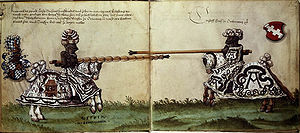 Depiction of Duke Wilhelm IV of Bavaria’s first jousting pass (1510). His opponent was Christoph Count von Ortenburg (right). Beneath the front hooves of Duke Wilhelm’s horse, the painter of the tournament book – the Munich court painter Hans Ostendorfer – names himself, together with the year of creation, 1541. (from: Turnierbuch Herzog Wilhelms IV. von Bayern, 1541, Bayerische Staatsbibliothek – Bavarian State Library, Cgm 2800, pp. 4–5, plate 1)
 -
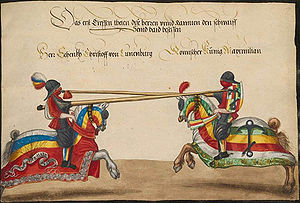 “Rennen” between Christoph von Lüneburg and Emperor Maximilian I at a tournament in Nuremberg in 1491. (from: Turnierbuch. Ritterspiele gehalten von Kaiser Friedrich III. und Kaiser Maximilian I. in den Jahren 1489–1511, Augsburg, mid-16th century, Bayerische Staatsbibliothek – Bavarian State Library, Cod.icon. 398, fol. 19r)


Shift in the significance of tournaments in the late Middle Ages
The original military function of practising knightly combat skills lost importance in the fifteenth and sixteenth centuries. By contrast, an increasingly prominent role was played not only by the display of sporting prowess, but also by the ritual staging of courtly festivities. This would often involve female spectators, the demonstrative expression of loyalty to a lord or the enacted solidarity of allied combatants, the resolution of conflicts through public duels and the affirmation of the individual’s or lineage’s membership of the nobility. Fighters who had distinguished themselves received the so-called “Turnierdank” as an honorary chivalric prize, which was often presented by ladies. Heralds were the experts responsible for admitting participants and overseeing the ceremonials. Tournaments were generally held in larger settlements, as only these offered sufficient infrastructure to accommodate all participants and their retinues, as well as a large enough audience.
Tournament venues in present-day Bavaria in the fifteenth and sixteenth centuries
“Tjosts” took place in the fifteenth and sixteenth centuries as part of court festivities and as a form of chivalric legal resolution, especially in the Old Bavarian residence towns and in the Hohenzollern residence of Ansbach. In Ansbach, for example, they occurred in close succession during the 1470s and 1480s; in Amberg, they were held on the occasion of the wedding of Elector Philip of the Palatinate (r. 1476–1508) in 1474; and in Landshut, they took place, for instance, on three days during the particularly splendid wedding in 1475 of Duke George (r. 1479–1503) to the daughter of the King of Poland. Particularly in Augsburg, besides several “Stechen” between townspeople, a number of duels between nobles are recorded. These offered the participants an opportunity either to demonstrate their prowess or to seek a legal resolution through combat. In Nuremberg, from the mid-fifteenth century onwards, the tradition of the so-called “Gesellenstechen” (a form of jousting practised by the patrician urban nobility) developed, from which the rural nobility largely kept their distance.
Reliable information about mass tournaments and their participants is available only from around 1400 onwards (Regensburg 1393, 1408). The first reports of supra-regional mass tournaments of the southern German knightly nobility of the Vierlande (that is, from Swabia, Franconia, Bavaria and the Rhine) date from 1434, from Nuremberg and Regensburg, and were also connected with the knight-friendly policies of Emperor Sigismund (r. 1410–1437). These tournaments of the 1430s, and especially the great Vierlande tournaments between 1479 and 1487, were major events in the history of the southern German nobility. As a rule, the knights competed in these tournaments in regional contingents and under the emblems of their respective societies, although some also appeared in the retinues of princes. Franconian and Bavarian tournament venues in the series from 1479 onwards were Würzburg (1479), Ingolstadt (1484), Ansbach (1485), Bamberg (1486) and Regensburg (1487).
-
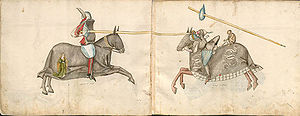 A “Rennen” carried out as a joust in the tournament book of Marx Walther. (Augsburg, 1506–1511, Bayerische Staatsbibliothek – Bavarian State Library, Cgm 1930, fol. 15v/16r)
 -
![Mass tournament with lances on the market square in Wittenberg (“Turnier auf dem Marktplatz”, woodcut, 1506, Lucas Cranach the Elder [1472–1553], Städel Museum, Frankfurt am Main, Graphische Sammlung) (© Städel Museum – ARTOTHEK)](/images/thumb/2/25/Artikel_45629_bilder_value_7_turniere7.jpg/300px-Artikel_45629_bilder_value_7_turniere7.jpg) Mass tournament with lances on the market square in Wittenberg (“Turnier auf dem Marktplatz”, woodcut, 1506, Lucas Cranach the Elder [1472–1553], Städel Museum, Frankfurt am Main, Graphische Sammlung) (© Städel Museum – ARTOTHEK)
Mass tournament with lances on the market square in Wittenberg (“Turnier auf dem Marktplatz”, woodcut, 1506, Lucas Cranach the Elder [1472–1553], Städel Museum, Frankfurt am Main, Graphische Sammlung) (© Städel Museum – ARTOTHEK)

![Mass tournament with lances on the market square in Wittenberg (“Turnier auf dem Marktplatz”, woodcut, 1506, Lucas Cranach the Elder [1472–1553], Städel Museum, Frankfurt am Main, Graphische Sammlung) (© Städel Museum – ARTOTHEK)](/Lexikon/Datei:Artikel_45629_bilder_value_7_turniere7.jpg)
Tournament societies of the knightly nobility in Franconia and Swabia
The cooperative, regionally organised knightly tournament societies that emerged in chivalric tournaments are a distinctive feature of the German late Middle Ages and form part of a broader cooperative movement within the knightly nobility. Knights allied themselves, often with the participation of counts and lords, and more rarely princes, to support one another in tournaments and to organise these tournaments collectively. The societies introduced exclusive rules for taking part in tournaments, such as proofs of ancestry and the requirement that applicants demonstrate ongoing tournament experience. In this way, they safeguarded the interests of the knighthood against the urban nobility (“patriciate”) as well as against those who had risen through princely favour or other means.
The promotion of knightly tournaments was already an important aim of an unnamed society of socially prominent Franconian knights founded in Schweinfurt in 1387. The same was true, alongside its religious and fraternal objectives, of the Franconian Fürspanggesellschaft (Fürspang Society), which was limited to 26 members and founded in 1392 with headquarters in Nuremberg and Würzburg. It was this society that initiated the first major southern German Vierlande tournament, held in Würzburg in 1479. Prior to the event, the society had already drawn up extensive tournament regulations. Over the course of this tournament series, a certain polarisation emerged within the Franconian knightly nobility. The newly founded Bärengesellschaft (Bear Society) allied itself with Margrave Albrecht Achilles von Brandenburg-Ansbach (r. 1440–1486), who at the tournaments asserted a leading role for the nobility throughout Franconia. The Einhorngesellschaft (Unicorn Society), founded at the same time, by contrast sought to maintain its independence from princely dominance. In Swabia, tournaments were organised primarily by the Gesellschaft zum Fisch (Society of the Fish) and the Gesellschaft zum Falken (Society of the Falcon). The Swabian tournament societies zur Krone (Crown Society) and zum Kranz (Wreath Society), which were also active during the major tournament series around 1480, were particularly centred in Upper Swabia and the Allgäu.
The Old Bavarian “tournament nobility”
The situation in Old Bavaria differed from that in Franconia and Swabia. Although short-lived societies were occasionally formed here as well for the purpose of organising tournaments (for example Hirsch (Stag) and Rüde (Hound) in 1408), the regional organisation of Bavarian tournament combatants at the major tournaments of the imperial nobility of the Vierlande rested on different foundations. Tournament poems of the fifteenth century (by Johann Holland and Jakob Püterich von Reichertshausen [c. 1400–1469]) list a fairly stable group of families and thus reflect a distinct status group of knightly nobles who defined themselves as the Bavarian tournament nobility in the narrower sense. However, this group was not organised into tournament societies like the tournament knights of other regions. Instead, they fought as the Bavarian tournament nobility without any cooperative association of their own, usually under the leadership of members of the ducal house. The members of these knightly lineages, which had long been established in the duchy, sought to make their participation in the great imperial tournaments a distinguishing marker in contrast to rising new families and to the numerous lesser nobles in the land, who were not admitted to these events. Although these established tournament families secured certain privileges around 1500 in terms of their consideration within the Landtag committees, no lasting estate-based boundary emerged between the old tournament lineages and the rest of the territorial nobility. Notably, Bavarian nobles who did not belong to the established tournament nobility also took part in the regional tournaments restricted to Old Bavaria (e.g. Munich 1427, 1439; Landshut 1452; Mühldorf 1460; Ingolstadt 1483).
Legacy of the knightly tournaments
After 1487, large-scale chivalric tournaments were scarcely held. However, the tournament books produced within the knightly milieu preserved the memory of the great tournaments of the late Middle Ages. From Bavaria and Franconia, the handwritten records of the early sixteenth century by Michel von Ehenheim (c. 1462/63–1518), Sigmund von Gebsattel, the tournament book of Ludwig von Eyb the Younger (c. 1450–1521), as well as the Raidenbucher and Neubeurer tournament books, are particularly noteworthy. These were complemented by the printed, supra-regional tournament books compiled by the imperial herald Georg Rixner. These tournament books by Rixner record the dates and participating lineages of fictitious tournaments from the time of King Heinrich I (r. 919–936 as King of the East Frankish realm) through to the historically attested tournaments of the fifteenth century. In doing so, they created a kind of collective history of the southern German knightly nobility, enabling it to place itself, in terms of lineage, on a level with the high noble families of princes, counts and lords. The tournament tradition thus strengthened the identity of the knighthood, which increasingly regarded itself as “reichsfrei” (subject to the Empire) and, with the exception of the Bavarian knights, united a few decades later to form the Imperial Knighthood. In Bavaria, the old tournament nobility survived merely as a kind of traditional elite which, unlike the nobility in Franconia and Swabia, was unable to establish any long-term independent organisation beyond the territorial principality, whether in the fifteenth century, during the era of the great tournaments, or in the period that followed.
-
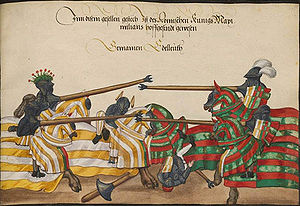 Journeymen’s jousting at the imperial tournament in Nuremberg in 1491. (from: Turnierbuch. Ritterspiele gehalten von Kaiser Friedrich III. und Kaiser Maximilian I. in den Jahren 1489–1511, Augsburg, mid-16th century, Bayerische Staatsbibliothek – Bavarian State Library, Cod.icon. 398, fol. 22r)
 -
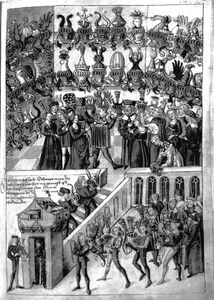 Depiction of a display of arms preceding a tournament. (from: Wappenbuch des Konrad Grünenberg, c. 1480, Bayerische Staatsbibliothek – Bavarian State Library, Cgm 145, fol. 233r)


Courtly tournaments in the Early Modern Period
Unlike the large-scale tournaments, which had fallen out of practice, single combats (“Rennen” and “Stechen”) continued to form a regular part of courtly festivities in the sixteenth century. Particularly at princely courts and on the occasion of Imperial Diets, knightly combats were presented in many different forms, partly modelled on Burgundian and wider West European traditions, the transmission of which owed much to Emperor Maximilian I (r. 1486–1508). In the first half of the sixteenth century, tournament books were also produced following the example set by Emperor Maximilian’s Freydal. These works recorded the successes of individual princes in knightly single combats, for example the tournament book of Duke Wilhelm IV von Bayern of Bavaria (r. 1508–1550). While heavily armoured horsemen were losing importance in actual warfare, the sixteenth century saw a growing number of exercises in which participants had to demonstrate speed and agility. One such discipline required riders to strike a suspended ring with a lance as they passed, or to carry it off (“Ringstechen”). Foot-combat displays were also incorporated and the combat of costumed participants was developed into theatrical spectacles. Extensive reports survive from Munich on the tournaments held in 1568 to mark the marriage of Duke Wilhelm V (r. 1579–1597) to Renata von Lorraine (1544–1602). The performances, which lasted several days, began with a ceremonial opening staged with great dramaturgical effect. They included a “Ringstechen”, a foot combat with sword and lance, a traditional mounted joust and a so-called “Kübelstechen”, in which the grotesquely padded fighters wore helmet-like buckets on their heads. In the evening, costumed fighters presented a jousting parody in the banquet hall. The programme also featured a free tournament with sharp weapons and, finally, a so-called “Krönleinstechen”, in which a small crown fixed to the tip of the lance was intended to prevent it from penetrating the opponent’s helmet visor. Further tournaments held as part of court festivities in Munich are recorded for 1603 and 1613.
After the Thirty Years’ War, tournament displays within courtly festivities moved even further away from actual combat and military exercises. They now formed part of instructive and entertaining productions alongside other elements, often drawn from classical literature and mythology, and members of the court sometimes took part in them personally. A particular curiosity is the tournament operas, known in the German-speaking world only from Vienna and Munich, which were performed at court festivals in Munich in 1658, 1662 and 1722. In these works, tournament combats formed part of a musical-theatrical narrative that served above all to present the martial courage of the nobility in allegorical form, at times even in exaggerated parody.
References
- Klaus Arnold, Der fränkische Adel, die "Turnierchronik" des Jörg Rugen (1494) und das Turnierbuch des Georg Rixner (1530), in: Erich Schneider (Hg.), Nachdenken über fränkische Geschichte (Veröffentlichungen der Gesellschaft für fränkische Geschichte IX 50), Neustadt an der Aisch 2005, 129-153.
- Josef Fleckenstein (Hg.), Das ritterliche Turnier im Mittelalter (Veröffentlichungen des Max-Planck-Instituts für Geschichte 80), Göttingen 1985.
- Stefan Grathoff, Art. Turnier, in: regionalgeschichte.net - Internetportal für regionale und lokale Geschichte.
- Hans H. Pöschko, Turniere in Mittel- und Süddeutschland von 1400-1550. Katalog der Kampfspiele und der Teilnehmer, Diss. Stuttgart 1987.
- Andreas Ranft, Die Turniere der vier Lande: Genossenschaftlicher Hof und Selbstbehauptung des niederen Adels, in: Zeitschrift für die Geschichte des Oberrheins 142 (1994), 83-102.
- Joachim Schneider, Spätmittelalterlicher deutscher Niederadel. Ein landschaftlicher Vergleich (Monographien zur Geschichte des Mittelalters 52), Stuttgart 2003.
- Helen Watanebe-O’Kelly, Turniere (Turnierplatz), in: Residenzenkommission der Akademie der Wissenschaften zu Göttingen (Hg.), Handbuch Höfe und Residenzen im spätmittelalterlichen Reich, Bd. 15.II-1, Ostfildern 2007, 502-505.
- Helen Watanabe-O’Kelly, Triumphall Shews. Tournaments at German-speaking Courts in their European Context 1560-1730, Berlin 1992.
Further Research
External links
Cite
Joachim Schneider, Tournaments (Middle Ages/Early Modern Period), published 29 August 2011, English version published 26 March 2026; in: Historisches Lexikon Bayerns, URL: <https://www.historisches-lexikon-bayerns.de/Lexikon/EN:Tournaments_(Middle_Ages/Early_Modern_Period)> (26.09.2026)