

In the 19th century, Bavaria gained a large Jewish minority as a result of territorial expansion. Their integration progressed gradually: first through the Jewish Edict of 1813, then through the lifting of remaining restrictions from 1861 onwards and finally through full legal equality with the founding of the German Empire in 1871. This caused major changes within Jewish communities. Around 1800, most Jewish families still lived in small rural communities in Franconia and Swabia, and even by the mid-century the remaining restrictions had prompted a significant wave of emigration. With the lifting of the restrictions from the 1860s onwards, there was an increasing migration into the cities, not only to Bavaria’s major urban centres but also to smaller and medium-sized towns. At first, many Jews continued to work in small-scale trade and moneylending, but over time their occupational fields broadened to include, among others, factory ownership and civil service. These changes were also reflected within the Jewish communities themselves, whose self-governance was curtailed and incorporated into the structures of state administration. Regulations concerning rabbinical training in the 19th century also led to internal community conflicts between Orthodox and Reform-oriented groups, raising fundamental questions about Jewish identity in modern society.
Background
As in the other German states, the 19th century was a period of profound change for the Jewish communities in Bavaria. It was marked by the difficult struggle for legal equality, by internal Jewish reform movements and by increasing acculturation. The efforts towards integration by both the Jewish population and the government were met, however, by the rise of antisemitism. The previously predominantly rural and small-town way of life gradually gave way to a middle-class, urban lifestyle with new occupational fields. At the same time, the Jewish history of Bavaria shows certain regional particularities. Owing to a restrictive government policy, legal and political emancipation was delayed. Although the newly formed Kingdom of Bavaria had a comparatively large Jewish population, it was concentrated in the recently incorporated regions of Franconia and Swabia, which had long been centres of southern German rural Jewry. These regional differences shaped the processes of change, influenced Bavarian policies toward the Jewish population and contributed to a distinct character in its relations with the non-Jewish population.
Rural Jewish life around 1800
Of the settlements identifiable in the so-called Montgelas statistics of 1809/10, 90% were located in Franconia and Swabia (data from Jewish Settlements in Bavaria 1500–1820 Jüdische Siedlungen in Bayern 1500 – 1820). This pattern of settlement was the result of the differing policies towards Jews pursued by early modern territorial rulers. In particular, the Franconian margraviates, the Further Austrian administration of the Margraviate of Burgau, the knightly estates of Franconia and Swabia, and the Palatine branches of the Wittelsbach dynasty admitted so-called “Schutzjuden” (protected Jews). By contrast, the Bavarian dukes and electors, with the exception of a small settlement of Jewish court factors in Munich, prevented Jewish settlement within their territories. Thus, while by around 1800 traditions of Jewish–Christian coexistence had already developed in Franconia and Swabia and in parts of what is today the Upper Palatinate, these traditions were largely absent in Old Bavaria.
-
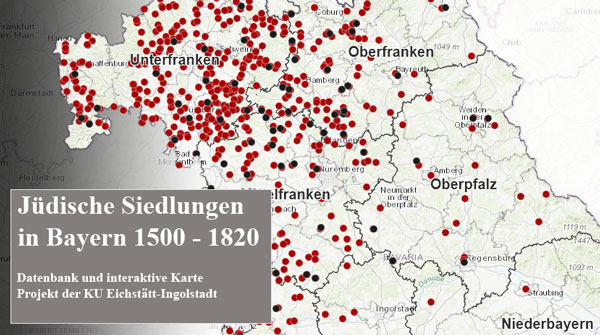 Jewish settlements in Bavaria 1500–1820. Database and interactive map on the website of KU Eichstätt–Ingolstadt.
Where Jewish populations possessed rights of residence, individual Jewish ordinances and protective privileges regulated the often restrictive conditions of daily life, including economic activity, religious practice, and housing and settlement rights. The Jewish communities were able to form local congregations and regional associations in the form of so-called “Landjudenschaften”, which enjoyed a considerable degree of autonomy. Religious life was shaped by an orthodox orientation, by communal leadership through the parnassim (community leaders), and by their own rabbinical jurisdiction. From the mid-18th century onwards, the Haskalah spread particularly in Franconia as part of the broader European Enlightenment. Centred in Berlin around the philosopher Moses Mendelssohn (1729–1786), the movement, supported by young Jewish intellectuals (the Maskilim), called for an engagement with wider society and culture without seeking complete assimilation.
Within the rural communities, the participation of Jewish householders in local communal rights often created points of tension. In places with a high Jewish population, this could lead to a broader involvement in municipal affairs. Livelihoods were adapted to the rural and small-town environment and were concentrated in the peddling trade in livestock, agricultural goods and credit. Differences in economic opportunities, together with the restrictive or preferential policies of the respective protective authorities, produced social distinctions within Jewish society. These ranged from the group of “Betteljuden” (impoverished Jews without protection rights), through the “Schutzjuden” (protected Jews), to the “Hofjuden” (court Jews) who were granted special privileges.
In 1813, 29,756 people in Bavaria east of the Rhine were counted as belonging to the Jewish faith. By 1822, there were 42,932 Jews in Bavaria and 10,470 in the Palatinate, amounting to around 1.25% of the total population (3.25 million in 1818).
Gradual legal equality in the Kingdom of Bavaria


When the old Jewish settlement areas became part of the Kingdom of Bavaria through the territorial expansions of 1803 to 1815, a discussion emerged concerning the position of the Jewish minority. It was strongly shaped by the educational ideas formulated by the jurist and Prussian official Christian Wilhelm Dohm (1751–1820) in his 1781 treatise “On the Civic Improvement of the Jews”. From this developed a political orientation that remained influential throughout the first half of the 19th century. Only a gradual granting of civil liberties was pursued and this was made dependent on internal reform and acculturation. After a series of individual decrees, the Jewish Edict of 1813 replaced the early modern legal framework as a constitutional law and incorporated the former “Schutzjuden” (protected Jews) into civic rights and their communities into the system of state church law, but under significant restrictions (such as the “Matrikelparagraph” matriculation clause and regulations governing occupations and means of livelihood). Efforts to revise the legislation were already made at the first Bavarian Landtag in 1819, when the Jewish communities sought to obtain full equality through petitions. In response, Christian merchants and traders, led by the Catholic deputy Joseph von Utzschneider (1763–1840), pressed for further restrictions on the Jewish peddling trade, which they perceived as commercial competition. Under the influence of the revolutionary events of 1848, the Bavarian Landtag achieved partial advances similar to those at the all-German Frankfurt National Assembly, including the granting of voting rights and eligibility to serve on jury courts. However, the attempt by the Bavarian Chamber of Deputies to revise the Jewish Edict failed once more in 1850, due to the House of Councillors, who, influenced by anti-Jewish petitions, voted against it. The principal organisers of the so-called address movement were the Catholic-conservative Pius associations. As a result, the process of emancipation in Bavaria advanced only gradually and hesitantly. The “Matrikelparagraph” (matriculation clause) was not abolished until 1861 and the remaining immigration restrictions were lifted only in 1868. The long-fought-for full equality finally took effect in 1871, when Bavarian law came under imperial legislation following Bavaria’s accession to the German Empire.
Political debates in the 19th century were accompanied by anti-Jewish unrest and agitation. Particularly striking were the Hep-Hep riots of 1819/1822, which in Bavaria occurred mainly in Franconia and the Upper Palatinate. Beginning in Würzburg, the disturbances spread to several places across the German Confederation, during which there were looting and attacks on Jews and their businesses. Supported mainly by merchants and craftsmen, these riots were among the first violent reactions to a feared rise in the social position of the Jewish population in the course of emancipation. Anti-Jewish currents then became particularly evident during the negotiations to revise the Jewish Edict between 1813 and 1850, which were marked by anti-Jewish stereotypes. This is also reflected in the reports submitted by civil servants in the regional courts, although these showed considerable regional variation in attitudes towards equality. In the second half of the 19th century, antisemitic attitudes also spread gradually in Bavaria. Now grounded in racial thinking and biological determinism – with the Berlin antisemitism dispute of 1879/81 playing a significant role – these forms of rejection and hostility became the counterpart to the emancipation that had been achieved.
Integration and acculturation
The emancipation movement and the rise of antisemitism were accompanied by steps towards integration. The degree of integration may be assessed, among other factors, by political participation, membership in the growing world of local associations, access to academic education and military service, and acceptance into non-Jewish social circles. There is much to suggest that in the rural communities, which could look back on a long history of Jewish–Christian coexistence, a “pragmatic path to emancipation” (Kießling, Jüdische Geschichte, p. 360) was also followed. Political integration at the communal level rested on already existing local traditions, such as the joint cultivation of common land within the pre-modern agricultural economy. The comparatively early participation of Jews in the municipal council of Ichenhausen in 1818/19, and the presence of Jewish community representatives in Krumbach-Hürben (both in the district of Günzburg) as early as 1822, point to this. However, the example of Fürth, where a Jewish representative was not elected until 1851, shows that this was not always the case. In the second half of the 19th century, Jews succeeded in being elected to many municipal bodies, including in the new urban communities: in Augsburg in 1863, and in Munich, Nuremberg and Ulm in 1869. Through the events of the 1848 Revolution, in which Jews also took part, participation at the level of state politics had already become possible somewhat earlier. The first Jewish members of the Bavarian Landtag were the lawyer Fischel Arnheim (1812–1864) and the tin-foil manufacturer David Morgenstern (1814–1882). Both exemplify the general political trend of a close association between Judaism and liberalism since the “Pre-March” period. Another path to integration ran through participation in associations. Jewish communities adapted to the new bourgeois forms of social organisation by establishing new associations, such as the social club founded in Würzburg in 1836. At the same time, bourgeois associations began to admit Jewish members gradually from the 1830s onwards, for example in Würzburg and Munich. In rural areas, as documented for Hürben, joint commercial and charitable associations were founded.
-
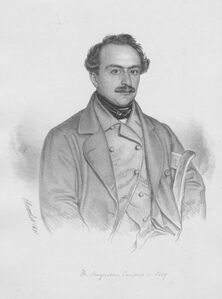 The tin-foil manufacturer and lawyer David Morgenstern (1814–1882) was among the first Jewish members of the Bavarian Landtag from 1849. Lithograph by Friedrich Knauber, 1851. (Bayerische Staatsbibliothek – Bavarian State Library, image archive port-025169)
 -
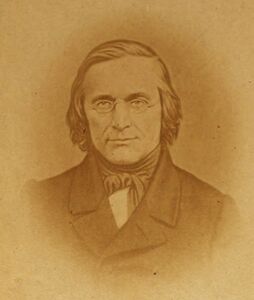 Jakob Herz (1816–1871) was the first Jewish professor in Bavaria. In 1869, he was appointed full professor of anatomy at the University of Erlangen. Image from: Doctor Jacob Herz. Zur Erinnerung für seine Freunde, Erlangen 1871, front endpaper. (Bayerische Staatsbibliothek – Bavarian State Library, Biogr. 518 yd)


The steps towards acceptance were offset by the limited access to academic life. Although some Jewish students were already enrolled at the universities of Erlangen, Munich and Würzburg in the first half of the 19th century, an academic career in state service was only possible through conversion. The physician Jakob Herz (1816–1871) was granted permission to teach only after the personal intervention of King Maximilian II (1811–1864, r. 1848–1864) in 1854; in 1869, he became the first Jewish full professor in Bavaria, at the University of Erlangen. Even more difficult, despite the introduction of compulsory military service, was a career in the army, which, with few exceptions, remained closed to Jews. Only after the middle of the century were Jews admitted to the civil service without conversion, as was the case for notaries and judges in 1861. A career in academia, however, remained a challenging path, achieved only in a few exceptional cases. Many Jewish intellectuals therefore turned to journalism, publishing, or the book trade. In addition to new professional paths, acculturation can be observed in many areas. The transformation of burial culture in the 19th century remains clearly visible today in the surviving Jewish cemeteries of Bavaria. German-language inscriptions were increasingly used, and the style and external form of the gravestones adapted to non-Jewish customs. The urban synagogue architecture, largely destroyed during the National Socialist period, reflected not only the new bourgeois aspiration for representation but also the independent architectural and cultural developments that had now become possible. The synagogues built in the Moorish style – for example in Nuremberg in 1874 – expressed a claim to religious independence, while at the same time emphasising a connection with German cultural tradition through historicising stylistic elements. In the cities, a process of social bourgeoisification began early, with its precursors found in the court factor families, who since the 18th century had modelled themselves not only on the nobility but also on the bourgeoisie. The adoption of middle-class social customs, such as visits to beer gardens and coffee houses, and participation in the cultural life of towns and cities, opened up new spheres of contact. Overall, change in the rural communities took place more slowly than in the newly established urban ones.
-
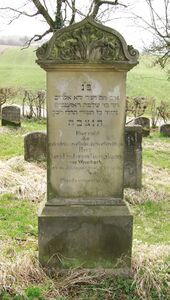 An example of Jewish acculturation in the 19th century was the adaptation of gravestones to non-Jewish forms and the increasingly frequent use of German-language inscriptions. The gravestone of David Salomon Rosenbaum (1800–1876) in the Jewish cemetery at Hagenbach (district of Forchheim) clearly illustrates this transition, with a German inscription added alongside the Hebrew one. (Photo by Janericloebe, licensed under CC BY 3.0 via Wikimedia Commons)
 -
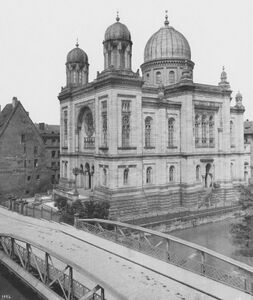 Nuremberg’s main synagogue was built by the architect Adolf Wolff (1832–1885) on Hans-Sachs-Platz. It was demolished in 1938 and has been commemorated by a memorial stone since 1988. Photo by Johann Brunner, 1891. (Bayerische Staatsbibliothek – Bavarian State Library, image archive port-02504)


Migration and socioeconomic change
Parallel to these developments, 19th-century Jewry experienced migration movements in various directions. In the rural Jewish communities, the population grew during the first half of the century, reflecting general demographic trends. However, the continued enforcement of the matriculation clause in Bavaria, which limited the number of Jewish households in each locality, led to precarious economic and housing conditions. Because the matriculation quotas restricted the number of Jewish households permitted in each locality, it was scarcely possible to establish new ones. As population pressure increased, a broad movement of emigration from the Jewish settlement areas of Swabia and Franconia to North America began in the 1830s. Some of the emigrants, such as Nathan Michael Ries (1815–1878) from Hainsfarth (district of Donau-Ries), who became a multimillionaire through real estate sales, and Levi Strauss (1829–1902) from Buttenheim (district of Bamberg), the inventor of jeans, achieved remarkable success as entrepreneurs there. After the wave of emigration reached its peak in the 1850s and the abolition of the matriculation clause in 1861, the number of emigrants declined. At the same time, migration into the cities began. At the beginning of the century, only a few of the old imperial cities, such as Augsburg in 1803, had admitted individual banking families in return for the granting of credit. From the 1860s onwards, the cities gradually opened up to Jewish migrants, leading to widespread internal migration from the countryside to the towns and cities. This was largely a localised movement, directed mainly towards the urban centres of each respective region. The major cities of Bavaria – Munich, Nuremberg and Würzburg – were the most attractive destinations. In the older Jewish settlement regions, smaller and medium-sized towns with railway connections, such as Schweinfurt, Rothenburg ob der Tauber (district of Ansbach) and Nördlingen (district of Donau-Ries), also played an important role. The extent of this structural shift is illustrated by the fact that, by the end of the century, 71% of the Jewish population lived in urban areas. For the rural settlements, this transformation meant a considerable decline in population, in some cases even leading to the dissolution of entire communities. The transition from rural to urban Judaism was thus complete. However, the historically evolved regional distribution remained largely unchanged, with the main centres in Franconia and Swabia, apart from Munich. Immigration from Eastern Europe, triggered by the pogroms in Russia in the 1880s, brought about a less extensive but nonetheless significant shift. Although this influx was not as strong in Bavaria as in Prussia, it influenced perceptions of Judaism through the negatively charged image of the “Eastern Jew” which became a focal point of antisemitic hostility. Around 4,000 immigrants settled mainly in the urban centres of Munich and Nuremberg–Fürth, where they accounted for about 20% of the Jewish population by the beginning of the 20th century.
-
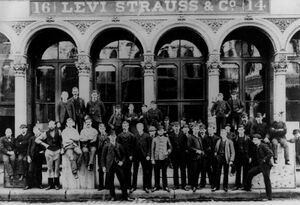 Employee of the fabric and haberdashery store founded by Levi Strauss and his brother Louis in San Francisco in 1853. From 1866, the store was located at 14–16 Battery Street. Photograph c. 1880. (Levi Strauss & Co.)
 -
![The old main synagogue in Munich was built between 1883 and 1887 on Herzog-Max-Straße according to the designs of the architect Albert Schmidt (1841–1913). It was demolished by the National Socialists in 1938. A memorial stone has commemorated the building since 1969. The new main synagogue was constructed on Jakobsplatz between 2003 and 2006. Photograph by Joseph Albert (1825–1886), c. 1886. (Bayerische Staatsbibliothek – Bavarian State Library, image archive port-028701])](/images/thumb/1/1e/Synagoge_Muenchen_1.jpg/224px-Synagoge_Muenchen_1.jpg) The old main synagogue in Munich was built between 1883 and 1887 on Herzog-Max-Straße according to the designs of the architect Albert Schmidt (1841–1913). It was demolished by the National Socialists in 1938. A memorial stone has commemorated the building since 1969. The new main synagogue was constructed on Jakobsplatz between 2003 and 2006. Photograph by Joseph Albert (1825–1886), c. 1886. (Bayerische Staatsbibliothek – Bavarian State Library, image archive port-028701])
The old main synagogue in Munich was built between 1883 and 1887 on Herzog-Max-Straße according to the designs of the architect Albert Schmidt (1841–1913). It was demolished by the National Socialists in 1938. A memorial stone has commemorated the building since 1969. The new main synagogue was constructed on Jakobsplatz between 2003 and 2006. Photograph by Joseph Albert (1825–1886), c. 1886. (Bayerische Staatsbibliothek – Bavarian State Library, image archive port-028701]) -
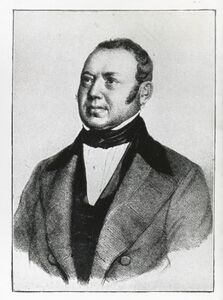 Joel Jakob von Hirsch (1789–1876), entrepreneur and banker from Würzburg. (Stadtarchiv Würzburg – Würzburg City Archives, BioM Joël Jakob von Hirsch)

![The old main synagogue in Munich was built between 1883 and 1887 on Herzog-Max-Straße according to the designs of the architect Albert Schmidt (1841–1913). It was demolished by the National Socialists in 1938. A memorial stone has commemorated the building since 1969. The new main synagogue was constructed on Jakobsplatz between 2003 and 2006. Photograph by Joseph Albert (1825–1886), c. 1886. (Bayerische Staatsbibliothek – Bavarian State Library, image archive port-028701])](/Lexikon/Datei:Synagoge_Muenchen_1.jpg)

Urbanisation was also accompanied by a change in occupational patterns. The Jewish Edict of 1813 had aimed to reshape the Jewish occupational structure by restricting peddling and promoting a shift towards agriculture and crafts in line with the prevailing “educational concept”. Initially, however, this had little effect. The vast majority of the Jewish population continued to work in trade and commerce, either through lack of alternatives or owing to their long experience and acquired skills. The preservation of the settlement structure through the matriculation clause also left little room for far-reaching change. Only in the skilled trades, drawing on the commercial traditions within the Jewish religious communities, was there a slight increase. It was only with urbanisation and the transition into the middle classes that a new dynamism emerged, shaped by the wider context of industrialisation. The economic rise associated with this was multifaceted. It included the transition from peddling to the establishment of open shops selling textiles, hardware and colonial goods, leading to the emergence of a broad urban middle class. At the same time, a Jewish upper middle class developed, which played a significant role in the innovative processes of industrialisation, such as Joel Jakob (Julius) Hirsch (1789–1876) in Würzburg, who invested in railway and shipping projects. The transition from trade to manufacturing was, of course, only possible in a suitably urban environment. It often occurred, as in the case of the Augsburg cloth manufacturer Samuel Kohn (1808–1879) from Steppach (town of Neusäß, district of Augsburg), through a move from the suburban communities into the cities. The economic rise and the emergence of a Jewish middle and upper class in the cities led to extensive socioeconomic integration into the structures of the majority society.
Jewish community organisation and communal life
Not least, the assimilationist pressure exerted by the Bavarian state, together with internal Jewish reform movements, brought about numerous changes in Jewish community organisation and communal life. The Jewish Edict of 1813 abolished the former autonomy of the communities by eliminating rabbinical jurisdiction and introducing state regulations for rabbinical training and the Jewish education system. In religious terms, they were granted the status of private church societies (Religious Edict of 1809), while politically they were integrated into the municipal constitution. As a result, the parnassim (community leaders) lost their functions and the leadership role of the rabbis was curtailed. However, the implementation of state supervision over the appointment of rabbis by the district school councils was delayed, as the requirements for academic training were vaguely defined and many communities rejected the associated move away from the Jewish tradition of Talmudic scholarship. Within and between the communities, opposing currents of Orthodoxy and Reform Judaism developed, shaping communal life in the 19th century and leading to numerous internal conflicts. For example, the appointment of the chief rabbinate in Fürth was delayed from 1819 to 1830, as the state authorities did not accept the community’s proposal and the community leaders were divided. In contrast, the gradual reorganisation of the district rabbinates from the 1820s onwards proceeded comparatively smoothly. The 39 districts established from 1853 reflected the varied patterns of Jewish settlement in Bavaria and represented less a systematic redistribution than a consolidation modelled on the old provincial rabbinates of the 18th century. It was only in the second half of the 19th century that the effects of urbanisation became evident here as well, with the district rabbinates being relocated to the cities, for example to Nuremberg in 1866 and to Schweinfurt in 1864. The reforms in the Jewish school system corresponded to the educational principles of state policy towards the Jews. On the one hand, Jewish children were permitted to attend general primary schools with separate religious instruction; on the other, the religious communities were given the option of establishing their own schools. In the still largely rural communities, implementation in this area was slow and, reflecting the differing orientations of the communities, led to considerable diversity within the Jewish school system.
In 1870, 56.3% of Jewish children attended Jewish primary schools; by 1911/12, this ratio had more than reversed, with 72.4% now attending Christian denominational schools. The abolition of the matriculation clause, the ensuing migration and the resulting dissolution of established social milieus were clearly reflected in this development.
The conflict between traditionalists and reformers also broke out over other aspects of religious life and synagogue worship. Reform-oriented congregations introduced new synagogue regulations in the first third of the century, which reflected acculturation through the introduction of German sermons, a synagogue choir and an organ. In many cases, traditional Ashkenazi practices such as the auctioning of synagogue honours were also discontinued, often in the face of fierce resistance from members of the congregation. The strong symbolic significance of these acculturation processes, in the sense of a “churchification,” was evident, for example, in the new official attire of reform-oriented rabbis, which was modelled on the dress of Catholic and Protestant clerics.
The ensuing inner-Jewish conflict of direction cut across and within the communities, with Orthodoxy being more deeply rooted in the rural congregations, where it continued to shape daily life. The contrast between Würzburg, where Rabbi Abraham Bing (1752–1841) pursued a path of partial openness, and Fürth, where Wolf Hamburger (1770–1850) upheld the Talmudic tradition, was characteristic of these opposing tendencies. In Franconia in particular, where the Haskalah had also spread in the 18th century, a number of reform rabbis emerged, such as Samson Wolf Rosenfeld (1783–1862) in Bamberg and Lazarus Adler (1810–1886) in Bad Kissingen, both district rabbis and editors of reform-oriented journals. The Jewish reform discourse, however, had a deeper dimension: ultimately, it concerned a redefinition of Judaism in the context of modernisation and the adoption of middle-class ways of life, as well as the search for a new identity no longer founded exclusively on religion.
-
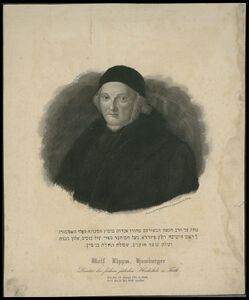 Wolf Hamburger (1770–1850) was a rabbi and the last head of the Talmud school in Fürth. Copper engraving by Gerson Löwensohn (1817–1871). (Public domain via The National Library of Israel)
 -
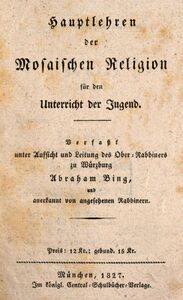 Title page of the book “Hauptlehren der mosaischen Religion für den Unterricht der Jugend”, published in 1827 by Abraham Bing. (Bayerische Staatsbibliothek – Bavarian State Library, Jud. 7 lm)
 -
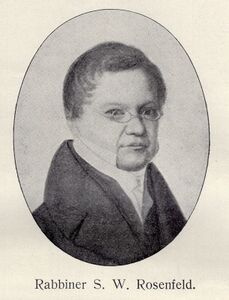 Samson Wolf Rosenfeld (1782–1862) was district rabbi in Bamberg and one of the first Jewish clergymen to preach in German in synagogues. Illustration from: Adolf Eckstein, Die Israelitische Kultusgemeinde Bamberg von 1803–1853. Festschrift zur Einweihung der neuen Synagoge in Bamberg, Bamberg, 1910. (Bayerische Staatsbibliothek – Bavarian State Library, Jud. 20 fk)


References
- Harm-Hinrich Brandt (Hg.), Zwischen Schutzherrschaft und Emanzipation. Studien zur Geschichte der mainfränkischen Juden im 19. Jahrhundert, Würzburg 1987.
- Michael Brenner/Renate Höpfinger (Hg.), Die Juden in der Oberpfalz, München 2009.
- Michael Brenner/Sabine Ullmann (Hg.), Die Juden in Schwaben (Studien zur Jüdischen Geschichte und Kultur 6), München 2013.
- Michael Brenner/Daniela F. Eisenstein (Hgg.), Die Juden in Franken, München 2012.
- Michael Brenner/Stefi Jersch-Wenzel/Michael A. Meyer, Emanzipation und Akkulturation 1780 und 1871 (Deutsch-jüdische Geschichte in der Neuzeit 2), München 1996.
- Richard Bauer/Michael Brenner (Hg.), Jüdisches München. Vom Mittelalter bis zur Gegenwart, München 2006.
- Peter Fassl (Hg.), Geschichte und Kultur der Juden in Schwaben, 2 Bde, Sigmaringen 1994, 2000.
- Ursula Gehring-Münzel, Vom Schutzjuden zum Staatsbürger. Die gesellschaftliche Integration der Würzburger Juden 1803-1871, Würzburg 1992.
- Arno Herzog/Hans Otto Horch/Robert Jütte (Hg.), Judentum und Aufklärung. Jüdisches Selbstverständnis in der bürgerlichen Öffentlichkeit, Göttingen 2002.
- Rolf Kießling, Jüdische Geschichte in Bayern. Von den Anfängen bis zur Gegenwart (Studien zur jüdischen Geschichte und Kultur in Bayern 11), München 2019.
- Rolf Kießling, Die jüdischen Gemeinden, in: Alois Schmid (Hg.), Handbuch der Geschichte Bayerns. Bd. IV: Das Neue Bayern. Von 1800 bis zur Gegenwart, München 2. Auflage 2007, 356-384.
- Hendrikje Kilian, Die jüdische Gemeinde in München, 1813-1871. Eine Großstadtgemeinde im Zeitalter der Emanzipation, München 1989.
- Andrea M. Kluxen/Julia Hecht (Hg.), Juden in Franken 1806 bis heute, Ansbach 2007.
- Hannes Ludyga, Die Rechtsstellung der Juden in Bayern von 1819 bis 1918. Studie im Spiegel der Verhandlungen der Kammer der Abgeordneten des bayerischen Landtags, Berlin 2007.
- Claudia Prestel, Jüdisches Schul- und Erziehungswesen in Bayern 1804-1933. Tradition und Modernisierung im Zeitalter der Emanzipation, Göttingen 1989.
- Claudia Ried, Die bayerische Judenpolitik in der ersten Hälfte des 19. Jahrhunderts und deren Folgen für das schwäbische Landjudentum, in: Aschkenas. Zeitschrift für Geschichte und Kultur der Juden 21 (2013), Themenschwerpunkt: Juden auf dem Lande vom Mittelalter bis ins 20. Jahrhundert. Hg. von Sigrid Hirbodian, 79-104.
- Stefan Rohrbacher, Gewalt im Biedermeier. Antijüdische Ausschreitungen in Vormärz und Revolution (1815-1848/49), Frankfurt a. Main 1993.
- Stefan Schwarz, Die Juden in Bayern im Wandel der Zeiten, München/Wien 1963.
- Manfred Treml/Josef Kirmeier unter Mitarbeit von Evamaria Brockhoff (Hg.), Geschichte und Kultur der Juden in Bayern, Aufsätze (Veröffentlichungen zur Bayerischen Geschichte und Kultur 17/88), München 1988.
- Shulamit Volkov unter Mitarbeit von Elisabeth Müller-Luckner (Hg.), Deutsche Juden und die Moderne (Schriften des Historischen Kollegs, Kolloquiuen 25), München 1994.
- Carsten Wilke, "Den Talmud und den Kant". Rabbinerausbildung an der Schwelle zur Moderne, Hildesheim 2003.
Further Research
- Keyword search in the online catalogue of the Bibliotheksverbund Bayern (Library Network Bavaria)
- Keyword-search in bavarikon
- Keyword-search in the Bavarian Bibliography
External links
- bavarikon: Ausstellung: Jüdisches Leben auf dem Land. Geschichte und Kultur der jüdischen Gemeinde in Ichenhausen (1541-1948) (bavarikon: Exhibition: Jewish life in the countryside. History and culture of the Jewish community in Ichenhausen (1541-1948)
- Sammlungen des Jüdischen Museums Augsburg Schwaben in bavarikon (Collections of the Jewish Museum Augsburg Schwaben on bavarikon)
- Haus der Bayerischen Geschichte: Jüdisches Leben in Bayern (House of Bavarian History: Jewish Life in Bavaria)
- KU Eichstätt-Ingolstadt: Jüdische Siedlungen in Bayern 1500 - 1820 (KU Eichstätt–Ingolstadt: Jewish Settlements in Bavaria, 1500–1820)
Related articles
- Antisemitismus (19. Jahrhundert)
- Judentum in Altbayern (bis 1800)
- Judentum in Schwaben (bis 1800)
- Judentum (Weimarer Republik)
- Judentum (nach 1945)
- Jüdisches Schulwesen in Bayern (1804-1918)
- Jüdisches Schulwesen in Bayern (1918/19-1945)
Alternative titles!
Cite
Sabine Ullmann, Judaism (19th Century), published 23 May 2023, English version published 19 March 2026; in: Historisches Lexikon Bayerns, URL: <https://www.historisches-lexikon-bayerns.de/Lexikon/EN:Judaism_(19th_Century)> (18.09.2026)