

On 26 May 1818, Max I Joseph (1756–1825, reigned 1799–1825) issued a new constitution for the Kingdom of Bavaria. Its introduction was driven by both foreign and domestic political motives. It aimed both to protect Bavaria’s sovereignty and to counter the unfavourable clauses of the Concordat of 1817, while also promoting the integration of the old and newly incorporated Bavarian territories through the introduction of a representative assembly. The imposed constitution, which was nevertheless very progressive for its time, transformed Bavaria into a constitutional monarchy, although the king remained the sole bearer of state sovereignty and the full separation of powers had not yet been achieved. Repeatedly adapted to the circumstances of the time, the Constitution remained in force until the end of the monarchy in 1918.
Bavaria’s foreign policy in 1818
Since 1815/1816, and following the final defeat of Napoleon I. (1769–1821, Emperor of the French 1804–1814 and 1815), peace had returned to Europe. During the Congress of Vienna, the German states – including Bavaria – had succeeded in establishing a defensive system for Central Europe in the form of the German Confederation. Munich expected this alliance to provide protection against revolutionary movements, but at the same time remained concerned about a possible erosion of its sovereignty by the major German powers, Austria and Prussia. Since the end of the Napoleonic era, Bavaria had scarcely pursued an independent foreign policy. The kingdom was too small and its military power too limited for such ambitions, and the major European powers no longer regarded Bavaria as a significant ally. From around 1814/1816, the Bavarian government entered into negotiations in Rome for a concordat (a treaty under international law) in order to place relations with the Curia on a stable footing once again, following the upheavals of mediatisation, secularisation, and the reforms of Maximilian von Montgelas (1759–1838).
-
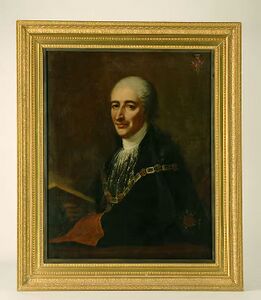 Maximilian Joseph Freiherr von Montgelas (1759–1838). Painting by Joseph Hauber (1766–1834), c. 1804. (Bayerisches Nationalmuseum, 2006/214.1-2, licensed under CC BY-NC-ND 4.0)
 -
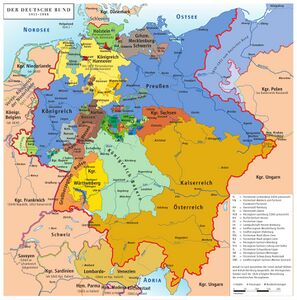 Map of the German Confederation (1815–1866). (Map: Ziegelbrenner, licensed under CC BY-SA 3.0 via Wikimedia Commons)
 -
 Deed of the Bavarian Concordat of 5 June 1817. (Bayerisches Hauptstaatsarchiv- Bavarian Main State Archives, Bayern Urkunden 1687, licensed under CC BY-NC-ND 4.0 via bavarikon)


Domestic political situation in Bavaria in 1818

In 1816, the Palatinate became the last of the newly acquired Bavarian territories to be incorporated into the kingdom, as compensation for lands that Bavaria had returned to Austria under the Treaty of Ried (8 October 1813). Since then, the kingdom’s domestic political situation had also begun to stabilise. However, integrating the new Bavarian territories remained a pressing challenge. Added to this were the high level of national debt and various hardships resulting from Montgelas’s reforms. The relationship between the state and the Catholic Church remained unresolved. The mediatisation of the ecclesiastical states had also resulted in several episcopal sees (Augsburg, Bamberg, Freising and Würzburg) being left vacant, which meant that no pontifical acts such as ordinations or confirmations could take place. However, as around three quarters of Bavaria’s subjects were Catholic, the Munich government could not leave such matters unaddressed indefinitely. The normalisation of relations required the conclusion of a concordat, which was signed in 1817 by the Bavarian envoy to the Holy See without consulting the Bavarian government. However, parts of this treaty called into question the parity of the three Christian denominations that had already been established in several edicts of 1803. The Constitution of 1818 was ultimately intended to provide the necessary remedy, as a new Religious Edict formed part of the Constitution, while the Concordat was published only as an appendix to that edict.
The motives for revising the 1808 Constitution

The Bavarian Constitution of 1808 was not destined to remain in force for long. Together with the Organic Edicts, it had by then fulfilled its purpose of transforming Bavaria into a state governed under a unified system. On 26 May 1818, a new “Staatsgrundgesetz” (Basic Law of the State), now referred to as the Constitution, was proclaimed throughout the kingdom to the sound of ringing bells and the thunder of cannon. Its adoption was prompted by a variety of motives. Criticism of the 1808 Constitution had soon arisen, particularly concerning the lack of citizen participation in the legislature. During these years, the Crown Prince, later King Ludwig I (1786–1868, reigned 1825–1848), was firmly convinced that a circle of educated or affluent subjects, including the landed nobility, should be granted the opportunity to participate in selected political matters. In addition, there was the idea of opening up a political sphere of activity within the kingdom not only to the landed nobility but, above all, to those members of the nobility who had formerly been immediate subjects of the Empire but were now mediatised. This was intended to encourage their willingness to integrate. Article 13 of the German Federal Act of 1815 also stipulated that every member state should possess a “landständische Verfassung” (a constitution based on estates representation). However, the Constitution of 1808 did not meet these requirements. For instance, the promised popular representation was never convened. Moreover, the government in Munich was concerned about whether, and in what way, Bavarian sovereignty could be preserved in view of the approaching Congress of Vienna and the planned reorganisation of Germany.
Among the motives for introducing a new constitution was the continuing threat of state bankruptcy after 1815. The debts accumulated during the Napoleonic era had by no means yet been repaid. Another factor was the renewed danger to Bavaria’s sovereignty in the winter of 1817/1818, arising from the framework principles for individual state constitutions envisaged by Clemens Wenzel von Metternich (1773–1859). There was also the hope of influencing to Bavaria’s advantage the ongoing border disputes with the Grand Duchy of Baden over a land connection between Bavaria east of the Rhine and the Palatinate, should Bavaria succeed in adopting a constitution before Baden. In this context, it is also important to note the aforementioned attempt by the Bavarian government to counter the disadvantageous provisions of the Concordat concluded with the Holy See in 1817 by means of a new Basic Law of the State.
The drafting of the 1818 Constitution
On 17 September 1814, King Max I Joseph (1756–1825, reigned 1799–1825) instructed his minister Montgelas to begin revising the Constitution of 1808. The immediate impetus and ultimately the concrete model for this was the Charter of 1814 proclaimed by the French King Louis XVIII (1755–1824). The work continued, with frequent interruptions, until 1818. On the basis of guiding principles for the constitutional deliberations, drafted by Montgelas and approved by the King, a specially appointed commission composed of civil servants and ministerial officials deliberated for several months under the chairmanship of the Minister of Justice, Heinrich Aloys Graf von Reigersberg (1770–1865). In Montgelas’s guiding principles, several fundamental concepts were already laid down that later came to characterise the Constitution: the bicameral system of popular representation, parliamentary responsibility for the national debt, and the determination of direct taxes, among others. However, indirect taxes were to remain beyond the control of parliament, and Montgelas did not intend to grant smallholders the right to stand for election.
In mid-February 1815, the commission presented a draft, adopted by a narrow majority, which had ultimately been drawn up by Johann Adam Freiherrn von Aretin (1769–1822). However, this draft sought to restrict the rights of the two proposed chambers of the not-yet-established parliament – as well as the rights of voters – even more severely than Montgelas’s guiding principles had already done. The supporters of constitutional reform on the commission, a liberal group led by Maximilian Freiherrn von Lerchenfeld (1778–1843), therefore felt compelled to oppose what they saw as a reactionary draft and submitted a minority opinion to Max I Joseph. The Constitution promulgated by the Bavarian king in 1818 ultimately went a long way towards meeting the demands of the supporters of constitutional reform. This was largely due to Ludwig’s at times sharp criticism of the commission’s draft; his father had requested his comments on it on 1 March 1815. Ludwig’s own proposals, by contrast, aimed at a far more active participation of the chambers in the legislative process.
-
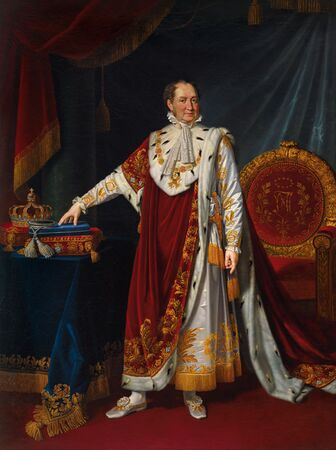 Max I Joseph (1756–1825, Elector Palatine of Bavaria 1799–1805, King of Bavaria 1806–1825) in royal regalia. The king’s right hand rests on the Constitution. Painting by Moritz Kellerhoven (1758–1830), probably 1818. (© Bayerische Schlösserverwaltung, Rainer Herrmann/Ulrich Pfeuffer/Maria Scherf, Munich ResMü. G 1254)
 -
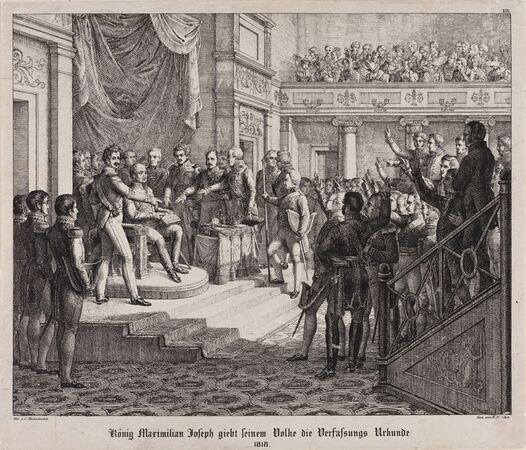 The king and ministers taking the oath in the Redoutensaal (later the plenary hall of the Chamber of Deputies) in Prannerstraße, 1818. Engraving by Dietrich Monten (1799–1843) and C. Heinzmann. (Münchner Stadtmuseum, Collection of Prints and Paintings)


As a result, the king immediately ordered a revision of the commission’s draft. Nevertheless, it was not until the spring of 1818 that work on the draft constitution truly began in earnest. Montgelas was chiefly responsible for the renewed delays. He undoubtedly wished to postpone promulgation of the new Constitution for even longer, as he did not consider the Bavarian subjects politically mature enough to share in governmental responsibility in accordance with the Crown Prince’s proposals.
It was only the fall in 1817 of the hitherto almost all-powerful Bavarian minister that cleared the way for the constitutional deliberations which ultimately achieved their goal. In the end, the Constitution of 1818 was drafted in record time. Thirty-six meetings of a specially convened ministerial conference, held from mid-March 1818 and led above all by Georg Friedrich von Zentner (1752–1835), were sufficient. On 26 May 1818, the Constitution was publicly proclaimed, with heralds reading the text aloud first in Munich and subsequently in other Bavarian cities. The king, for his part, swore an oath to the Constitution and marked the occasion with a thanksgiving service and a festive opera performance.
Like the Constitution of 1808, the Constitution of 1818 was drawn up solely on the king’s orders by his officials and was, in effect, “granted” to the people. As the subjects were not involved in its drafting, it is described as an imposed constitution.
-
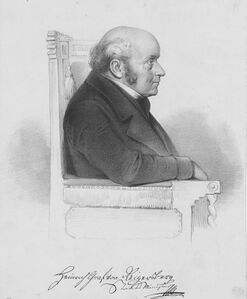 Heinrich Alois von Reigersberg (1770–1865), Bavarian Minister of Justice from 1810 to 1823 and chairman of the Constitutional Commission in 1814. Print by an unknown artist, c. 1850. (Bayerische Staatsbibliothek – Bavarian State Library, image archive port-025192)
 -
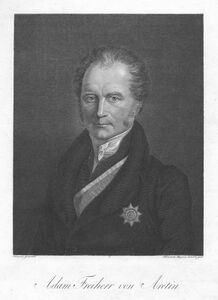 Johann Adam von Aretin (1769–1822), member of the Constitutional Commission in 1814. The Bavarian civil servant held several posts during his career, including envoy to the Federal Assembly in Frankfurt am Main from 1817. Print by Johann Meyer (1801–1877) after Christian Heinrich Hanson (1790–1863). (Bayerische Staatsbibliothek – Bavarian State Library, image archive port-019444, licensed under PDM 1.0)
 -
 Maximilian Emanuel Graf von Lerchenfeld auf Köfering (1778–1843), Bavarian Minister of Finance from 1817 to 1825 and member of the Constitutional Commission from 1817. Portrait drawing by Franz Hanfstaengl (1804–1877), 1835. (Österreichische Nationalbibliothek, Portrait Collection)
 -
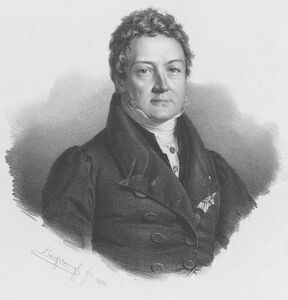 The constitutional lawyer and Bavarian civil servant Georg Friedrich von Zentner (1752–1835) worked in the Ministry of the Interior from 1813 and served as Councillor of State in the same ministry from 1817. He was also a member of the Constitutional Commission. Lithograph by Franz Hanfstaengl (1804–1877), 1830. (Bayerische Staatsbibliothek – Bavarian State Library, image archive port-010171, licensed under PDM 1.0)


Content of the Constitution
The preamble to the Constitution refers to the Constitution of 1808 and to the Congress of Vienna, and declares its purpose to be the promotion of the welfare of all Bavarian subjects. This is followed by a statement of intent to establish an “Assembly of the Estates”. The civil rights are then listed, supplemented by various rights and duties that had already been introduced through Montgelas’s reforms, including the abolition of estate privileges and the introduction of universal conscription. The main body of the Constitution is divided into ten titles.
| Titel | Überschrift | Inhalt |
|---|---|---|
| I. | General Regulations. | Bavaria is a sovereign state (§ 1); the representation of the people is divided into two chambers (§ 2). |
| II. | Of the King and the Succession to the Throne, and of the Regency of the Realm. | All state authority emanates from the King (monarchical principle), which he exercises in accordance with the provisions of the Constitution (§ 1); provisions on succession to the throne in the male line (agnatic succession) until the extinction of the ruling house (§§ 2–6); majority of the heir to the throne (§ 7); provisions on the regency (§§ 9–22). |
| III. | Of the Property of the State. | The Kingdom is indivisible and inalienable (§ 1); enumeration of what constitutes the inalienable state property (e.g. all archives, public institutions and buildings, collections for the arts and sciences, etc.); management of the state property (§§ 2–7). |
| IV. | Of General Rights and Duties. | Conditions under which male subjects enjoy their civil, public and private rights (§§ 1–4); enumeration of these rights (equal eligibility for public offices and benefices, freedom of conscience, equality in taxation, etc.) (§§ 5–14); relationship between the State and the Church in Bavaria (§ 9). |
| V. | Of Peculiar Rights and Privileges. | Crown offices and Crown officials (§ 1); the formerly immediate imperial nobility (§§ 2–3); the Bavarian nobility (§ 4); senior civil servants and clergy (§§ 5–6). |
| VI. | Of the Assembly of the Estates. | Composition of the two chambers, the House of Councillors and the Chamber of Deputies (§§ 1–10); conditions for the election of deputies (§§ 11–14); procedures of the two chambers (§§ 15–19). |
| VII. | Of the Sphere of Influence of the Assembly of the Estates. | Legislation of the chambers with the sole right of legislative initiative vested in the King and his Government (§§ 1–2); powers of the chambers with regard to direct and indirect taxation (§ 3); limited budgetary rights of the two chambers (§ 4); duration of the financial period (§§ 5–10); rights of the chambers concerning the national debt and its redemption (§§ 11–16); right of petition (§§ 19–20); possibility of a constitutional complaint (§ 21); duration of the legislative period (§§ 22–23); ratification of laws (§ 30). |
| VIII. | Of the Administration of Justice. | Jurisdiction emanates from the King (§ 1); judges are independent in the exercise of their office (§ 3); the monarch has the right to grant acts of clemency (§ 4); proclamation of a unified civil law for the whole of Bavaria (§ 7). |
| IX. | Of the Military Constitution. | Universal conscription, with the exception of the clergy (§ 1); organisation and duties of theBavarian army (§§ 2-7). |
| X. | Of the Security of the Constitution. | Oath of the monarch, the regent and the royal princes to the Constitution (§§ 1–2); oath of civil servants and male citizens to the monarch (§ 3); conditions for constitutional amendments (§ 7). |
Of the ten titles of the constitution, Title II ("Of the King and the Succession to the Throne"), Title VI ("Of the Assembly of the Estates") and Title VII ("Of the Sphere of Influence of the Assembly of the Estates") are the most extensive in the constitutional text. They deal with the key points of the constitutional monarchy in Bavaria. The provision stating that only the monarch had the right to ratify the laws passed shows, however, that there had not yet been a full separation of powers in Bavaria since 1818. This was because the king was responsible for the executive, but was also involved in the legislature. Furthermore, only he was allowed to appoint or dismiss the ministers; the majority in the Assembly of the Estates had no influence on this.
-
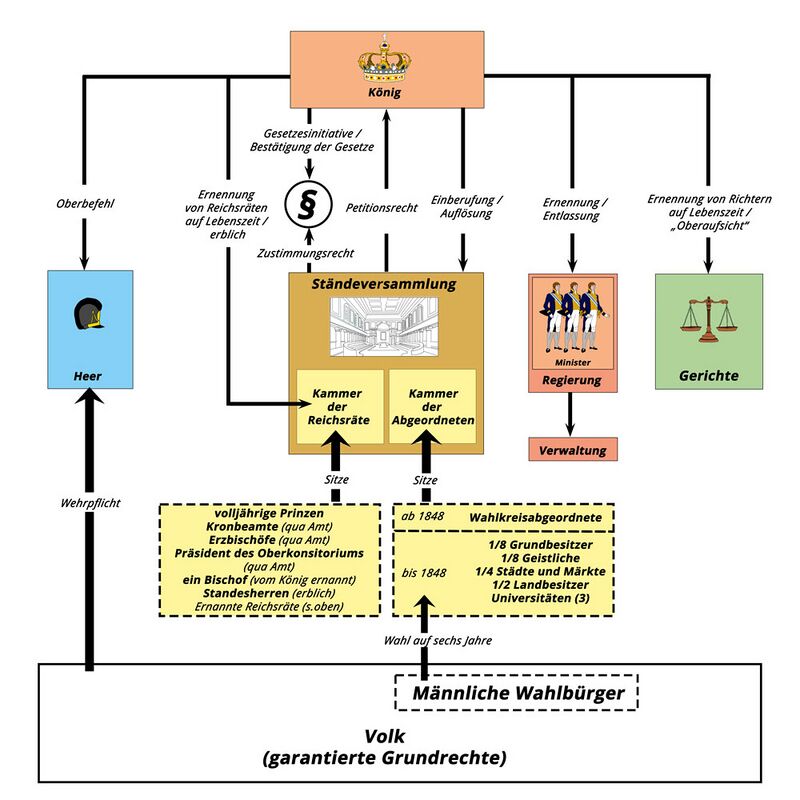 Political System of the Constitution of 1818 (Stefan Schnupp)

Dated 26 May 1818, the Bavarian Constitution was publicly proclaimed on 17 June 1818. It was accompanied by ten edicts, including those on freedom of the press, the rights of the nobility and the Assembly of the Estates. Of particular importance was the second edict, the so-called Religious Edict, which regulated relations between the Bavarian state and the churches, especially the Catholic Church, following the Concordat of 1817. The Religious Edict included, as appendices, the Concordat of 1817 and a Protestant Edict. It was published on 22 June 1818.
| Beilage Nr. | Titel | Inhalt |
|---|---|---|
| I. | Edict on Citizenship. | Determination of who in Bavaria is entitled to enjoy “civil, public and private rights” and what duties are associated with them; in modern terms, this would correspond to a definition of citizenship. |
| II. | Edict on the External Legal Relations of the Kingdom of Bavaria with Regard to Religion and Ecclesiastical Communities. | Reaffirmation of the laws on tolerance and religious parity already in force in Bavaria; establishment of the primacy of the state’s interpretation of ambiguous passages of the Concordat; reintroduction of various state supervisory rights, particularly over the Catholic Church in Bavaria. |
| III. | Edict on the Freedom of the Press and the Book Trade. | Definition of the conditions and limits of freedom of the press. |
| IV. | Edict concerning the Constitutional Status of the Former Imperial Princes, Counts and Lords. | Rights and duties of the formerly immediate imperial princes, counts and lords within the kingdom and in their mediatised territories (including titles, judicial rights, policing, religious and ecclesiastical affairs, lordship over estates and the taxation of the now mediatised nobles). |
| V. | Edict on the Nobility in the Kingdom of Bavaria. | Definition of what is meant by nobility; rights of the nobility in Bavaria; loss of noble status. |
| VI. | Edict on Manorial Rights and Manorial Jurisdiction. | Description of the manorial rights of the nobility and of manorial jurisdiction; policing; school, church and municipal affairs; taxation, etc. |
| VII. | Edict on Family Fideicommissa. | Possibility for members of the nobility to establish family fideicommissa intended to protect a family’s total estate from division; description of a family fideicommissum; conditions for its establishment; associated rights and duties; succession; dissolution of family fideicommissa. |
| VIII. | Edict on the Use of Official Seals. | Definition of those entitled to use a seal in the Kingdom of Bavaria (nobility and senior officials); loss of the right to use a seal. |
| IX. | Edict on the Conditions of Civil Servants, Particularly with Regard to their Status and Salary. | Conditions of appointment to the civil service; salary grades; dismissal from service; disciplinary and other penalties; conditions of retirement; pensions, including those for widows and orphans. |
| X. | Edict on the Assembly of the Estates. | Precise definition of the composition of the two chambers; election of deputies; conditions for convening the Assembly of the Estates and for its sessions; powers; conduct of business; committees; resolutions of the two chambers; dissolution of the Assembly of the Estates. |
Significance, effectiveness and further development of the Constitution
It should be noted that the Bavarian Constitution of 1818 was extraordinarily progressive for its time. It formed part of the development of early constitutionalism in southern Germany, alongside the almost contemporaneous constitutions of the Grand Duchy of Baden (1818), the Kingdom of Württemberg (1819) and the Grand Duchy of Hesse-Darmstadt (1820). By contrast, the two major German powers, Austria and Prussia, did not adopt constitutions until after 1848. It should be borne in mind, however, that in the Palatinate – the part of Bavaria on the left bank of the Rhine, which became part of the kingdom in 1816 – various reforms and achievements dating from the Napoleonic era that went beyond the provisions of 1818 were not revoked by the Bavarian government. As a result, the Palatinate acted as a kind of catalyst in the demand for, and assertion of, greater rights for Bavarian subjects. One need only recall the Hambach Festival of 1832.
It is remarkable that the core of the Bavarian Constitution of 1818 remained in force until the end of the kingdom in 1918. Repeatedly modified and adapted to the circumstances of the time, it survived both the revolutionary events of 1848–1849 and the founding of the German Empire in 1870–1871. The Constitution of 1818 finally transformed Bavaria into a constitutional monarchy. It enshrined the monarchy as the form of government in Bavaria until 1918. Under King Max II (1811–1864, reigned 1848–1864), a series of constitutional amendments were enacted in the wake of the Revolution of 1848. Among other things, these concerned the composition of the Second Chamber of the people’s representation, which from that time onwards was officially referred to as the Bavarian Landtag. The number of eligible voters was significantly increased. However, the indirect and public election of deputies was retained (the secret ballot was introduced in 1881). It is particularly noteworthy that in 1848 the two chambers were also granted the right of legislative initiative. The monarchical principle, the position of the King as the sole source of state sovereignty, and his right to appoint the government independently of parliamentary majorities remained unaffected. Attempts by Max II in the 1850s to return to the pre-1848 provisions failed owing to the composition of the Landtag and the opposition of his ministers.
It was not until 1906 that Bavarian deputies were finally elected by direct vote and that the relative majority system replaced the absolute majority system. These reforms were complemented by the statutory division of electoral districts, also enacted in 1906. From that year onwards, all men over the age of 25 who had paid direct taxes for at least one year and had held Bavarian citizenship for the same period were entitled to vote in elections to the Bavarian Landtag. From then on, Bavaria possessed one of the most progressive state electoral laws within the German Empire.
In the autumn of 1918, the attempt supported by Ludwig III (1845–1921, reigned 1912/1913–1918) to transform Bavaria into a parliamentary monarchy ultimately failed. The aim had been to avert the long-impending revolution. However, the process of constitutional amendment had not yet been completed when Kurt Eisner (1867–1919) proclaimed a republic in Bavaria during the night of 7–8 November 1918. The Constitution of 1818 thereby lost its validity. On 15 September 1919, a new Bavarian constitution, the so-called Bamberg Constitution, came into force; however, the Weimar Constitution, which had already been promulgated on 14 August 1919, largely determined the framework of political life in Bavaria as well.
-
 To underscore the importance of the Constitution, the document was kept in an elaborately decorated chest. The chest and the document it contained were displayed in the plenary chamber during the opening and closing sessions, and at all other times were kept in the Landtagsarchiv (parliamentary archives). (Image archive of the Bayerischer Landtag / Photographer: Rolf Poss) (3D object in bavarikon)
 -
 Commemorative coin marking the proclamation of the constitution, which was issued in 1818. (Staatliche Münzsammlung München, Inv.-Nr. 6-07069, licensed by CC BY-NC-SA 4.0; Foto: Lena Nitzer, 2016)
 -
 Commemorative medal marking the installation of the Gaibach Constitution Column, minted in Munich in 1828. (Staatliche Münzsammlung München, Inv.-Nr. 6-07673, licensed by CC BY-NC-SA 4.0; Foto: Geneva Karr, 2016)
 -
 Commemorative medal by Hans Schwegerle (1882–1950) and Maximilian Dasio (1865–1954) marking the centenary of the Bavarian Constitution, minted in Munich in 1918. (Staatliche Münzsammlung München, Inv.-Nr. M1657, licensed by CC BY-NC-SA 4.0; Foto: Lena Nitzer, 2016)


References
- Karl Otmar von Aretin, Der Sturz des Grafen Montgelas. Ursachen und Wirkungen auf die Außenpolitik und den inneren Staatsaufbau Bayerns, in: Zeitschrift für bayerische Landesgeschichte 20 (1957), 83-135.
- Karl Otmar von Aretin, Bayerns Weg zum souveränen Staat. Landstände und konstitutionelle Monarchie 1714-1818, München 1976.
- Michael Doeberl, Ein Jahrhundert bayerischen Verfassungslebens, München 1918.
- Heinz Gollwitzer, Ludwig I. von Bayern. Königtum im Vormärz. Eine politische Biographie, München 2. Auflage 1987.
- Rudolf M. Kloos (Hg.), Bayerns Weg zum modernen Staat. Ausstellung des Bayerischen Hauptstaatsarchivs München zum 150. Jahrestag der Verfassung des Königreichs Bayern vom 26. Mai 1818, München 1968.
- Hans-Michael Körner, „Bemerkungen über den Entwurf der Verfassung für Baiern“. Das Verfassungsgutachten des Kronprinzen Ludwig von Bayern vom 9. März 1815, in: Zeitschrift für bayerische Landesgeschichte 49 (1986), 421-448.
- Michael Kotulla, Deutsches Verfassungsrecht 1806-1918. Eine Dokumentensammlung nebst Einführungen, Bd. 2: Bayern, Berlin, Heidelberg 2007.
- Andreas Kraus, Die Regierungszeit Ludwigs I. (1825-1848), in: Alois Schmid (Hg.), Handbuch der bayerischen Geschichte, begründet von Max Spindler, Bd. IV: Das Neue Bayern. Von 1800 bis zur Gegenwart, Teilbd. 1: Staat und Politik, München 2. Auflage 2003, 127-234.
- Karl Möckl, Der moderne bayerische Staat. Eine Verfassungsgeschichte vom Aufgeklärten Absolutismus bis zum Ende der Reformepoche (Dokumente zur Geschichte von Staat und Gesellschaft in Bayern III/1) , München 1979.
- Karl Möckl, Reform und „Nation“ Bayern. Von der Konstitution von 1808 zur Verfassung von 1818, in: Alois Schmid (Hg.), Die bayerische Konstitution von 1808. Entstehung, Zielsetzung, europäisches Umfeld, München 2008, 337-357.
- Karl Borromäus Murr, Ludwig I. Königtum der Widersprüche, Regensburg 2012.
- Katharina Weigand, Gaibach. Eine Jubelfeier für die bayerische Verfassung?, in: Alois Schmid / Katharina Weigand (Hgg.), Schauplätze der Geschichte in Bayern, München 2003, 291-308.
- Eberhard Weis, Zur Entstehungsgeschichte der bayerischen Verfassung von 1818. Die Debatten in der Verfassungskommission 1814/15, in: Zeitschrift für bayerische Landesgeschichte 39 (1976), 413-444.
- Eberhard Weis, Die Begründung des modernen bayerischen Staates unter König Max I. (1799-1825), in: Alois Schmid (Hg.), Handbuch der bayerischen Geschichte, begründet von Max Spindler, Bd. IV: Das Neue Bayern. Von 1800 bis zur Gegenwart, Teilbd. 1: Staat und Politik, München 2. Auflage 2003, 3-126.
- Eberhard Weis, Montgelas, Bd. 2: Der Architekt des modernen bayerischen Staates 1799-1838, München 2005.
- Dietmar Willoweit / Steffen Schlinker / Kyrill-Alexander Schwarz, Deutsche Verfassungsgeschichte. Vom Frankenreich bis zur Europäischen Union. Ein Studienbuch, München 9. Auflage 2024.
Sources
- unprinted sources:
- printed sources:
- Bairischen Nationalzeitung: Ausgabe Nr. 123 (27.05.1818) u. Nr. 124 (28.05.1818).
- Rolf Kießling / Anton Schmid (Bearb.), Die bayerische Staatlichkeit ( Dokumente zur Geschichte von Staat und Gesellschaft in Bayern III/2), München 1976.
- Gesetzblatt für das Königreich Bayern, München 1818.
- Alfons Wenzel (Bearb.), Bayerische Verfassungsurkunden. Dokumentation zur bayerischen Verfassungsgeschichte, Stamsried 4. Auflage 2002.
Further research
- Keyword-search in the Online Catalogue of the Bibliotheksverbund Bayern
- Keyword-search in bavarikon
- Keyword-search in the Bavarian Bibliography
External links
- bavarikon: Ausstellung: Die Verfassung des Königreichs Bayern 1818–1918 (bavarikon: Exhibition – The Constitution of the Kingdom of Bavaria 1818–1918)
- Haus der bayerischen Geschichte: Portal Königreich Bayern 1806-1918: Die bayerischen Verfassungen der Jahre 1808 und 1818 (Haus der Bayerischen Geschichte: Portal – Kingdom of Bavaria 1806–1918: The Bavarian Constitutions of 1808 and 1818)
- www.verfassungen.de: Verfassung des Königreiches Bayern vom 26. Mai 1818 (Constitution of the Kingdom of Bavaria of 26 May 1818)
Related articles
- Regierung unter Max I. Joseph
- Konstitution des Königreichs Bayern (1808)
- Verfassung des Freistaates Bayern (1919)
- Verfassung des Freistaats Bayern (1946)
Alternative titles!
Cite
Katharina Weigand, Constitution of the Kingdom of Bavaria (1818), published on 27 January 2025, English version published 19 March 2026; in: Historisches Lexikon Bayerns, URL: <https://www.historisches-lexikon-bayerns.de/Lexikon/EN:Constitution_of_the_Kingdom_of_Bavaria_(1818)> (20.09.2026)