

The Alemannic dialects, which are divided into Swabian and Alemannic in the narrower sense, are spoken in the south-west of the German-speaking region. There is no single feature shared by all Alemannic–Swabian dialects. In Bavarian Swabia, mainly Swabian but also Alemannic dialects are spoken. In the early Middle Ages, the whole of southern Germany shared a largely uniform language. What later came to be known as Swabian or Bavarian arose through more recent developments. Towards the Bavarian language area, the river Lech north of Augsburg forms a clear linguistic boundary, while south of it there is a gradual and fluid transition. The first features of what is generally regarded as Swabian can already be observed in the western suburbs of Munich. Since the second half of the 20th century, the old, organically developed dialects have increasingly been replaced by more regionally widespread forms of speech.
The dialects of the German-speaking south-west are referred to as Alemannic. They are spoken in Switzerland, in Baden and Württemberg, but also in Alsace, Vorarlberg and south-western Bavaria, that is, mainly in what is now the administrative district of Swabia (see map “The German dialects”). This linguistic area is itself divided into two parts: Swabian, centred roughly around Ulm and Alemannic in the narrower sense (where people say “iis” for “Eis” and “huus” for “Haus”), which occupies the southern and western parts of the region (Switzerland, Baden, Alsace and Vorarlberg). In present-day Bavaria, only the south-westernmost corner of Bavarian Swabia, including the West and Upper Allgäu and the Lake Constance area, is Alemannic.
Dialects and dialect boundaries
Among non-specialists, there is a widespread belief that dialects are self-contained units with sharply defined external boundaries. The linguistic reality is quite different. In linguistics, terms such as “Bavarian” or “Swabian” are auxiliary constructs. They are used to group together different local dialects, to allow them to be described on a broader scale and thereby to make them easier to handle. Their names are motivated as much by historical considerations as by linguistic ones.

The transitions between the defined linguistic areas are generally gradual rather than abrupt. They shade into one another through the increasing or decreasing presence of features regarded as characteristic, although such features often apply only to parts of a given area or may extend into neighbouring areas. For example, the “sch” in medial position in words such as “Gascht” and “Fescht” (for “Gast” and “Fest”), which is usually considered a Swabian feature, is also found in western Bavarian dialects (as far as Pasing) and extends across the whole south-west as far as Luxembourg (see the relevant boundary in the map “The German dialects”). In the old local dialects, “Fasching”, often described as a Bavarian keyword, only appears a good distance east of Munich, although from that point onwards it is used all the way to the Hungarian border. The word is therefore not found in all local dialects of what is commonly called “Bavarian”. Above all, it is not a word used in the traditional dialect of the Bavarian capital, Munich.
Hermann Fischer (1851–1920), the creator of the six-volume Schwäbisches Wörterbuch (Swabian Dictionary), which was groundbreaking for its time, spent his life searching in vain for features that were unique to what was described as Swabian and to Swabian alone. This once led him, in frustration, to write that there was no such thing as Swabian. There is even less a single defining feature common to the Swabian–Alemannic dialects of Bavaria, and certainly none for the dialects of the political entity “Bavarian Swabia.”
The naming of the clearly distinguishable dialects in the southern German region was based on the old tribal designations. Research into how the population itself defines and divides these linguistic areas is still in its early stages. Naturally, people are aware of certain dialect features. For instance, speakers from the eastern and upper Allgäu can be recognised by their “Laiter” and “brait” for the words which in High German are pronounced “Leiter” and “breit”, while most Bavarians say “Loata” and “broat” and a large proportion of Swabians say “Loiter” and “broit” (see map 21 in the “Kleiner Bayerischer Sprachatlas”). Forms such as “Hããd” for “Hand” and “Kẽẽd” for “Kind” are likewise known as characteristic of the north of Bavarian Swabia. The names used by local people for their dialects are based on old landscape and settlement names. People say they speak “rieserisch”, “allgäuerisch”, or “augsburgerisch”, but not “mittelschwäbisch”. The dialects spoken between the Ries and the Allgäu have no distinct name of their own. The landscape term “Mittelschwaben” is neither widespread nor old enough to be used in connection with dialect.
The Swabian–Alemannic boundary is recognised throughout the region. People are well aware that in the next village the way of speaking is “quite different”. The border with Württemberg, established at the beginning of the 19th century with the Iller as the boundary river, played no role in the development of the older dialects. Today, however, it is more significant. The R sound articulated at the back of the mouth, which has become established in Württemberg dialects west of the Iller over the past 60 years, now runs roughly along the state boundary.
Towards Bavarian, the border north of Augsburg can be clearly recognised, and its sharp concentration of dialect differences along the Lech makes it relatively well defined. Further south, by contrast, it is more fluid and diffuse, resulting in a slow and gradual transition. It is reported that, in the past, residents of the Munich district of Giesing referred to the people of Pasing as Swabians; the people of Pasing, however, were firmly convinced that they spoke Bavarian and believed that Swabian began further to the west. And so this continued, step by step, all the way to the Lech. Everyone counted, and still counts, themselves as speakers of “Bairisch” and as real Bavarians, while their western neighbours were already regarded as Swabians. West of the river, there was no longer any doubt that Swabian was spoken there and that Swabians lived there. In this context, “Bairisch-speaking” and Bavarian and “Schwäbisch-speaking” and Swabian are entirely interchangeable. This shows very clearly how strongly a language and its classification – that is, the terminological assignment of a linguistic form to a historically defined group of people – can convey identities and be used to define the “tribal” affiliations of individuals and groups. Yet the historical development of the dialects, including the history of settlement in Bavarian Swabia and neighbouring Upper Bavaria, demonstrates that such an equation is not justified.
-
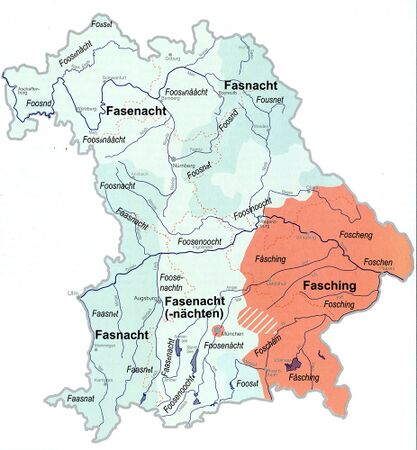 Map: Basic dialectal distribution of “Fase(enacht)” and “Fasching” in Bavaria. (Manfred Renn/Werner König, Kleiner Bayerischer Sprachatlas. Munich, 2nd edition 2006, map 49)
 -
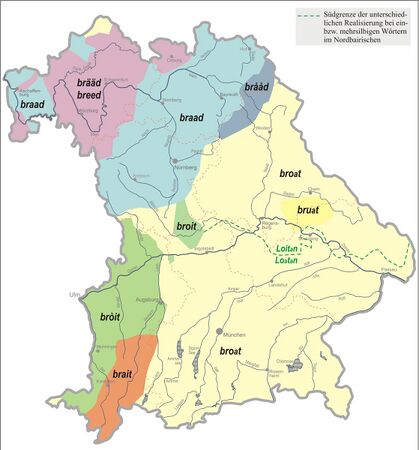 Map: MHG ei in “breit” and “Leiter”. (Manfred Renn/Werner König, Kleiner Bayerischer Sprachatlas. Munich, 2nd edition 2006, map 21)


Historical development
The history of the dialects of south-western Bavaria begins with the immigration of Germanic-speaking populations from the north into the region north of the Danube from around AD 250 and into the region south of the Danube from the end of the 5th century.
These groups of people were referred to as Alemanni at an early date (shortly after 200) and – from 550 onwards – also as Bavarians. They did not migrate as ethnically homogeneous communities in a single act of territorial settlement. Rather, the study of the earliest row graves from the 5th and 6th centuries has shown that there was a continuous, long-lasting movement of immigration by individual families who were not only Alemanni but could also have come from the Franconian-Rhenish north-west – present-day Thuringia or Bohemia. A pre-existing Romance, and possibly still Celtic, population was also overlaid by these newcomers. According to archaeological evidence, the right bank of the Lech north of Augsburg (the southern section has not yet been examined in this respect) was not settled until the mid-7th century and this settlement came from the left, Alemannic, side of the Lech.
The language of the Alemanni and the Bavarians only becomes tangible in the 8th century, with the emergence of German as a written language. There are virtually no differences between the earliest Old High German in the Alemannic and Bavarian regions. It can be assumed that the uniform written form of Old High German in the areas inhabited by the Alemanni and the Bavarians in the 8th and 9th centuries also largely reflects a uniformity in regional spoken usage. This uniformity was probably the result of linguistic levelling processes brought about by the mixing of different population groups within the incoming settlers. This kind of standardisation can be compared with developments that took place, for example, in the 18th century in the German settlement areas of the Balkans in the Habsburg Empire, where the dialects of immigrants from diverse backgrounds blended and, within a few generations, merged into a single village dialect.
Today’s differences in the dialects of southern Bavaria are therefore the result of developments that took place from the 8th and 9th centuries onwards, not a reflection of earlier tribal differences, as was once assumed. This divergence can already be observed in certain spellings from the 12th century. By the 14th and 15th centuries the written languages were strongly shaped by regional usage and primarily reflected dialectal developments spread over large areas. Truly local features are scarcely found in the spellings today.

The early medieval linguistic innovations came primarily from the north. Language follows power. At that time, the south was dominated by ruling dynasties from the north (the Merovingians, the Carolingians and the Saxon emperors). Over the course of the High Middle Ages, the centre of power shifted to the German south. As a consequence, the south was also able to assert itself linguistically and even to export its language. This culminated in the Low German north adopting, from around 1500 onwards, the written language that had developed in the south and centre – known then, and still today, as High German – and abandoning its old, traditional Low German written language. In the south, it was the south-east, with the imperial court in Vienna, that subsequently played the dominant role in linguistic development.
Linguistic geography
This fact is also reflected in the linguistic geography of the Alemannic–Swabian region in Bavaria (see map “Dialects and linguistic boundaries in Bavarian Swabia”). It is shaped by major contrasts between east and west, but also by loosely aligned linguistic boundaries between north and south. Taken together, these are so pronounced that an inhabitant of the Ries and someone from the southern Allgäu may find it difficult to communicate with one another in their traditional local dialects. In the medieval and early modern centuries, when the linguistic unity of the 8th and 9th centuries was breaking apart, the area of present-day Bavarian Swabia, lacking its own political power centre, was more a passive recipient of linguistic influences than an active generator of new ones.

The present course of the language boundaries still shows that developments coming from the east and from the north-west were particularly influential (see map “Schematic language boundaries in Bavarian Swabia”). The east–west orientation of most of the boundaries, which north of Augsburg usually ended at the Lech, indicates that linguistic innovations came chiefly from the east. South of Augsburg, these innovations often did not reach the Lech. The Ammersee and Lake Starnberg, together with the extensive moorlands in the area, formed obstacles to movement. In their “shadow”, a zone developed in the Lechrain region that displays a relatively conservative dialect characterised by many distinctive, local developments. This dialect did not adopt the newer features and was able to survive in part because it was supported from the south, by linguistically conservative Tyrol. The intensive transport links that Augsburg maintained with Italy through Tyrolean intermediaries, such as carters, also helped preserve the older forms. Far fewer linguistic developments came from the west, and here again chiefly from the north-west, into the areas between the Iller and the Lech.
Internal structure

A method based on the inclusion of much larger amounts of material, going beyond the previously intuitive selection of boundary-forming linguistic features, has been developed for most of Bavarian Swabia as part of a follow-up project to the “Sprachatlas von Bayerisch-Schwaben”. Using a formally transparent procedure, mathematical methods (factor analysis) were applied to compare 2,155 linguistic maps containing approximately 600,000 individual attestations, in order to determine the locations at which the forms appearing on the maps coincide. Where there was a high degree of agreement, the colouring and its intensity indicate the proportion of identical forms. This produces a picture that highlights areas with a comparatively uniform dialect. It is noteworthy that the dialects of the Lechrain have more in common with the dialects west of the Lech, the Swabian dialects, than with the Old Bavarian dialects to the east.
The Lech as a language border
One of the most clearly marked borders in the German-speaking world lies along the Lech north of Augsburg. For roughly a thousand years, the Lech formed the relatively stable western frontier of the Duchy and later Electorate of Bavaria, facing to the west a territory that, over time, fragmented increasingly into smaller dominions. For Untermühlhausen, it has been shown for the period from 1671 to 1721 that the Swabian “foreign land” to the left of the Lech played virtually no role in the village’s external relations, whether in economic matters, family ties (such as marriage), or administration. In the 50 years examined, there were no marriage connections across the Lech at all. The same is true of marriage patterns in the villages of Herbertshofen and Thierhaupten, which are separated by the Lech, for the period after 1778. In the first half of the 20th century, people did not even go to a market on the other side of the Lech. The political authorities wished to keep capital and people within their own territories and therefore promoted infrastructures that were oriented toward centres inside those territories.
In the case of the Lech, there was also the fact that, as a mountain river, it was bordered by a wide gravelly strip of wasteland with alluvial woodland and had a broad, constantly shifting riverbed. From Landsberg northwards it was accompanied by an even wider belt of almost barren heathland, where there were virtually no villages and which was used, at best, only extensively for grazing. These geographical conditions meant that the Lech was more of an obstacle to movement than other rivers.
As a boundary to movement, the Lech also became a linguistic boundary over time. In contrast, the Danube, for example, does not function as a linguistic boundary in this region.
Looking ahead
The results of the surveys, as shown in the maps of the existing language atlases, represent the end point of a previously quite continuous development of the dialects. This development was shaped above all by the mutual influence of geographically neighbouring language varieties, and less by the influence of more prestigious spoken and written forms. Since the second half of the 20th century, regional languages have been developing rapidly towards the standard language and have become increasingly levelled in the process. In some cases, especially among young people in the large cities, they have even been abandoned altogether in an abrupt shift towards an all-pervasive standard, promoted by the media and oriented towards Northern German.
State of research
The dialects of Bavarian Swabia are, compared with those of other regions, very well researched and documented. For historians, Hermann Fischer’s six-volume Schwäbisches Wörterbuch (Swabian Dictionary), which not only records the dialects of the 19th and 20th centuries but also provides a wealth of historical evidence and historical vocabulary, is particularly important. The same can be said of Johann Andreas Schmeller's (1785–1852) Bayerisches Wörterbuch (Bavarian Dictionary), which likewise contains a substantial amount of material from Bavarian Swabia. A relatively new research project, published digitally and based at the Bavarian Academy of Sciences and Humanities, is devoted to describing vocabulary, including in multimedia formats and with extensive cross-linking. It builds on the dictionary by Brigitte Schwarz and appears under the name DIBS, Dialektales Informationssystem von Bayerisch-Schwaben (https://dibs.badw.de/das-projekt.html). It forms part of the portal Bayerns Dialekte Online (BDO, https://bdo.badw.de/). The linguistic–geographical situation of the older dialects, as they could still be found around 1985, is documented in the 14-volume Sprachatlas von Bayerisch-Schwaben, which contains around 2,700 maps. The Kleiner Sprachatlas von Bayerisch-Schwaben and the Kleiner Bayerischer Sprachatlas, with 121 maps, offer a popular selection of important maps (180 in total) accompanied by historical commentaries. The more recent developments mentioned in the outlook are documented by Manfred Renn (born 1948) for the Augsburg area (1994) and by the Atlas zur deutschen Alltagssprache (see below under Links).
References
- Volker Babuke, Nach Osten bis an den Lech. Zur alemannischen Besiedlung der westlichen Raetia Secunda, in: Karlheinz Fuchs/Dieter Planck/Barbara Theune-Großkopf (Hg.), Die Alamannen. Begleitband zur Ausstellung "Die Alamannen", 14. Juni 1997 bis 14. September 1997 SüdwestLB-Forum Stuttgart, Stuttgart 1997, 249-260.
- Rolf Bergmann/Ursula Götz, Altbairisch = Altalemannisch? Zur Auswertung der ältesten Glossenüberlieferung, in: Peter Ernst (Hg.), Deutsche Sprache in Raum und Zeit. Festschrift für Peter Wiesinger zum 60. Geburtstag, Wien 1998, 445-461.
- Rudolf Freudenberg, Der alemannisch-bairische Grenzbereich in Diachronie und Synchronie. Studien zur oberdeutschen Sprachgeographie (Deutsche Dialektgeographie 72), Marburg 1974.
- Pankraz Fried, Zur Entstehung und frühen Geschichte der alamannisch-bairischen Stammesgrenze am Lech, in: Ders. (Hg.), Bayerisch-schwäbische Landesgeschichte an der Universität Augsburg 1975-1977. Vorträge, Aufsätze, Berichte, Sigmaringen 1979, 47-67.
- Dieter Geuenich/Hagen Keller, Alamannen, Alamannien, Alamannisch im frühen Mittelalter. Möglichkeiten und Schwierigkeiten des Historikers beim Versuch der Eingrenzung, in: Herwig Wolfram (Hg.), Die Bayern und ihre Nachbarn. Berichte des Symposions der Kommission für Frühmittelalterforschung, 25. bis 28. Oktober 1982, Stift Zwettl, Niederösterreich. 1. Band (Veröffentlichungen der Kommission für Frühmittelalterforschung 8), Wien 1985, 135-155.
- Dieter Geuenich, Geschichte der Alemannen, Stuttgart 2. Auflage 2005.
- Dieter Geuenich, Zur Kontinuität und zu den Grenzen des Alemannischen im Frühmittelalter, in: Pankraz Fried (Hg.) Die historische Landschaft zwischen Lech und Vogesen. Forschungen und Fragen zur gesamtalemannischen Geschichte (Veröffentlichungen der Schwäbischen Forschungsgemeinschaft 1/17 = Veröffentlichungen des Alemannischen Instituts 59), Augsburg 1988, 115-136.
- Ernst Walter Ibrom, Lauttopographie der schwäbisch-bairischen Dialekte beiderseits des unteren Lech, Augsburg 1970.
- Werner König, Der nördliche Lech als Sprachgrenze, in: Der nördliche Lech. Lebensraum zwischen Augsburg und Donau, Augsburg 2001, 45-54.
- Werner König, dtv-Atlas Deutsche Sprache. Tafeln und Texte. Mit 138 farbigen Abbildungsseiten, München 1. Auflage 1978, 16. Auflage 2007.
- Werner König, Großmundarträume und Dialektgrenzen, in: Hans Frei/Pankraz Fried/Rolf Kießling (Hg.), Historischer Atlas von Bayerisch-Schwaben, Augsburg 2. neu bearbeitete und ergänzte Auflage im Auftrag der Schwäbischen Forschungsgemeinschaft 1982ff., Karte III,1.
- Werner König/Manfred Renn, Kleiner Sprachatlas von Bayerisch-Schwaben (Materialien zur Geschichte des Bayerischen Schwaben 30), Augsburg 2. Auflage 2007.
- Ferdinand Kramer, Außenbeziehungen und Einzugsgebiet eines Dorfes in der frühen Neuzeit, in: Peter Fassl (Hg.), Aus Schwaben und Altbayern. Festschrift für Pankraz Fried zum 60. Geburtstag (Veröffentlichungen der Schwäbischen Forschungsgemeinschaft 7/5), Sigmaringen 1991, 133-155.
- Eduard Nübling, Der Lechrain als sprachliche Saumlandschaft zwischen den süddeutschen Großmundarten Bairisch und Schwäbisch-Alemannisch, in: Pankraz Fried (Hg.), Forschungen zur schwäbischen Geschichte mit Berichten aus der landesgeschichtlichen Forschung in Augsburg (Veröffentlichungen der Schwäbischen Forschungsgemeinschaft bei der Kommission für Bayerische Landesgeschichte 7/4), Sigmaringen 1991, 235-315.
- Ingo Reiffenstein, Mundarten und Hochsprache, in: Max Spindler (Hg.), Handbuch der Bayerischen Geschichte. 4. Band, München 1. Auflage 1975, 708-731.
- Manfred Renn, Die Mundart im Raum Augsburg. Untersuchungen zum Dialekt und zum Dialektwandel im Spannungsfeld großstädtisch-ländlicher und alemannisch-bairischer Gegensätze (Sprache - Literatur und Geschichte 9), Heidelberg 1994.
- Manfred Renn/Werner König, Kleiner Bayerischer Sprachatlas. München 2. Auflage 2006.
- Stefan Sonderegger, Althochdeutsche Sprache und Literatur. Eine Einführung in das älteste Deutsch. Darstellung und Grammatik, Berlin/New York 3. Auflage 2003.
- Bernhard Stör, Die mundartlichen Verhältnisse in der Region München. 2 Bände (Europäische Hochschulschriften 1/1715), Frankfurt am Main 1999.
- Bernhard Stör, Mit der Trambahn ins Schwäbisch-Alemannische. Ostschwäbische Lautformen in der westlichen Region München, in Edith Funk u. a. (Hg.), Bausteine zur Sprachgeschichte, Heidelberg 2000, 289-320.
- Marcus Carl Trier, Die frühmittelalterliche Besiedlung des unteren und mittleren Lechtales nach archäologischen Quellen, Trier 1990.
- Theo Vennemann, Der Ursprung der Baiern in sprachwissenschaftlicher Sicht, in: Jahresbericht über das Jahr 1988 (Jahresberichte der Stiftung Aventinum 3), Abensberg 1989, 5-27.
Sources
- Ludwig M. Eichinger (Hg.), Sprachatlas von Oberbayern, Heidelberg 2005ff. (noch nicht abgeschlossen)
- Hermann Fischer, Geographie der schwäbischen Mundart, Tübingen 1895.
- Hermann Fischer (Bearb.), Schwäbisches Wörterbuch, auf Grund der von Adelbert v. Keller begonnenen Sammlungen... 6 Bände, 1904-1936.
- Kommission für Mundartforschung (Hg.), Bayerisches Wörterbuch, München 1995ff.
- Werner König, Bibliographie zur Mundartforschung in Bayerisch-Schwaben, in: Rolf Bergmann u. a., Bibliographie zur Namenforschung, Mundartforschung und historischen Sprachwissenschaft Bayerisch-Schwabens (Schriften der Philosophischen Fachbereiche der Universität Augsburg 13), München 1978.
- Werner König (Hg.), Sprachatlas von Bayerisch-Schwaben. 13 Bände, Heidelberg 1997-2006 (Registerband 2008).
Further Research
External links
- Atlas zur deutschen Alltagssprache (AdA) (Atlas of German Everyday Language)
- bavarikon: Schmeller, Johann Andreas: Bayerisches Wörterbuch (BLO: Schmeller, Johann Andreas: Bavarian Dictionary)
- BayDat - Die bayerische Dialektdatenbank (The Bavarian Dialect Database)
- Bayerische Akademie der Wissenschaften: Bayerisches Wörterbuch (Bavarian Academy of Sciences and Humanities: Bavarian dictionary)
- Dialekte und regionale Kultur: Sprechender Sprachatlas von Bayern (Talking Linguistic Atlas of Bavaria)
Related articles
Alternative titles!
Cite
Werner König, Alemannic–Swabian Dialects in Bavaria, published 06 December 2010, English version published 27 March 2026; in: Historisches Lexikon Bayerns, URL: <https://www.historisches-lexikon-bayerns.de/Lexikon/EN:Alemannic-Swabian_Dialects_in_Bavaria> (26.09.2026)