


In 1810, a horse race was held in honour of the marriage of Crown Prince Ludwig of Bavaria (1786–1868) to Princess Therese of Saxe-Hildburghausen (1792–1854). Since then, the Oktoberfest has been held here at Theresienwiese every year for around two weeks. Since 1819, its organisation has been the responsibility of the City of Munich. At times, the Bavarian Farmers’ Association’s agricultural festival is held alongside it. The Oktoberfest has enjoyed great international renown, especially since the 1950s. Despite a bomb attack in 1980 and increased terror warnings after 11 September 2001, visitor numbers have remained consistently high.
Wedding of the Crown Prince, 1810
The origins of the Oktoberfest lie in a horse race organised by the Munich civic militia on 17 October 1810 in honour of the wedding of the Bavarian Crown Prince Ludwig (1786–1868, King from 1825 to 1848) and Princess Therese von Saxe-Hildburghausen (1792–1854).
-
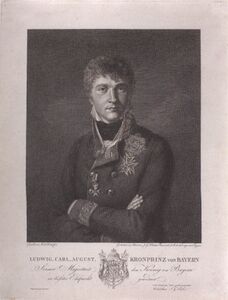 Johann Georg Raber (1764-1830 ) after Moritz Kellerhoven (1758-1830), Ludwig Carl August, Crown Prince of Bavaria, c. 1810. Copper engraving, 38 × 28.6 cm. (Münchner Stadtmuseum - Munich City Museum, G-MII/523)
 -
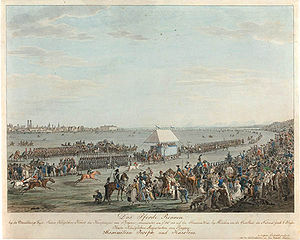 Peter Heß, “The Horse Race at the Wedding Celebration of His Royal Highness the Crown Prince of Bavaria, organised on 17 October 1810 on the Theresienwiese near Munich by the Cavalry of the 34th Class of the National Guard. Dedicated in deepest reverence to Their Royal Majesties of Bavaria, Maximilian Joseph and Karoline, by the participants in the October festivities.” 1810, coloured outline engraving. (Münchner Stadtmuseum - Munich City Museum, G-IIIc/8)
 -
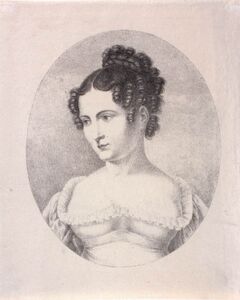 Princess Therese Charlotte Louise of Saxe-Hildburghausen (1792–1854, Queen 1825–1848). The bride of the Bavarian Crown Prince Ludwig (1786–1868, King 1825–1848) gave her name to the “Theresienwiese”, where the Munich Oktoberfest has been held since 1810. Lithograph, c. 1810, 32 × 26 cm. (Münchner Stadtmuseum - Munich City Museum, G-MII/582)


Due to the great enthusiasm of those involved, Major Andreas von Dall'Armi (1765–1842) of the civic guard submitted a request to the royal household only a few days after the horse race, asking for the festival to be repeated. King Max I Joseph (1756–1825, Elector from 1799, King from 1806) approved the request in 1811, and the festival has been held ever since. Until the end of the Bavarian monarchy in 1918, the festival took place with the participation of the royal family. In the now bourgeois metropolis, the folk festival developed from 1921 onwards into an important event for the economy and tourism, and it has enjoyed international attention since the 1950s. The poster advertising that began at that time expanded to the United States in the 1960s, after American soldiers in the post-war period had become known as enthusiastic visitors to the festival. Since the 2000s, digital media have taken over the worldwide promotion of the festival. The world’s largest folk festival has gained further significance through globalisation. As a local event, however, it continues to hold a special place in public esteem. In its 200-year history, the Oktoberfest has been cancelled 24 times due to wars or epidemics.
The Bavarian national festival

The elevation of Bavaria to a kingdom in 1806 was accompanied by a significant consolidation and expansion of Bavarian territory. Large parts of Franconia and Swabia were incorporated into the new kingdom through secularisation and mediatisation. In these newly acquired regions in particular, loyalty to the Wittelsbach royal house could not be taken for granted. From 1810 onwards, the Oktoberfest provided a means by which the idea of Bavarian unity could be dynastically reinforced and promoted throughout the kingdom. The national enthusiasm was so great that, at the suggestion of the civic militia, the festival grounds were named the “Theresienwiese” after the Crown Princess. For the people of Munich, however, the name soon proved too long, and by the 1890s at the latest they referred to it simply as the “Wiesn”. In 1913, the Bavarian national festival was held for the last time under monarchical patronage. On 1 August 1914, the German Reich declared war on Russia, and no Oktoberfest was held until the end of the war. In 1919 and 1920, only small “autumn festivals” were organised, and it was not until 1921 that the Oktoberfest was celebrated again.
The Central Agricultural Festival
From 1811 to 1818, the Agricultural Association in Bavaria took charge of organising the Oktoberfest and added to it a horse race and a cattle market, the so-called “Zentral-Landwirtschaftsfest” (ZLF) (Central Agricultural Festival). The state treasury and the citizens of Munich provided financial support. The “livestock exhibition with market” was intended to acknowledge the economic importance of agriculture in Bavaria and to stimulate an upswing in the Bavarian economy. In the second half of the 19th century, the ZLF lost much of its significance. After a break from 1914 to 1925, it was held again only in 1927 and 1933 by the Landesbauernkammer. Since 1949, the Bavarian Farmers’ Association (BBV) has organised the ZLF – initially every two years, then, due to the declining importance of agriculture in Bavaria, every three years from 1975, and every four years since 1996.
The role of the City of Munich

Since 1819, after Munich obtained municipal self-government under the Municipal Edict of 1818, the city has been responsible for organising and financing the festival. From 1824 onwards it secured the Theresienwiese as the festival site by purchasing private plots of land there. The city also issues licences to beer-tent proprietors and fairground operators. After the end of the monarchy in 1918, the festival developed in a way that more clearly reflected Munich’s own character and circumstances. In 1930 the city administration initiated a redesign of the festival grounds, which had included open areas since the removal of the royal tent. The site was reorganised into one street for the beer tents and another for the fairground operators. After the longest enforced break, during the Second World War (1939–1945), the Munich City Council played a key role in reviving the festival and promoting its distinctly Bavarian character. Over the decades, the Oktoberfest has gained international renown and has become a defining symbol of Munich. The Lord Mayor of Munich plays a central role in this: since 1950, he has officially opened the festival at 12 noon on the first Saturday by tapping the first beer barrel in the Schottenhamel tent; since 1952, he has taken part in the procession of the Oktoberfest tent hosts and brewers, and he rides in his own carriage in the traditional costume and marksmen’s parade.
The festival programme
Alongside the ZLF, horse racing and shooting competitions formed part of the annual festival programme in the 19th century. By around 1825 the Oktoberfest had developed a programme that remained largely unchanged until 1913. On the main festival Sunday, cannon fire at 2 pm signalled the royal family’s departure from the Residenz. After their arrival, the prize-winning animals and products were inspected, and the royal family then took their seats in the royal tent. This was followed by a parade of the prize-winners in front of the tent and the presentation of the awards. The horse race began next, once again starting from the same spot. After the racing prizes had been distributed, the royal family returned to the city at 5 pm. From 1818 to 1875 a “Nachrennen” (second race) was also held on the festival’s second Sunday. From 1913 onwards no further horse races took place on the Theresienwiese, as the grounds no longer met the requirements of a racecourse. In 1934 the horse enthusiast and Nazi city councillor Christian Weber (NSDAP, 1883–1945) had a new racecourse built in the southern part of the Theresienwiese, and races were again held there until 1938.
-
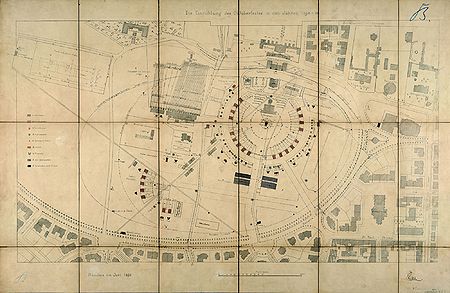 Plan of the Oktoberfest grounds, 1898. (Stadtarchiv München – Munich City Archives, DE-1992-OKT-0090-001)
 -
 Site plan of the Oktoberfest, 1929. (Münchner Stadtmuseum - Munich City Museum, G-2010/7)


The “Königlich privilegierte Hauptschützengesellschaft” (Royal Privileged Shooting Society) has organised an Oktoberfest shooting competition on the Theresienwiese since 1816. From then on, marksmen gathered in front of the Town Hall at 10 am on the Monday after the main festival Sunday and marched to the shooting ranges on the festival grounds. The competitions ran throughout the week, and the winners were awarded prize flags and cash prizes at 3 pm on the second Sunday. The first “Zimmerstutzen” shooting competition, held in 1896, developed into the “Oktoberfest-Landesschießen” state shooting competition, which continues to take place today.
In the years between the wars there was no fixed festival programme. It was only with the first official post-war Oktoberfest in 1949 that the core elements of the festival became firmly established: the entry procession of the Wiesn hosts, the tapping of the first keg, the (international) traditional costume and marksmen’s parade, the ZLF, and the state shooting competition. These features have remained unchanged ever since.
Duration and timing of the festival
The official one-week programme was informally extended by the festival hosts into the preceding week, with the authorities’ tacit approval. By 1829 it was already established that the festivities on the Theresienwiese lasted for 14 days. In the 1890s the festival was brought forward several times in order to take advantage of the more favourable September weather. From 1905 onwards the main festival Sunday was set on the last Sunday in September, while the festival itself began a week earlier on the preceding Saturday at 12 noon, initially without any opening ceremony. Since then, the Oktoberfest has generally lasted 16 days.
Catering
In the early years, visitors could drink their beer oudoors and not inside a beer-tent. From the 1820s onwards the wooden stalls were enlarged, providing indoor seating for festival-goers. The provision of food, drink and entertainment for visitors quickly grew in importance.
In 1825, the city magistrate issued a regulation permitting only 18 Munich beer hosts to operate at the festival. The fairground was characterised by the circular arrangement of these 18 timber-built beer stalls, known as the “Wirtsbudenring”. In 1895, the larger breweries began to construct temporary beer halls accommodating around 1,500 visitors. In 1907, the small stalls of the Wirtsbudenring were replaced by six large festival halls built by Munich’s major breweries. These festival halls have since become defining landmarks of the Oktoberfest. It was no coincidence that in 1898 the well-known toast arose, still heard in every beer tent today: “Ein Prosit, ein Prosit der Gemütlichkeit! Oans – zwoa – drei – gsuffa!” It was during this period that the Oktoberfest firmly established its image as a beer festival.
After the First World War, only nine large Munich breweries were licensed to supply the Oktoberfest: Löwenbräu, Spatenbräu, Thomasbräu, Pschorrbräu, Hackerbräu, Paulanerbräu, Augustinerbräu, Wagnerbräu and Franziskaner-Leistbräu. In 1952 the state-owned Hofbräu brewery was added, and since then the city has also concluded supply contracts with Augustinerbrauerei, Hacker-Pschorrbräu, Löwenbräu, Paulanerbräu and Spatenbrauerei. For this quintessential festival of Munich beer, the City of Munich allows only these major Munich breweries to supply their brew. The architecture of the fourteen large festival halls has changed only slightly since the 1960s; each provides indoor seating for between 1,900 and 8,450 guests.
-
 Advertisement from an issue of the Oktoberfest newspaper. (Plakatsammlung Münchner Stadtmuseum - poster collection of the Munich City Museum)
 -
 Interior of the Augustiner tent, 1930. Over time, the traditional beer hall-style seating was replaced by the beer bench seating used today. (Augustiner Bräu Wagner KG)


Fairground attractions

The Travelling Trades Regulation of 1871 and the expanding railway network were important factors in the flourishing of the fairground trade. They made it possible, for example, for the showman Carl Hagenbeck (1844–1913) of Hamburg to present his “Nubian Caravan” of around 30 people at the Oktoberfest in 1879. This first major “Völkerschau” (ethnological exposition) marked the beginning of a series of such attractions that shaped the fairground area until the 1930s. Around 1900, the fairground was dominated by a thriving carousel industry. Michael August Schichtl (1851–1911) added a distinctly local flavour with a performance style aimed particularly at the people of Munich and the surrounding Bavarian region. In the period between the two world wars, the fairground trade at the Oktoberfest maintained a remarkable presence and significance, despite the difficult economic conditions, with its large-scale “Völkerschau” (ethnological exposition) and the imposing wooden constructions of the mountain railways.
Since the post-war period, the large crowds at the Oktoberfest have provided the financial basis for innovative investments by fairground operators. In 1951 pneumatics were used for the first time to control rides, making completely new forms of motion possible. Traditional attractions such as the Toboggan, the Krinoline, the Devil’s Wheel and the Witch’s Swing are characteristic features of the Wiesn, and their preservation forms part of the City of Munich’s festival policy.
The Oktoberfest bombing
On the evening of 26 September 1980, the 21-year-old right-wing extremist Gundolf Köhler (1959–1980) carried out a bomb attack at the main entrance to the festival grounds on the Bavariaring. Twelve people were killed, in addition to the attacker, and 215 others were injured, some of them severely. That same night, Lord Mayor Erich Kiesl (CSU, 1930–2013; Lord Mayor 1978–1984) decided that, despite the devastating event, the Oktoberfest would not be cancelled. Instead, a permanent day of mourning was to be established. Whether Köhler acted alone has repeatedly been called into question and remains unresolved to this day. One year after the attack, a memorial to the victims, designed by Friedrich Koller, was unveiled at the main entrance to the Theresienwiese, and in 2008 the area surrounding the memorial was redesigned.
Cancellations of the Oktoberfest
In its history, the Munich Oktoberfest has been cancelled several times since 1810, mainly because of wars and epidemics. Although Oktoberfest-like events were held on the Theresienwiese after both the First and the Second World War, their scale in 1919 and 1920, and again from 1945 to 1947, was hardly comparable with that of the festivals held in times of peace. The Oktoberfest had to be cancelled in the following years:
- 1813: Napoleonic Wars (Wars of Liberation)
- 1854: Cholera epidemic (around 3,000 deaths in Munich)
- 1866: Austro-Prussian War (the so-called German War)
- 1870: Franco-Prussian War
- 1873: Cholera epidemic
- 1914–1918: First World War
- 1923–1924: Hyperinflation
- 1939–1945: Second World War
- 2020–2021: COVID-19 pandemic
Visitor numbers and beer consumption
Beer consumption at the Oktoberfest has risen steadily since 1950. In 1950, around 1.5 million litres of beer were drunk; by 1960 this had risen to 2.9 million litres, to four million litres in 1970, and to five million litres in 1980. Visitor numbers during this period were consistently estimated at between five and six million. Since 1990, attendance has been around 6.5 million, while beer consumption has risen from 5.4 to 6.6 million litres.
Looking ahead
While the elements of the festival have changed little since the mid-20th century, its dynamism towards the end of the century lay in the rejuvenation of its audience. To mark the 200th anniversary of the Oktoberfest, an additional area was created for a historical version of the Wiesn, featuring horse races, historic fairground rides, a museum tent, a small performing-arts tent and a festival tent with a dance floor. With 500,000 paying visitors, it proved so successful that the city council decided to continue the concept annually under the name “Oide Wiesn”, except in the years when the ZLF takes place.
Traditional costume increasingly became a fashion trend. Even at the beginning of the 21st century, most visitors still came from Munich and the surrounding region. Globalisation has by no means made the world’s largest folk festival obsolete; the beer tents are frequently closed due to overcrowding. In 2011 around six million visitors spent approximately €1.1 billion at the Oktoberfest and in the city of Munich during the festival period, of which about €340 million was spent on the festival grounds themselves.
| Year | Price | Remarks | |
|---|---|---|---|
| from | to | ||
| 1810 | 3 Kreuzer 3 Pfennige | ||
| 1830 | 6 kr. | 1823: 1 loaf of rye bread, 2 kr. 1 dl. (Fürstenfeldbruck) | |
| 1840 | 12 kr. | ||
| 1890 | 24 kr. | ||
| 1900 | 35 kr. | ||
| 1910 | 38 kr. | 1910: 1 pound of rye bread, 0.17 marks (Munich) | |
| 1920 | 2,50 RM | 1920: 1 pound of rye bread, 0.60 mark (officially fixed maximum price, Fürstenfeldbruck) | |
| 1922 | 50 RM | ||
| 1925 | 1 RM | ||
| 1931 | 1,10 RM | ||
| 1949 | 1,70 DM | ||
| 1959 | 1,90 DM | ||
| 1968 | 2,40 DM | ||
| 1970 | 2,65 DM | ||
| 1975 | 3,50 DM | 3,75 DM | |
| 1980 | 4,80 DM | 4,90 DM | |
| 1985 | 5,90 DM | 6,30 DM | |
| 1990 | 6,95 DM | 7,55 DM | |
| 1995 | 9,50 DM | 10,40 DM | |
| 2000 | 11,20 DM | 12,60 DM | |
| 2002 | 6,30 € | 6,80 € | |
| 2005 | 6,80 € | 7,25 € | |
| 2010 | 8,30 € | 8,90 € | |
| 2015 | 10,10 € | 10,40 € | |
| 2018 | 10,70 € | 11,50 € | |
| 2024 | 13,60 € | 15,30 € |
Figures according to: Development of the price of beer (festival beer) at the Oktoberfest in Munich from 1971 to 2018 (in €, until 2001 in DM). In Statista – The Statistics Portal. nowiki>https://de.statista.com/statistik/daten/studie/272209/umfrage/bierpreisentwicklung-auf-dem-oktoberfest-in-muenchen/</nowiki>. (accessed 16 January 2025), by Toni Drexler, Historical Values File: Prices, Wages, Yields for the region of western Upper Bavaria and Swabia east of the Lech – Version 1.02, status December 2007 (accessed 18 September 2018) (http://www.blf-online.de/historische-werte-datei-preise-loehne-ertraege) (accessed: 18.09.2018).
References
- Richard Bauer/Fritz Fenzl, 175 Jahre Oktoberfest, 1810-1985, hg. von der Landeshauptstadt München, München 1985.
- Amadeus Danesitz, Festhalle Schottenhamel. 150 Jahre Oktoberfest-Geschichte, Stuttgart 2017.
- Florian Dering/Ursula Eymold, Das Oktoberfest 1810-2010, München 2010.
- Florian Dering (Hg.), Das Oktoberfest. Einhundertfünfundsiebzig Jahre bayerischer National-Rausch, Katalog zur Ausstellung im Münchner Stadtmuseum vom 25. Juli bis 3. November 1985, München 1985.
- Ernst von Destouches, Säkular-Chronik des Münchener Oktoberfestes 1810-1910, hg. von der Landeshauptstadt München, München 1910.
- Anne Dreesbach/Michael Kamp, 195 Jahre Oktoberfest. Ein historischer Streifzug, München 2005
- Simone Egger, Phänomen Wiesntracht. Identitätspraxen einer urbanen Gesellschaft. Dirndl und Lederhosen, München und das Oktoberfest (Münchner ethnographische Schriften 2), München 2008.
- Elfi M. Haller/Hermann-Joseph Busley/Christine Pressler, Festzug zur Feier der Jubelehe des Königs Ludwig und der Königin Therese zu München am 4. Oktober 1835, München 1983.
- Gerda Möhler, Das Münchner Oktoberfest. Brauchformen des Volksfestes zwischen Aufklärung und Gegenwart (Miscellanea Bavarica Monacensia 100), München 1980.
- Gerda Möhler, Das Münchner Oktoberfest. Vom bayerischen Landwirtschaftsfest zum größten Volksfest der Welt. München 1981.
- Sybille Spiegel, Das Herbstfest 1946 im Trümmermünchen. Kein Oktoberfest aber eine richtige Wies'n, in: Friedrich Prinz (Hg.), Trümmerzeit in München. Kultur und Gesellschaft einer deutschen Großstadt im Aufbruch 1945-1949, München 1984, 339-344.
- Brigitte Veiz, Das Oktoberfest - Masse, Rausch und Ritual: Sozialpsychologische Betrachtungen eines Phänomens, Gießen 2006.
- Elmar Walter, Musik auf dem Münchener Oktoberfest. Ein Beitrag zum Jubiläum "200 Jahre Oktoberfest", in: Volksmusik in Bayern 27 (2010), 49-51.
Sources
- Hanns Vogel, Oktoberfest München 1949. Offizielle Festschrift. Zusammengestellt von Hanns Vogel. Fest-Beiträge: Hans Fitz, Adolf Gondrell, Alois Hahn, Ernst Hofrichter, Josef Maria Lutz, Kurt Preis, Theo Prosel, Eugen Roth, Carl Borro Schwerla, Karl Steinacker, Eduard Stemplinger, Emil Vierlinger, Willy Vierlinger, Hanns Vogel, München 1949.
Further Research
External links
- bavarikon: virtual Exhibition "Oktoberfest - History, Background, Highlights"
- Bayerischer Rundfunk Online (Bavarian Broadcasting): History of the Oktoberfest
- Beer and Oktoberfest Museum, Munich
- Information from the City of Munich regarding the "Memorial for the Victims of the Oktoberfest Attack"
Related articles
Wiesn, Wies'n, Theresienwiese
Cite
Ursula Eymold, Oktoberfest, published 05 June 2013 (updated version 24 November 2020), English version published 26 March 2026; in: Historisches Lexikon Bayerns, URL:<https://www.historisches-lexikon-bayerns.de/Lexikon/EN:Oktoberfest> (26.09.2026)