

The earliest evidence of trade in the salt produced at the Reichenhall salt works dates back to the 8th century. In particular, the Saalach–Salzach–Inn–Danube waterways developed into the most important logistical route for the Bavarian salt trade. After salt from Hallein in the Archbishopric of Salzburg had, from the late 12th century onwards, captured crucial markets in Bohemia and Austria and dominated the waterways, it was not until the 14th century that Reichenhall was able to regain its leading position in the Bavarian salt market. The Bavarian salt, which was now transported exclusively overland, was carried by “Sender” (licensed salt carriers) and “Säumer” (muleteers) along fixed routes, along which staple rights (the obligation to unload and offer goods for sale locally) and customs duties led to the development of numerous towns and market centres. From the 16th century onwards, the Duchy of Bavaria succeeded in binding both Berchtesgaden and Hallein salt to itself by contract and in enforcing a state monopoly on the salt trade, making Bavaria one of the largest salt exporters in Central Europe. In addition to Swabia, Switzerland became the most important foreign market.
The early salt trade by land and water


As a product indispensable to society, salt already held an exceptional status as a traded commodity in prehistoric and Roman times. In his biography of St Emmeram, Bishop Arbeo of Freising (c. 723–783) observed that the land of Bavaria possessed salt in abundance. The salt traded in Bavaria during Arbeo’s lifetime came from Reichenhall (today Bad Reichenhall, in the district of Berchtesgadener Land), which until the end of the twelfth century was the only saltworks in the Eastern Alpine region producing for export.
Depending on the terrain and accessibility, salt from the Reichenhall salt works was transported by boat, by wagon or on pack animals to even the most remote parts of the country. Transport followed the main routes, especially the established waterways, since larger quantities could only be moved via rivers and streams. The so-called Raffelstetten Customs Regulations (Raffelstetter Zollordnung) of 903/906, for example, highlights the value of salt transported on the Danube, ranking it as the most important traded commodity – ahead of slaves and horses. In Reichenhall, close to the salt works, there was a landing stage on the River Saalach with corresponding loading facilities, first mentioned in a document in 973. Standardised salt barges were used to transport the salt mainly downstream along the Saalach–Salzach–Inn–Danube River system. While part of the cargo continued down the Danube, other boats were hauled upstream by people (later replaced by horses), a process known as “towage” with the tributaries also being used intensively.
Transhipment points were established along the main waterways, which developed into important settlements and, in some cases, acquired urban characteristics during the High Middle Ages. The first major stop for Reichenhall salt was Salzburghofen (today part of Freilassing, in the district of Berchtesgadener Land), at the confluence of the Saalach and Salzach rivers. Here, the cargo was probably transferred to larger barges, known as “Plätten”. At the distinctive bend in the river at Laufen (district of Berchtesgadener Land), a rocky outcrop known as the Nock posed a danger to navigation. For this reason, the Plätten had to be brought ashore, and the cargo was carried around the obstacle before the journey could continue. From the 12th century onwards, an urban settlement developed here, supported in particular by citizens of Reichenhall, not least because the minting of coins by the archbishops of Salzburg also played a temporary role in the town. The settlement of Burghausen (district of Altötting), situated directly on the River Salzach and seat of the counts of the same name, also gained considerable importance. The central transhipment point for Reichenhall salt was located where the Inn flows into the Danube near Passau. From Passau, the salt-deficient regions of Bohemia – one of the most lucrative markets – were supplied overland. The trade route to Bohemia, which divided into three main branches, was first recorded in 1010 and, from the 16th century onwards, became known as the “Goldener Steig” (Golden Trail).
Although most Reichenhall salt was transported by water until the 12th century, the cargo ultimately reached its final consumers by land. The starting points for this overland distribution were the settlements situated along the rivers. In regions far from navigable waterways, the transport of salt by land assumed an even greater importance. The Raffelstetten Customs Ordinance, for example, refers to salt wagons drawn by several horses, as well as to pack animals.
Competition from foreign salt
After the destruction of the town of Reichenhall in 1196, which brought an end to the monopoly of Reichenhall salt, the salt produced by the Salzburg salt works in Hallein (in what is today the federal state of Salzburg) assumed market dominance in the Eastern Alpine region. Although the Reichenhall salt works resumed large-scale production from the 1220s onwards, the emerging territorial borders between the Duchy of Bavaria and the Archbishopric of Salzburg meant that the water route was no longer available for transporting Reichenhall salt. The salt from Hallein, which also included the salt extracted in the Berchtesgaden salt works at Schellenberg (Marktschellenberg, district of Berchtesgadener Land), now dominated transport by water. By contrast, trade in Reichenhall salt was from then on confined to overland routes to the west.
Until the 1330s, the salt trade in the area nowadays called ‘Altbayern’ was largely subject to free market conditions, but after that foreign salt was increasingly displaced in favour of Reichenhall salt. Nevertheless, in the Duchy of Lower Bavaria, to which Reichenhall belonged in the late Middle Ages, Reichenhall salt at first achieved only limited market penetration. This was because the convenient waterway allowed Hallein salt to be transported in large quantities from Passau up the Danube to Regensburg and further into the Upper Palatinate. The ports of Deggendorf and Straubing served as important distribution centres.
Reichenhall salt, which was largely dependent on overland transport, could only make limited use of short stretches of the Inn and Isar in order to reach the towns of Lower Bavaria. With the emergence of Salzburg as a territorial state in the course of the 14th century came a move away from reliance on foreign salt supplies. In 1329, for example, the Bavarian dukes prohibited the transport of Hallein salt upstream on the Danube, thereby establishing a general transit ban on foreign salt. An imperial decree of 1346 made it a punishable offence for the citizens of Burghausen to unload Salzach barges and transfer Hallein salt to cart transport. Until that time, a large part of Lower Bavaria had been supplied from the transhipment point there.
Salt trade, urban policy and the staple right
From the 13th century onwards, the main sales area for Bavarian salt was above all the region to the west of the saltworks town of Reichenhall. This area lay away from the major waterways, and its border location proved disadvantageous for trade. The urban policy of the Wittelsbach dynasty went hand in hand with economic policy shaped by the salt trade. In the context of founding towns and market settlements, Reichenhall salt played a decisive role, as it led to the development of trading centres and customs posts and thus became an important factor in the territorial development of Bavaria during the High and Late Middle Ages.
Traunstein, for example, to which both a road and a mule track led from Reichenhall, developed into the first important transhipment centre for Bavarian salt after a toll station that had originally been located in Lauter, northwest of Surberg (both in the district of Traunstein), was moved to the River Traun in 1275. A short time later, Traunstein, which had rapidly risen to the status of a town, was granted the staple right, which required merchants to unload and offer the salt for sale there. Salt traders were prohibited, under penalty, from bypassing the town. Large salt barns in the towns holding the staple right ensured sufficient storage capacity, allowing production bottlenecks to be compensated for.
From Traunstein, the entire Bavarian region was supplied with salt along various routes, which changed only slightly over the centuries due to the existing staple rights. The immediate Alpine foothills were supplied via Rosenheim and Tölz by pack-animal transport, while the most important salt route, still reflected today in place names such as „Halfurt“ and „Hallerschneid“ (both in the district of Rosenheim), carried the large salt wagons via Wasserburg (district of Rosenheim) to Munich. The salt from Reichenhall was laboriously transported overland via Trostberg (Traunstein district) to Neuötting (Altötting district), which was also a town founded by the Wittelsbachs and developed into a key trading hub. One route then led via Altenmühldorf (Mühldorf am Inn district), Dorfen (Erding district) and Erding towards Munich. Another route served the royal seat of Landshut, passing through Neumarkt-St. Veit (Mühldorf am Inn district) and Vilsbiburg (Landshut district), and from there continued to supply the wider regions around Kelheim and Ingolstadt. Finally, a third route ran via Massing (Rottal-Inn district) and Dingolfing (Dingolfing-Landau district) in the direction of Straubing and Regensburg. Until well into the 18th century, the territories of Kitzbühel, Kufstein and Rattenberg, which Bavaria had ceded to Tyrol in 1506, were also supplied with Bavarian salt.
The routes led from Munich, which had owed its rise since the mid-12th century to revenues from the salt trade, further via Friedberg (Aichach-Friedberg district) and Landsberg am Lech into Swabia and Franconia. West of Lake Constance, Bavarian salt encountered its main competitor, salt from Schwäbisch Hall (Baden-Württemberg), which had gained regional importance as a producer from the 12th century onward. Switzerland, which was highly dependent on salt due to its intensive livestock farming and cheese production —and was itself a salt-deficient region until the 19th century— was a fiercely contested market. However, the spread of Reichenhall salt there was limited by competition from other producers, including Hall in Tyrol, Lorraine, Burgundy, Savoy, Roche and the sea-salt works of the Mediterranean.
“Sender” (licensed salt carriers) and “Säumer” (muleteers)
At the Reichenhall salt works, coopers produced the wooden containers used for transporting the salt. The main packaging units were the smaller “Scheiben”, which held about 75 kg of salt and the larger “Krötlinge”, which held around 300 kg. The salt works remained responsible for the product until it was ready for shipment and deposited at the designated depots. Only then was it handed over to the carters for transport.
The large-scale salt trade was in the hands of the so-called “Sender”, who were responsible for organising the transport. Originally, it was the proprietors of the salt works who selected them for the first stage of the route from Reichenhall. As the “Sendwerk” (the transport right) was hereditary, it was generally held by respected bourgeois families with considerable wealth and tax standing. They operated as independent entrepreneurs at their own risk and, alongside the owners of salt flats, usually held the largest share in the salt trade. The protectionist trading system based on the staple right allowed merchants in places such as Traunstein, Wasserburg or Munich to secure a reliable income from the salt trade and to form the patrician elite of these towns.
They were only permitted to transport salt as far as the nearest salt depot. For example, the carriers from Traunstein could transport salt only from Reichenhall to Traunstein, where the carriers from Wasserburg took over and continued the route to Wasserburg. The carriers from Munich, however, held a special privilege granted by Emperor Ludwig the Bavarian (r. 1294–1347 as Duke of Bavaria or Upper Bavaria, from 1314 as King of the Romans and from 1328 as Emperor), which allowed them to collect salt directly in Reichenhall. If necessary, they were also allowed to trade salt from Hallein. This privilege helped prevent transport shortages and the risk of famine in the densely populated residence city.
-
 The brand marks on the Reichenhall salt barrels during the period of the salt patriciate, 1459. Redrawn by Erwin Henning, in 1935, with attribution by Johannes Lang.
 -
 Portrait of the Munich patrician and salt merchant Andreas Ligsalz (1520-1564), painted in 1540 by Hans Muelich (1516-1573). (Bayerische Staatsgemäldesammlungen - Alte Pinakothek München, Inventarnummer 19, licensed under CC BY-SA 4.0)
 -
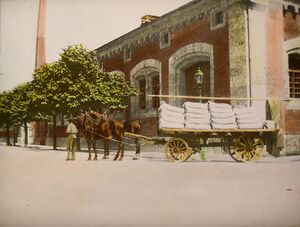 Salt cart in front of the Reichenhall salt works, c. 1900. (Photo: Stadtarchiv Bad Reichenhall – Bad Reichenhall City Archives)


While the Sendwerk dominated the lowlands, the Säumer prevailed in the mountain regions, where often no roads existed, only narrow tracks. The pack horses used for this purpose carried loads of around 130 to 150 kilograms on their backs. The Säumer who led them often came from farming backgrounds and worked independently on their own account. Both the Sender and the Säumer always transported return goods when they collected salt from the storage depots. Grain was the most important of these, followed by wine. In many towns and market centres, the salt stores were therefore often located directly beside the grain warehouses.
Although the Bavarian territorial princes had repeatedly intervened in the internal Bavarian salt trade since the 13th century, Duke Wilhelm V (r. 1579–1597) sought to secure a trade monopoly within his lands. By purchasing the trading and staple rights from the major salt-trading towns, he succeeded, between 1586 and 1589, in establishing a state monopoly over both the domestic and foreign trade of Bavarian salt. Within a few years, the salt-carriers’ guilds in the towns dissolved and several towns lost much of their former importance, while the role of the state in the salt trade increased. The former municipal salt depots were converted into ducal salt offices, where all salt was required to be sold until the abolition of the state sales monopoly in 1868.
Bavaria’s trade in salt from Berchtesgaden and Hallein
The export of salt produced at the Schellenberg salt works in the territory of the Prince-Provostry of Berchtesgaden relied primarily on transport along the River Salzach. The river ran mostly through Salzburg territory and was also used to carry salt from the Hallein works. As a result, the Berchtesgaden salt exported together with Hallein salt did not appear as a separate product, but was marketed under the name of Hallein salt. In addition, the Schellenberg salt works was pledged to Salzburg until 1556. Agreements made in 1555 and 1589 regulated Bavaria’s purchase of a share of the salt produced in Berchtesgaden. In the second half of the 18th century, two-thirds of the salt produced was transported overland to Bavaria, while the remainder was exported via the Salzach or carried overland to Tyrol.
-
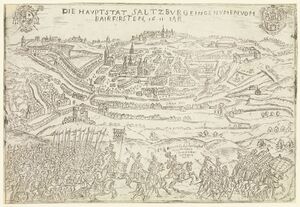 Depiction of the capture of Salzburg on 26 October 1611 by Bavarian troops during the Salt War. Drawing by Peter Wilhelm Zimmermann (1589- c. 1630). (© Germanisches Nationalmuseum, Inv.Nr.: HB 6393; Foto: Sebastian Tolle)
 -
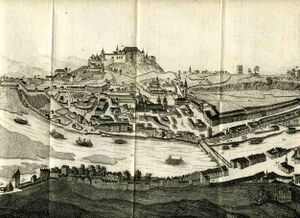 Salt ships on the Salzach near Salzburg. Copperplate engraving by J. C. Wirsing, um 1792. (Stadtarchiv Bad Reichenhall – Bad Reichenhall City Archives)


After Salzburg’s salt trade had been increasingly pushed out of the important Bohemian market from 1526 onwards, Duke Wilhelm V (r. 1579–1597) undertook in 1594 to purchase a fixed quantity of Hallein salt at an agreed price. This salt relied on export via the Bavarian rivers Inn and Danube. By this agreement, Bavaria had effectively secured a contractual monopoly over foreign salt exported by water. After Bavaria’s victorious Salt War against Salzburg in 1611, Duke Maximilian I. (r. 1597–1651) renegotiated the terms of trade in Hallein salt on conditions favourable to Bavaria. As a result, the quantity of salt sold under the Bavarian salt monopoly doubled and Bavaria rose alongside Austria to become the leading salt trader in southern Germany. By bypassing the Prince-Bishopric of Passau and establishing a Bavarian salt office outside its gates in St. Nikola, shipments of Hallein salt were taken up the Danube to the markets of the Upper Palatinate, Franconia and parts of Lower Bavaria.
-
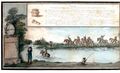 In the first section of the picture, the dimensions of the salt barrels (the so-called “Kuffen”) are explained. It also shows the forerider ahead of the towing convoy, checking the riverbed and the kitchen boy who is required to sign the toll documents. (Museen der Stadt Regensburg, GN 1994-2))
 -
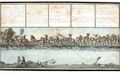 The second section of the picture shows the towpath. The horses pulled the ship train using a rope. (Museen der Stadt Regensburg, GN 1994-2)
 -
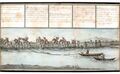 The third section of the picture shows the rope connection used to attach the horses to the first boats (known as "Zillen"). These were necessary to keep the rope above water, enable the riders to cross at river mouths and transport the horses back downstream. (Museen der Stadt Regensburg, GN 1994-2)
 -
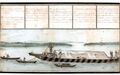 The fourth section of the picture shows the main ship with the commander of the convoy. (Museen der Stadt Regensburg, GN 1994-2)
 -
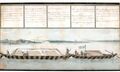 The fifth section of the image shows another transport ship, followed by the so-called "Kuchlschiff" (kitchen ship), which was used to cater for the crew and was located in the middle of the convoy. (Museen der Stadt Regensburg, GN 1994-2)
 -
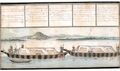 Two further transport ships can be seen in the sixth section of the image. Usually, a ship train consisted of four transport ships and several barges. (Museen der Stadt Regensburg, GN 1994-2)
 -
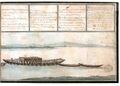 The last section of the picture shows the so-called "Fuderzille". The boat carried feed for the horses. (Museen der Stadt Regensburg, GN 1994-2)


The salt trade with Swabia and Switzerland

In the early modern period, Bavaria’s most important and profitable export was salt. It was produced in Reichenhall and, from 1619, in Traunstein and supplemented by salt from Hallein and Berchtesgaden, which was contractually bound to the Bavarian salt trade. In 1810, Rosenheim became an additional Bavarian production site supporting the powerful state-run salt industry, while the trade of salt from the Habsburg Salzkammergut (the historic salt-producing region) and Tyrol was prohibited within Bavaria. Since Franconia, the Upper Palatinate and parts of Lower Bavaria were largely supplied with salt from the Hallein salt works, efforts were increasingly directed towards distributing Reichenhall salt further to the west. The main areas of supply included southern Swabia and Switzerland, from Basel to an imaginary line running from Fribourg via Bern and the canton of Unterwalden to Chur. The transport towards Lake Constance followed three main routes: the Buchhorn, Lindau and Augsburg routes.
From the 1710s onwards, intermediary wholesalers were initially granted the monopoly on the sale of salt to Swabia, with the town of Memmingen traditionally playing a prominent role. From the mid-18th century, however, the Bavarian electors sought to manage the export trade themselves. The salt trade with Switzerland was conducted through the Bavarian salt office established in 1755 in the Imperial City of Buchhorn (today Friedrichshafen, Baden-Württemberg), whose role went beyond that of a mere staple depot. Conceived by the court chamber councillor Franz Xaver Stubenrauch (1718–1793), this extraterritorial Bavarian trading base developed, on the one hand, into a forerunner of the basic infrastructure and transport system between the Lech border and the Lake Constance region. On the other hand, it served as a point of contact between the Munich court and the Swiss Confederation. This resulted, for example, in the purchaser, the Canton of Bern, ultimately exerting influence on the production processes of the supplier, Bavaria. Bavaria’s involvement in the Helvetic Republic only came to an end when France imposed state control over the Swiss salt trade.
References
- Johann Dorner, Die Burghauser Salzfertiger, in: Manfred Treml u.a. (Hg.), Salz macht Geschichte. Aufsätze, Augsburg 1995, 297-303.
- Jean-Claude Hocquet, Der bayerische Salzhandel mit der Schweiz, in: Manfred Treml u.a. (Hg.), Salz macht Geschichte. Aufsätze, Augsburg 1995, 323-330.
- Fritz Koller, Die Salzachschiffahrt bis zum 16. Jahrhundert, in: Mitteilungen der Gesellschaft für Salzburger Landeskunde, Bd. 123 / 1983, 1-126.
- Fritz Koller, Bayern – Salzburg – Berchtesgaden. Der Streit um den Salzhandel 1587 – 1611, in: ZBLG, Bd. 50 / Heft 3, München 1987, 767-821.
- Fritz Koller, Das Salzwesen, in: Walter Brugger/Heinz Dopsch/Peter F. Kramml (Hg.), Geschichte von Berchtesgaden. Stift – Markt – Land. Bd. I. Zwischen Salzburg und Bayern, Berchtesgaden 1991, 739-842.
- Johannes Lang, Geschichte von Bad Reichenhall, Neustadt a.d.Aisch 2009.
- Lorenz Maier, Salzstraßen in Bayern, in: Manfred Treml u.a. (Hg.), Salz macht Geschichte. Aufsätze, Augsburg 1995, 280-287.
- Max Messerschmidt, Buchhorn unter bayerischer Verwaltung, in: Schriften des Vereins für Geschichte des Bodensees und seiner Umgebung, Bd. 80 / 1962, 52-112.
- Richard Loibl, Korn um Salz. Der Passauer Salzhandel im 15. und 16. Jahrhundert, in: Max Brunner (Hg.), Passau – Mythos und Geschichte, Regensburg 2007, 144-158.
- Martin Ott, Salzhandel in der Mitte Europas. Raumorganisation und wirtschaftliche Außenbeziehungen zwischen Bayern, Schwaben und der Schweiz 1750 – 1815 (Schriftenreihe zur bayerischen Landesgeschichte 165), München 2013.
- Rudolf Palme, Salzwesen und Salinenwälder, in: Walter Brugger/Heinz Dopsch/Peter F. Kramml (Hg.), Geschichte von Berchtesgaden. Stift – Markt – Land. Bd. II / 1. Vom Beginn der Wittelsbachischen Administration bis zum Übergang an Bayern 1810, Berchtesgaden 1993, 535-578.
- Erwin Probst, Baierisches Salz für Franken. Ein Beitrag zur fränkischen Wirtschaftsgeschichte des 18. Jahrhunderts, in: Mainfränkisches Jahrbuch für Geschichte und Kunst, 10 (1958), 159-185.
- Reinhard Stauber, Der Weg zum landesherrlichen Salzmonopol in Bayern vom 15. bis zum 17. Jahrhundert, in: Manfred Treml u.a. (Hg.), Salz macht Geschichte. Aufsätze, Augsburg 1995, 223-233.
- Hermann Vietzen, Der Münchner Salzhandel im Mittelalter 1158-1587 (Kultur und Geschichte 8), München 1936.
- Heinrich Wanderwitz, Studien zum mittelalterlichen Salzwesen in Bayern (Schriftenreihe zur bayerischen Landesgeschichte 73), München 1984.
Sources
- Archival holdings: The majority of sources relating to the history of the Bavarian salt trade is housed in the Bavarian Main State Archives in Munich (Bayerisches Hauptstaatsarchiv, München). Further holdings are located in the State Archives in Munich (Staatsarchiv München), the city archives of Traunstein, Burghausen, Wasserburg and Munich (Stadtarchive Traunstein, Burghausen, Wasserburg, München), as well as in the State Archives in Stuttgart (Hauptstaatsarchiv Stuttgart).
- Josef Ernst von Koch-Sternfeld, Die deutschen, insbesondere die bayerischen und österreichischen Salzwerke …, München 1836.
- Vortrag des engern Ausschusses der baierischen Salz-Handlungs-Gesellschaft. Die Vereinigung des Halleiner Salzhandels mit dem reichen betreffend, o.O. 1801.
- Franz Xaver von Stubenrauch, Unterricht vom Salzwesen, Augsburg 1771.
Further Research
Related articles
Cite
Johannes Lang, The Salt Trade in Old Bavaria (Middle Ages/Early Modern Period), published 09 February 2023, English version published 18 March 2026, in: Historisches Lexikon Bayerns, URL: <https://www.historisches-lexikon-bayerns.de/Lexikon/EN:The_Salt_Trade_in_Old_Bavaria_(Middle_Ages/Early_Modern_Period)> (17.09.2026)