

Sabine Fütterer und Alexander Straßner
The Red Army Faction (RAF) was a social-revolutionary terrorist organisation active in the Federal Republic of Germany from 1970 to 1998. It described itself as anti-imperialist, anti-capitalist and anti-fascist, as well as an “urban guerrilla” and left-wing protest movement. Among its founding members were Andreas Baader (1943–1977) and Ulrike Meinhof (1934–1976). The RAF recruited its members from the left-wing milieu. It carried out several bomb attacks in the Federal Republic of Germany, some of them in Bavaria. The organisation’s terrorist actions reached their peak in the so-called “German Autumn” of 1977. However, the second generation of the RAF failed in its aim of freeing the founding members from prison through acts of terrorism. The state responded to RAF terrorism by restricting defendants’ rights in trials against RAF members, by tightening prison conditions, and by granting the public prosecutors’ offices and the Federal Public Prosecutor greater powers to pursue those involved. The collapse of “real existing” socialism, changes in the state’s approach to counter-terrorism (the so-called Kinkel Initiative), and criticism from within its own ranks led to the decline of the RAF, which finally dissolved itself in 1998.
Founding and historical background
The Red Army Faction (RAF) was a social-revolutionary terrorist organisation that was active in the Federal Republic of Germany from 1970 to 1998.
The RAF emerged ideologically from the student movement of the 1960s, which by the end of the decade had expanded into a broader youth revolt. Parts of the Socialist German Student Union (SDS) became increasingly radicalised during the so-called ’68 movement. What united those involved was a rejection of various developments both within West Germany and internationally. Students in Germany initially took up protest movements originating in the United States, which were directed primarily against the Vietnam War. After the student Benno Ohnesorg (1940–1967) was shot dead by a police officer in West Berlin on 2 June 1967 during a demonstration against the visit of the Shah of Iran, Mohammad Reza Pahlavi (1919–1980), the movement spread across Germany. Demonstrations followed, directed against police arbitrariness, the unaddressed Nazi past of the parent generation and of the social and political elite, as well as international issues such as the Vietnam War. The situation was further intensified after the assassination attempt on the student leader Rudi Dutschke (1940–1979) on 11 April 1968, and by the so-called Emergency Laws of 30 May 1968, introduced at around the same time by the first grand coalition of the CDU/CSU and SPD. After the peak of the student movement had passed, the RAF emerged from elements on its outer left fringe.
The RAF’s relationships with other terrorist organisations are in some respects difficult to trace. They ranged from expressions of solidarity in a shared struggle against capitalism to forms of open or covert cooperation – particularly with groups such as Action directe (AD) in France, the Brigate Rosse (BR) in Italy, the Cellules Communistes Combattantes (CCC) in Belgium, or the Popular Front for the Liberation of Palestine (PFLP), which was part of the Palestine Liberation Organisation (PLO). The number of supporters and sympathisers of the organisation was much larger, with estimates suggesting several thousand individuals. This group is generally taken to comprise between 2,000 and 5,000 people who assisted active members, for example by making their homes available for use by the RAF. The question of whether such supporters contributed actively to furthering the organisation’s actions, and whether they should therefore also be subject to criminal prosecution, gave rise to a major public debate.
The founding moment of the RAF is clearly defined: it was marked by the freeing of the imprisoned Andreas Baader (1943–1977) while he was at the Institut für Soziale Fragen (Institute for Social Issues) in Berlin, where he claimed to be working on a project for marginalised young people. There is, however, disagreement about the group’s historical roots. While most authors still regard the RAF as having emerged from the student movement of 1968, other scholars argue that the radicalisation of several founding members had become evident some years earlier.
What both interpretations share is the view that, as the student movement was already beginning to disintegrate, a radical and militant core broke away, to which the later leading figures of the “first generation” of terrorists belonged: Andreas Baader, Gudrun Ensslin (1940–1977), Jan-Carl Raspe (1944–1977), Horst Mahler (1936–2025), and later also the well-known journalist Ulrike Meinhof (1934–1976). The group adopted an ideology that was purely eclectic in character: elements taken from various ideological traditions were selected insofar as they helped to justify their own aims, and were then woven together into something new. The group drew not only on elements of anarchism (a simplified belief in the viability of a society without authority), but also on Marxism (the conviction that revolution drives social change), Leninism (the idea that a small avant-garde can accelerate the revolution), and Maoism (the claim that political power grows out of the barrel of a gun). On this basis, the ideological motivation of the RAF can be located in the spheres of anti-imperialism, anti-fascism, and the anti-Vietnam War movement. From 1966 to 1969, the Federal Republic was governed by a grand coalition of the CDU/CSU and SPD under Federal Chancellor Kurt Georg Kiesinger (CDU, 1904–1988, Chancellor 1966–1969). Within the circles from which the RAF later emerged, this government was viewed as the extended arm of an international capitalist–military conspiracy, which also failed, in their view, to come to terms adequately with the crimes of National Socialism. In this context, the group sought to convey to people in the “European metropolises” the same “crackling Vietnam feeling” (as they wrote in a communique) by setting fire to the Kaufhof and Schneider department stores in Frankfurt am Main (Hesse) in 1968. Baader was arrested in connection with the ensuing prosecution, but was freed shortly afterwards by several individuals who would later become members of the RAF.
The development of the “urban guerrilla”: the formation of the RAF
After Baader’s liberation on 14 May 1970, the RAF published its first programme document, “Das Konzept Stadtguerilla” (The Urban Guerrilla Concept), in 1971. Its authors included Ulrike Meinhof and Horst Mahler (born 1936). In it, they set out the group’s ideological foundations and called for an (international) class struggle against imperialism and the rule of capitalism, placing themselves at the forefront as a self-appointed fighting avant-garde. Meanwhile, a group of RAF members – around 20 individuals in addition to Baader, Ensslin, Mahler and Meinhof – travelled to a camp of the organisation al-Fatah in Jordan. There, they received instruction in guerrilla and terrorist warfare, including the construction of time bombs.
-
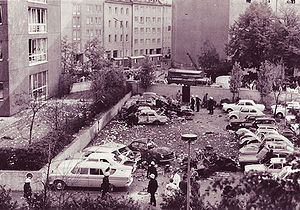 Aftermath of the attack on the Bavarian State Criminal Police Office (LKA) in Munich. On 12 May 1972, the RAF carried out a car bomb attack in the LKA car park, injuring five police officers. (Archiv Redaktion Bayerns Polizei)
 -
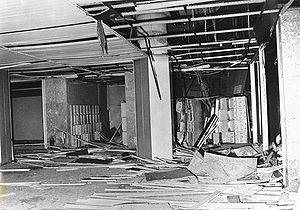 The photograph shows the scene in the Stachus Centre at Karlsplatz in Munich, where the RAF carried out a devastating bomb attack in 1976. Photograph taken on 14 May 1976. (Photo: Landeskriminalamt) (Foto: Landeskriminalamt)


After their return to Germany, the “Baader–Meinhof Group”, as the media referred to them until 1972, set about securing their financial base. With three simultaneous bank robberies in Berlin (the so-called “Dreierschlag”), they obtained funds that enabled the purchase of weapons and allowed some members to lead a comparatively comfortable life underground. Recruitment at this time took place mainly through personal contacts. Once the organisation had established itself, the RAF launched its first “May Offensive” in 1972, during which Bavaria also became a focus of the attacks. With a series of bomb attacks on the V Corps of the US Armed Forces in Frankfurt am Main (11 May 1972), the police headquarters in Augsburg (12 May 1972), the Bavarian State Criminal Police Office in Munich (12 May 1972), the Springer publishing house in Berlin (19 May 1972), and the headquarters of the US Armed Forces in Heidelberg, Baden-Württemberg (24 May 1972), the operational capacity of the organisation became clearly apparent. The intensified measures taken by the state and federal authorities now led to swift successes in the search for RAF members. By the end of the year, all core members were in custody, and a new high-security wing was constructed for them at the prison in Stuttgart-Stammheim (Baden-Württemberg).
The process of radicalisation: the “second generation” of the RAF
The successes of the authorities did not, however, mark the end of the RAF. Various underground groups, led by Brigitte Mohnhaupt (born 1949), now began to devise strategies to force the release of the imprisoned members of the first generation. The organisation still possessed strong integrative power: recruitment was carried out through left-wing groups such as Rote Hilfe (Red Aid) or Schwarze Hilfe (Black Aid) in Munich, and the Sozialistisches Patientenkollektiv (Socialist Patients' Collective) in Heidelberg. New members quickly stepped forward – among them, in particular, Christian Klar (born 1952), Stefan Wisniewski (born 1953) and Peter-Jürgen Boock (born 1951) – who were prepared to choose armed resistance in pursuit of the goals being propagated. To this end, an RAF commando occupied the German Embassy in Stockholm in 1975. Although two members of the embassy staff were killed during the operation, the RAF failed to achieve its objective. Several arrests followed.
However, the Stockholm operation was only the prelude to the large number of terrorist attacks in 1977, now known as the “German Autumn”. First, Federal Prosecutor General Siegfried Buback (1920–1977, in office since 1974) and his two drivers were murdered in Karlsruhe (Baden-Württemberg). Then a plan took shape to increase pressure on the political authorities by carrying out a kidnapping. The attempt to kidnap Jürgen Ponto (1923–1977), the Chairman of the Board of Dresdner Bank, failed because Ponto was shot dead during the operation. However, the kidnapping of Hanns-Martin Schleyer (1915–1977), Chairman of the Confederation of German Employers (BDA) and President of the Federation of German Industries (BDI), succeeded and resulted in the murder of his driver and his bodyguard. Schleyer was held captive by the RAF for over six weeks. When it became apparent that the Federal Government would not yield to the RAF’s demands, the group increased the pressure by having a German Lufthansa passenger aircraft, the Landshut, hijacked by the Popular Front for the Liberation of Palestine (PFLP; a political liberation organisation that combined its ethnic and separatist aims with social-revolutionary ideas). The pilot of the aircraft, Jürgen Schumann (1940–1977), was murdered during the hijacking. The kidnapping of Hanns-Martin Schleyer in particular makes clear that the RAF regarded other terrorist groups as models, and that the influence was mutual (for example, the Brigate Rosse (BR) in Italy or Action Directe (AD) in France). This becomes evident, for instance, in the similarity between the Schleyer kidnapping and the abduction of Aldo Moros (1916–1978, Italian Prime Minister 1963–1968 and 1974–1976) in 1978 by the Brigate Rosse.
After an odyssey involving several airports both within and outside Europe, the hijacked Lufthansa aircraft finally landed in Mogadishu, Somalia. There, it was freed by Border Guard Group 9 (GSG 9), the special unit of the Federal Border Guard (today the Bundespolizei or Federal Police), which had been established after the 1972 Olympic Games in Munich. Three of the four hijackers were killed, while almost all of the passengers remained unharmed. The operation to free the RAF founders, which had required enormous logistical, financial and personnel resources, had failed; the RAF now stood on the brink of dissolution. Schleyer was murdered, and the members of the RAF dispersed in all directions: the Middle East, Yugoslavia and, not least, the GDR became places of refuge for the failed terrorists. Upon receiving news of the failure of the kidnapping, the imprisoned members of the “first generation” committed suicide.
In addition, this was a period in which certain groups became increasingly isolated, particularly within the left-wing extremist milieu. This can be attributed above all to the emergence of antisemitic tendencies that became evident among terrorist groups in the Federal Republic. One example of this is the hijacking of an Air France aeroplane on 27 June 1976 on its way to Tel Aviv in Israel by a German–Palestinian commando; the German perpetrators were the Revolutionary Cells terrorists Wilfried Böse (1949–1976) and Brigitte Kuhlmann (1947–1976). The 250 passengers, most of whom were Jewish, and the crew were eventually freed at Entebbe Airport in Uganda, where the aircraft had landed. Actions such as this caused other left-wing radicals to distance themselves from the group.
The resistance re-forms: the “third generation” of the RAF
Between 1977 and 1982, there were high-profile attacks on NATO generals in Germany, including one in 1979 on the then NATO Supreme Allied Commander Europe (SACEUR), Alexander Haig (1924–2010), and another in 1981 on Frederick J. Kroesen (1923–2020), the commanding general of NATO’s Central Army Group. To this day, these attacks remain largely unresolved; however, it became clear after 1990 that RAF members who had gone underground in the GDR had been trained by the Ministry for State Security (Stasi).
The fact that the RAF was able to re-emerge at all after the disastrous defeat of 1977 and the arrest of Mohnhaupt and Klar in 1982 was solely due to global political circumstances that proved favourable to it. In the wake of the NATO Double-Track Decision (1979), a Europe-wide peace movement arose in opposition to the planned deployment of US medium-range nuclear missiles across Central Europe. Once again, a militant structure emerged on the fringes, which now took the RAF of the preceding years as its model. The members of the so-called “third generation” (only the involvement of Eva Haule(-Frimpong) [born 1954], Birgit Hogefeld [born 1956] und Wolfgang Grams [1953-1993] is regarded as certain; all others remain unknown to this day) had the significant advantage of being able to draw upon a strategic programme that originated from those who had gone underground in the GDR: the “May Paper”. In it, all reference to Marxist ideology was set aside, and instead the emphasis was placed solely on military methods: the war against the “military–industrial complex” was (once again) declared.
-
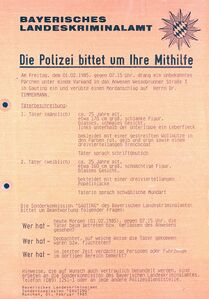 Flyer issued by the Bavarian State Office of Criminal Investigation after the attack on Ernst Zimmermann, Gauting, 1 February 1985. (Interfoto)
 -
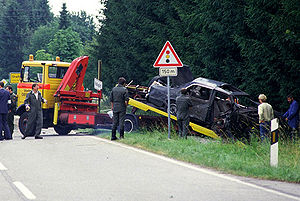 Clean-up work following the attack on Siemens manager Karl-Heinz Beckurts (1930–1986), who, together with his chauffeur Eckhard Groppler, was murdered by a car bomb shortly before the town boundary of Straßlach. (Interfoto)


The “Offensive ’85/’86”, which was subsequently carried out with considerable brutality, took place mainly in Bavaria, after preparatory actions to establish suitable logistics had targeted an arms shop in Maxdorf (Rhineland-Palatinate) and a Bundeswehr barracks in Neukirchen. At the outset, an attack on the NATO SHAPE School in Oberammergau failed in 1984. But with the targeted assassinations, this marked the start of a new series of political murders on a scale similar to that of 1977. It began with the attack on the Motoren- und Turbinen-Union (MTU) manager Ernst Zimmermann (1929–1985), who was shot dead in Gauting on 1 February 1985. This had been preceded on 25 January 1985 by a murder carried out by Action directe (AD) on the French General René Audran (d. 1985). After the US Rhein-Main Air Base in Frankfurt am Main became the site of a devastating attack on 8 August 1985 (carried out jointly by the RAF and the French Action directe), Bavaria once again came into focus: in 1986, the RAF killed Siemens manager Karl-Heinz Beckurts (1930–1986) in Straßlach with a remotely detonated bomb. The other fatal attacks – in 1986 on Gerold von Braunmühl (1935–1986, a diplomat in the Federal Foreign Office), in 1989 on Alfred Herrhausen (1930–1989, Chairman of the Board of Deutsche Bank), and in 1991 on Detlev Karsten Rohwedder (1932–1991, President of the Treuhandanstalt, the agency responsible for privatising East German state assets) – likewise showed that the RAF now possessed far greater logistical capability and a markedly higher degree of professionalism than in earlier years. The result was that, to this day, only one of the attacks is considered to have been solved: the murder of the US soldier Edward Pimental (1965–1985), which is attributed to Birgit Hogefeld.
The beginning of the end: the degeneration of the RAF
While the rejection of ideological justification had already been made in theory in the “May Paper”, it was put into practice in the killing of Pimental: he was not murdered because he was an “agent of the system”, but because they sought to obtain his identification card in order to gain access to the military area at Frankfurt Airport. The result was broad and substantial resistance to the RAF, even from within the far-left milieu, towards which the RAF had always presented itself as uncompromising and in a position of command.
Alongside the criticism arising from within its own ranks, global events now also worked against the RAF: with the collapse of actually existing socialism, the aim of establishing a socialist counter-order, which had at least continued to operate beneath the surface, fell away. At the same time, the members of the second generation who had gone underground in the GDR became willing to talk and presented a defeatist and resigned picture of life in hiding, causing many activists to turn away from the RAF. In addition, the state changed its approach to combating terrorism. Alongside a largely unsuccessful scheme offering reduced sentences to those who cooperated as state witnesses, the Federal Minister of Justice at the time, Klaus Kinkel (FDP, 1936–2019; in office 1991–1992), introduced the so-called “Kinkel Initiative” in 1992, which provided that members of the RAF who wished to leave the organisation would no longer face the full severity of the law.
The consequences for the RAF were severe. Among the imprisoned members, a dispute arose over how to respond to the Kinkel Initiative, which resulted in the irreconcilable split of the prisoners’ collective in 1993. Those RAF commandos who remained at liberty responded clearly to the initiative: in 1992 they declared a temporary renunciation of violence, but made this conditional on the future conduct of the state towards the RAF. When the last two known members of the RAF’s third generation, Birgit Hogefeld and Wolfgang Grams, were apprehended in Bad Kleinen (Mecklenburg–Western Pomerania) in 1993, Grams died shortly afterwards in circumstances that remained unclear for many years. His death occurred during a GSG 9 operation, in which he was shot and, while severely wounded, apparently took his own life. At the time, many feared a renewed terrorist offensive. However, despite the RAF’s threat to revoke its renunciation of violence, no such escalation followed. From this point onwards, the RAF carried out only one further public attack, the bombing of a newly constructed prison building in Weiterstadt (Hesse) in 1993; thereafter, it issued only brief statements to the press.
In 1998, the RAF finally issued a statement declaring its own dissolution.
References
- Stefan Aust, Der Baader-Meinhof-Komplex, Hamburg 1997.
- Sabine Bergstermann, Stammheim. Eine moderne Haftanstalt als Ort der Auseinandersetzung zwischen Staat und RAF (Quellen und Darstellungen zur Zeitgeschichte 112), Berlin 2016.
- Wolfgang Kraushaar (Hg.), Die RAF und der linke Terrorismus. 2 Bände, Hamburg 2006.
- Butz Peters, Tödlicher Irrtum, Die Geschichte der RAF, Berlin 2004.
- Alexander Straßner, Die dritte Generation der "Roten Armee Fraktion". Entstehung, Struktur, Funktionslogik und Zerfall einer terroristischen Organisation, Wiesbaden 2005.
- Alexander Straßner, Perzipierter Weltbürgerkrieg: Rote Armee Fraktion in Deutschland, in: ders. (Hg.), Sozialrevolutionärer Terrorismus. Theorie, Ideologie, Fallbeispiele, Zukunftsszenarien, Wiesbaden 2008, 209-236.
- Petra Terhoeven, Die Rote Armee Fraktion. Eine Geschichte terroristischer Gewalt (Beck Wissen 2878), München 2017.
- Annette Vowinckel/Jan-Holger Kirsch (Hg.), Die RAF als Geschichte und Gegenwart. Texte und Materialien zum "Deutschen Herbst" und seinen Folgen, in: Zeitgeschichte-online, Mai 2007.
- Klaus Weinbauer u. a. (Hg.), Terrorismus in der Bundesrepublik. Medien, Staat und Subkulturen in den 1970er Jahren, Frankfurt am Main 2006
- Willi Winkler, Die Geschichte der RAF, Berlin 2007.
- Tobias Wunschik, Baader-Meinhofs Kinder. Die zweite Generation der RAF, Wiesbaden 1997
Sources
- Alexander Gallus (Hg.), Meinhof, Mahler, Ensslin. Die Akten der Studienstiftung des deutschen Volkes, Göttingen 2016.
- Ulrike Marie Meinhof, Die Würde des Menschen ist antastbar. Aufsätze und Polemiken, Berlin 1984.
- Rote Armee Fraktion, Das Konzept Stadtguerilla. April 1971, in: Rote Armee Fraktion. Texte und Materialien zur Geschichte der RAF, Berlin 1997, 27-48.
- Terrorismus: Hier spricht die RAF, in: Der SPIEGEL, 4.2.1985.
- Terror: Da waren Superprofis am Werk, in: Der SPIEGEL, 14.7.1986.
External links
- Bundesarchiv: Verzeichnis der Kabinettsprotokolle der Bundesregierung (darunter auch die Protokolle zum sog. Deutschen Herbst) (Federal Archives: Index of the cabinet minutes of the Federal Government, including the minutes relating to the so-called German Autumn)
- Deutsches Historisches Museum - Lebendiges Museum Online: Linksterrorismus: Rote-Armee-Fraktion (German Historical Museum – “Living Museum Online”: Left-Wing Terrorism: Red Army Faction)
- Karl Heinz Beckurts-Stiftung (Karl Heinz Beckurts Foundation)
Cite
Sabine Fütterer/Alexander Straßner, Red Army Faction (RAF), published 20 January 2015, english version published 17 February 2026; in: Historisches Lexikon Bayerns, URL: <https://www.historisches-lexikon-bayerns.de/Lexikon/EN:Red_Army_Faction_(RAF)> (22.10.2026)